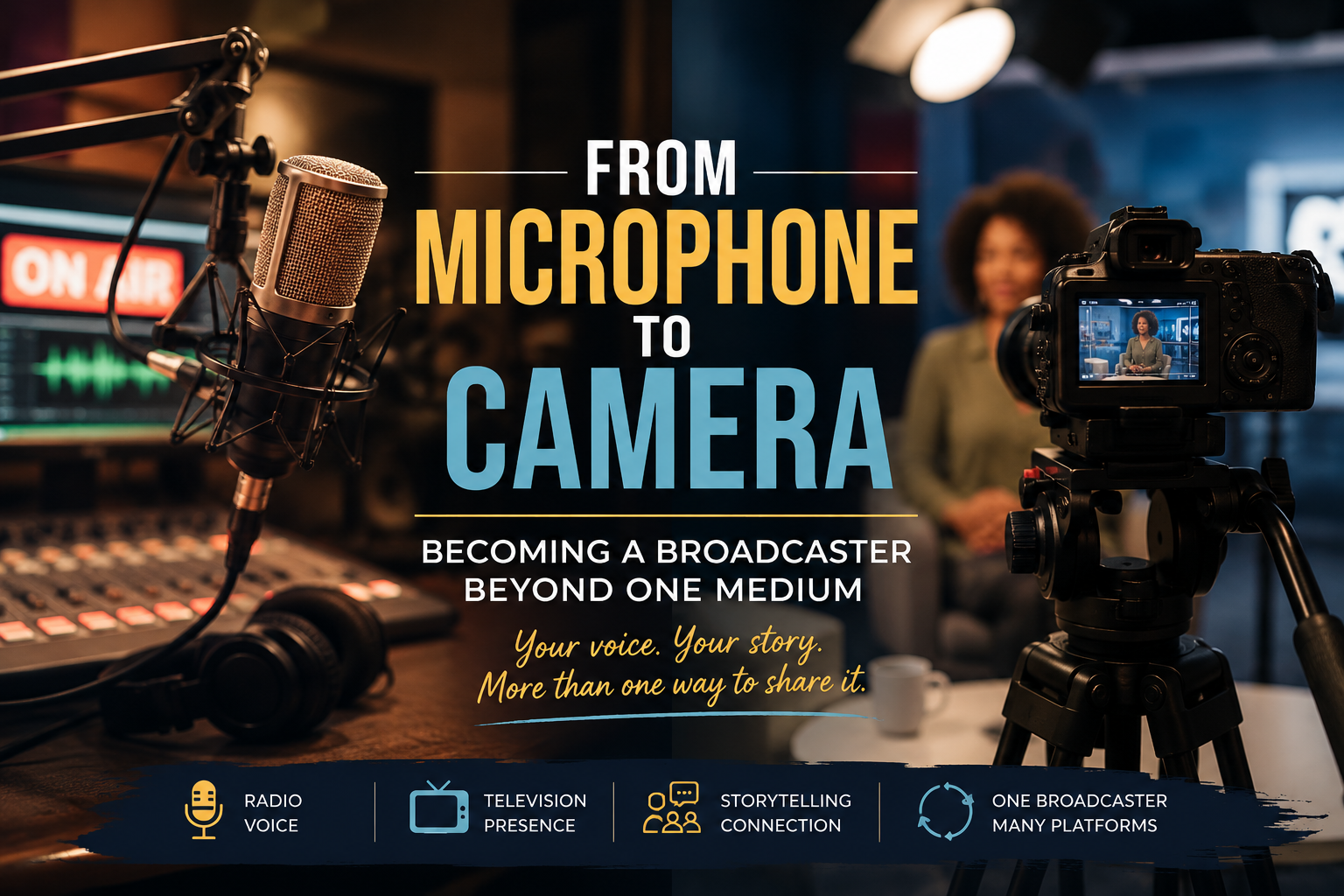
You may fall in love with radio first. You may dream of television. But in today’s changing media landscape, perhaps the bigger opportunity is learning how to become comfortable in both.
There is something special about radio. You sit behind a microphone, put on your headphones and speak to people you cannot see. They don’t know what you’re wearing, what you’re doing with your hands or whether you glanced at your notes halfway through a sentence. All they have is your voice, and somehow you learn to use it to create pictures.
For many aspiring broadcasters, that’s where the dream begins. They imagine themselves hosting a radio show, interviewing guests, introducing music and building a relationship with listeners. For others, the dream has always been television: the studio, the camera, the interviews and the opportunity to communicate with an audience that can both see and hear them.
For a long time, we have treated these as fairly separate broadcasting paths. But the media landscape around us is changing, and perhaps the lines aren’t as clear as they once were.
When Radio Meets Television
Today, a radio interview can become a video clip. A television presenter can host a podcast. A radio personality may be expected to speak to followers through a phone camera, while a podcast can exist simultaneously as an audio programme and a video show.
That doesn’t mean every broadcaster must do everything. There are exceptional radio broadcasters who may never want television, just as there are television presenters who have no desire to sit behind a radio microphone.
But for an aspiring broadcaster, there is value in asking a slightly different question. Instead of only asking, “Do I want to work in radio or television?”, perhaps we should also ask:
“How comfortable am I communicating when the medium changes?”
Because being comfortable behind a microphone doesn’t automatically mean you’ll feel comfortable in front of a camera.
I know that personally.
When the Camera Comes On
Give me a microphone, and I can talk. Audio feels familiar to me. I can concentrate on the conversation, the story and the person on the other side without thinking too much about myself.
Put a camera in front of me, however, and something changes. Suddenly I become aware of where I’m looking, what I’m doing with my hands, how I’m sitting and what my face is doing. The communication hasn’t disappeared, but my awareness of being seen changes the experience completely.
Ironically, being in front of the camera is exactly where I now want to grow. I want to talk about my projects visually. I want to explore video podcasting and become as comfortable communicating through a camera as I am through a microphone.
And perhaps there is an important lesson in that:
Experience in one medium doesn’t automatically remove the fear of another.
Sometimes even an experienced broadcaster has to become a beginner again.
Two Mediums, Different Muscles
Radio asks you to create something the listener cannot see. Voice, tone, timing, listening and storytelling carry much of the experience. Television introduces another dimension because the audience can now see the communication happening.
The skills aren’t completely separate, but neither are they identical.
And this is where the changing media environment becomes interesting for anyone trying to enter broadcasting today. You may begin in community radio, online radio, television, podcasting, digital video or somewhere else entirely. Your first opportunity doesn’t necessarily have to determine the kind of broadcaster you eventually become.
Perhaps the goal isn’t to master every platform.
Perhaps it’s to become willing to stretch beyond the one that feels safest.
Beyond the Platform
There is something liberating about looking at broadcasting this way.
If radio is where you feel at home, you don’t have to abandon it simply because video has become important. And if television is where you naturally shine, there may still be something valuable in discovering what happens when the pictures disappear and your voice has to carry the story.
The point isn’t that one medium is better than the other.
It’s that each one asks something different from the person communicating through it.
And as radio, television, podcasting and digital content continue to overlap, versatility may become an increasingly valuable part of a broadcaster’s toolkit.
For me, that means there is still another broadcasting challenge waiting.
The camera.
I’ve spent enough time being comfortable behind the microphone. Perhaps it’s time to discover what happens when I stop hiding behind it.
And I suspect I’m not the only broadcaster who feels that way.
The microphone and the camera may require different kinds of confidence, but perhaps becoming comfortable with both is a journey worth exploring.
And that conversation?
We’re only getting started.
Continue the Conversation
Are you more comfortable behind a microphone or in front of a camera?
And if you’re a broadcaster who has successfully moved between radio, television, podcasting or digital video, what helped you become comfortable in a new medium?
I’d love to hear your experience in the comments.
If you enjoy reflections on broadcasting, career growth and navigating a changing media industry, subscribe to Reflections in Motion for new articles every Wednesday.
Ready to Build Beyond the Microphone?
If you’re beginning to think about how your broadcasting experience can create opportunities beyond one platform, my book From Broadcaster to Brand explores that journey—from professional identity and visibility to building something you own.
📘 Explore From Broadcaster to Brand on Amazon:
https://www.amazon.com/author/kgalalelontumelang
And if podcasting is part of your next chapter, From Microphone to Money is a practical building guide, launching and monetising your podcast.
🌐 Visit Reflections in Motion:
https://reflectionsinmotion.blog
Work With Me
If you’d like to work with me around broadcasting, podcasting, content development, media training or communication, get in touch.
📧 Email: lelon@reflectionsinmotion.blog
🌐 Website: https://reflectionsinmotion.blog
Leave a Reply