Author: Lelo

  • When a Fundraiser Is Having a Bad Day

    When a Fundraiser Is Having a Bad Day

    The person behind the pitch doesn’t always arrive at work feeling their best

    There are days when a fundraiser arrives at the stand ready for the day.

    The energy is there. The confidence is there. Starting conversations feels natural.

    And then there are other days.

    Maybe you didn’t sleep well. Something happened at home. You’re worried about money. You’ve had an argument with someone. You’re emotionally exhausted.

    Or perhaps nothing dramatic has happened at all.

    You’re simply having a bad day.

    But the fundraising stand doesn’t disappear because you’re struggling. The targets are still there. People are still walking past. And your job still requires you to approach strangers, smile, start conversations, tell the organisation’s story and ask people to care.

    That creates a difficult reality in face-to-face fundraising:

    What happens when the person whose job is to create connection doesn’t feel connected themselves?

    Fundraisers Are People Before They Are Performers

    Face-to-face fundraising is deeply human work.

    Unlike jobs where someone can quietly work through a difficult day behind a computer, a fundraiser’s emotional state can become visible very quickly.

    It shows in your face, your voice and your body language. It can affect your willingness to approach the next person after several rejections.

    People often respond not only to what you say, but to how you make them feel.

    That creates an unspoken pressure for fundraisers to appear positive regardless of what may be happening in their lives.

    But professionalism and pretending are not the same thing.

    Being professional means managing what you are carrying so that it does not negatively affect donors, colleagues or the work.

    It does not mean becoming a person who is never allowed to struggle.

    Don’t Give the Next Person Your Previous Rejection

    A difficult day can follow you into your conversations without you even noticing.

    Your shoulders drop. Your greeting becomes mechanical. You’re approaching people because you have to rather than because you’re genuinely open to the conversation.

    Then someone says no.

    Another person ignores you.

    Someone else waves you away before you’ve finished introducing yourself.

    On a good day, you might brush those moments off. On a difficult day, each rejection can feel heavier than usual.

    And this is where emotional discipline becomes part of the profession.

    The next person walking towards you knows nothing about what happened earlier.

    They didn’t reject you.

    They weren’t rude to you.

    They didn’t waste your time.

    They deserve to meet you, not the frustration left behind by the person before them.

    Learning to reset between conversations is one of those quiet skills experienced fundraisers develop over time.

    Don’t Make One Difficult Morning the Whole Day

    Sometimes the biggest mistake happens before lunchtime.

    You decide:

    “Today is just not my day.”

    Once you believe that, you start looking for evidence.

    Every rejection confirms it. Every person who walks past confirms it. Every colleague who gets a donor while you’re struggling confirms it.

    Before long, you’re no longer simply having a difficult morning.

    You’ve mentally written off the entire day.

    Sometimes you don’t need a dramatic transformation.

    You need a reset.

    Step away briefly if you can. Drink some water. Clear your head. Stop thinking about the entire target and come back to one good conversation.

    Not ten donors.

    Not what your colleague has achieved.

    Not everything that went wrong this morning.

    Just the next person.

    Sometimes one genuine conversation is enough to change the rhythm of the day.

    Your Team Leader Cannot Support What They Cannot See

    There is another difficulty that can develop when someone is having a bad day.

    The fundraiser says nothing.

    The team leader sees someone who is unusually quiet, approaching fewer people or appearing disengaged.

    The fundraiser thinks:

    “Surely they can see I’m not okay.”

    The team leader thinks:

    “Why aren’t they working?”

    Now a personal difficulty has the potential to become a performance conflict.

    This doesn’t mean fundraisers need to disclose every detail of their private lives at work.

    They don’t.

    Sometimes a simple:

    “I’m having a difficult morning. I’m going to keep working, but I’m not quite myself today.”

    is enough to provide context.

    Good teams need enough trust for people to communicate when something is affecting them.

    Leadership Needs to Know the Difference

    This is where the team leader’s judgement matters.

    Not every drop in performance means someone has become lazy or uncommitted.

    Patterns matter.

    If someone repeatedly avoids work, ignores expectations, and consistently underperforms, that requires a performance conversation.

    But if a normally engaged fundraiser arrives one morning and is clearly not themselves, perhaps the first question shouldn’t immediately be:

    “Why are your numbers down?”

    Sometimes it should be:

    “Are you okay today?”

    This doesn’t mean targets disappear or standards suddenly stop mattering.

    It means understanding that performance is produced by people.

    And people do not operate exactly the same way every single day.

    Be Careful With Comparison

    A difficult day can feel much worse when the person standing next to you is having an excellent one.

    You’ve had nothing for two hours.

    Your colleague has already signed several donors.

    Suddenly you’re not only struggling. You’re comparing.

    “Maybe I’m not good at this anymore.”

    “Everyone is moving except me.”

    Healthy teams should learn from strong performers. But another fundraiser’s good day should not automatically become evidence of your failure.

    Fundraising results fluctuate. Timing matters. Location matters. Different fundraisers connect with different people.

    And sometimes someone simply has a better day.

    Learn where you can.

    Then return your attention to your own conversations.

    Professionalism Does Not Mean Performing Happiness

    There is an important balance here.

    Having a difficult day is not permission to treat donors badly, snap at colleagues or abandon your responsibilities.

    But neither should fundraising cultures expect people to pretend that everything is perfect every day.

    You can be struggling and still be professional.

    You can be quieter than usual and still be respectful.

    You can ask for a moment to reset.

    You can tell your leader you’re not at your best.

    And sometimes you can simply acknowledge:

    Today I may not be operating at 100%, but I can still give what I reasonably have.

    Tomorrow Is Another Stand

    One of the dangers of a difficult fundraising day is carrying it home and turning it into a judgement about yourself.

    “I was terrible today.”

    “Maybe I can’t do this anymore.”

    “I’ve lost my touch.”

    But one day’s numbers cannot tell the whole story of a fundraiser.

    Review the day. Be honest about what you could have done differently. Learn what needs to be learned.

    Then allow the day to end.

    Tomorrow, the people walking past the stand will be different.

    The conversations will be different.

    And you may be different too.

    Beyond the Pitch

    Face-to-face fundraising asks people to do something emotionally demanding.

    Approach strangers. Accept rejection. Stay present. Tell stories with conviction. Ask people to care.

    Then repeat the process throughout the day.

    We talk a lot about techniques, targets and performance.

    We should also talk about the person doing the work.

    A fundraiser having a difficult day does not automatically need lower standards.

    Sometimes they need perspective.

    Sometimes they need a reset.

    Sometimes they need support.

    And sometimes they simply need someone to recognise that behind the branded shirt, the target and the pitch is a human being.

    Fundraisers spend their days asking strangers to care.

    Sometimes we need to remember to care about the person doing the asking.


    Continue the Conversation

    If you work in face-to-face fundraising, how do you reset when you’re having one of those days?

    And if you lead fundraisers, how do you balance supporting someone who is struggling with maintaining the standards the job requires?

    Share your experience in the comments.

    Want to Go Further?

    Face-to-face fundraising is about far more than learning the perfect pitch.

    My book Beyond the Pitch: The Art of Face-to-Face Fundraising explores the people, conversations, leadership challenges and realities behind the work.

    📘 Find Beyond the Pitch and my other resources on Reflections In Motion:
    https://reflectionsinmotion.blog/shop/

    Work With Me

    I work with fundraising teams and organisations around face-to-face fundraising, fundraiser development, team coaching, communication and leadership.

    If your organisation wants to strengthen the people behind the pitch through practical training and development:

    📧 lelon@reflectionsinmotion.blog

    🌐 https://reflectionsinmotion.blog

    Reflections In Motion — Ideas. Insight. Impact.

  • When the Story Shouldn’t Become Entertainment

    When the Story Shouldn’t Become Entertainment

    The responsibility of broadcasting someone else’s worst day

    There are stories that arrive in a newsroom already carrying pain.

    A family has lost someone. A survivor is trying to make sense of what happened. A community is grieving. A person has experienced violence, loss or trauma and, suddenly, that experience becomes part of a public conversation.

    For broadcasters and journalists, these stories matter. They may expose failures, document injustice, give communities a voice or help the public understand the human cost behind a headline.

    But they also come with a difficult question:

    When does telling the story become using someone’s pain to create compelling content?

    The Person Behind the Story

    Broadcasting is built around questions.

    We ask what happened, why it happened, who is responsible and what happens next.

    But when the person in front of the microphone is living through one of the worst moments of their life, the usual rhythm of an interview can change.

    A grieving parent is not simply a source. A survivor is not simply a soundbite. A family standing outside a home where something terrible has happened is not simply visual material for a bulletin.

    The story may belong in the public domain, but the pain still belongs to the person experiencing it.

    That distinction matters.

    Sometimes the pressure to make a story emotionally powerful can push broadcasters towards questions designed to produce a reaction rather than understanding. We may replay the most painful moment repeatedly, search for the most dramatic quote or linger on someone’s grief because it makes the story feel more compelling.

    And somewhere along the way, journalism can begin to look uncomfortably close to spectacle.

    Compassion Does Not Mean Avoiding Difficult Journalism

    There is another side to this conversation.

    Being humane does not mean avoiding hard questions.

    Some stories require difficult interviews. Some truths are uncomfortable. Sometimes the emotional reality of what happened is precisely what helps an audience understand the seriousness of an issue.

    The answer is not to remove emotion from journalism.

    The answer is to remember why the emotion is there.

    The purpose should be to help the audience understand the story more deeply, not simply to create a dramatic moment.

    A broadcaster can be compassionate and still be rigorous. A producer can pursue an important story and still recognise when a person needs space. A newsroom can report tragedy without turning grief into a performance.

    Those things are not opposites.

    The Language We Use Matters

    Sometimes the difference between responsible storytelling and exploitation sits in something as small as a question.

    We have all heard the familiar:

    “How do you feel?”

    It may seem natural, but imagine being asked that question minutes after receiving devastating news.

    There are moments when a person’s emotions are obvious. Asking them to explain those emotions immediately may add very little to the public’s understanding of what happened.

    Perhaps the better question is not always the most dramatic one.

    Sometimes it is the one that allows the person to speak without being pushed towards a particular reaction.

    That requires judgement.

    And judgement is part of the craft.

    When the Broadcast Ends

    One of the strange things about broadcasting is that stories move quickly.

    Today’s tragedy becomes tomorrow’s follow-up and eventually disappears from the running order.

    But for the people inside the story, life does not move at newsroom speed.

    When the cameras leave, the family is still grieving. When the microphone is packed away, the survivor still has to live with what happened. When the clip stops circulating, the person whose pain was shared publicly may still be processing the experience.

    That is worth remembering before we press record.

    The microphone gives us access.

    It does not give us ownership of someone’s pain.

    Some of the most important stories we will ever tell will come from people’s darkest moments. Our responsibility is not to make those moments more dramatic.

    It is to tell them truthfully, carefully and with enough humanity to remember that when the broadcast ends, the person in the story still has to live with what happened.

    A Quiet Reminder

    A powerful interview is not always the one that produces tears.

    A powerful story is not always the one with the most dramatic soundbite.

    Sometimes good journalism is demonstrated by the question we choose not to ask, the image we choose not to use, or the moment we decide a person has given enough.

    That restraint is not weakness.

    It is part of the responsibility that comes with being trusted to tell someone else’s story.


    Reflections In Motion — Ideas. Insight. Impact.

    Continue the Conversation

    Where do you think journalism should draw the line when reporting grief, trauma and tragedy?

    Can a story be emotionally powerful without becoming exploitative?

    Share your thoughts in the comments.

    Want to Go Further?

    If you are interested in what happens behind the broadcast—from finding and developing stories to preparing interviews, verifying information and helping shape the programme audiences eventually hear—my practical guide, So You Want to Be a News Producer? takes you behind the microphone and into the work of the producer.

    📘 Get So You Want to Be a News Producer?
    https://reflectionsinmotion.blog/product/so-you-want-to-be-a-news-producer/

    🌐 Explore Reflections In Motion:
    https://reflectionsinmotion.blog

    Work With Me

    I work across broadcasting, media, content development and communication, drawing on years of experience in radio news production, editing and storytelling.

    For media projects, content development, broadcasting-related training or collaboration:

    📧 lelon@reflectionsinmotion.blog

    🌐 https://reflectionsinmotion.blog

  • Handling Conflict at the Face-to-Face Fundraising Stand

    Handling Conflict at the Face-to-Face Fundraising Stand

    The fundraising stand is quiet.

    Then a potential donor approaches.

    Two fundraisers believe the person was theirs to approach. A disagreement begins. Words are exchanged. Voices become louder.

    Suddenly, a conflict between colleagues is happening in front of the very people they are supposed to be engaging.

    Conflict is inevitable in face-to-face fundraising. Targets, competition, rejection, long hours and different personalities can create tension even within strong teams.

    The real test is not whether conflict happens.

    It is how the team handles it when it does.

    Conflict Is Normal. Public Conflict Is the Problem.

    Face-to-face fundraising can be intense. Fundraisers work under performance pressure, experience rejection throughout the day and often share relatively small working spaces for hours at a time.

    Add individual targets, commission structures and different personalities, and disagreements are hardly surprising.

    But a disagreement becomes something more serious when it begins affecting the donor experience.

    Fundraisers arguing at the stand, criticising one another in front of the public or visibly refusing to cooperate not only damage their own working relationships. They can change how people perceive the organisation they represent.

    The fundraising stand is a public-facing workplace. Professionalism therefore matters even when colleagues disagree.

    Small Arguments Are Not Always About Small Things

    Conflict may begin with something as simple as:

    “That was my donor.”

    “You keep approaching people on my side.”

    “Why am I always placed in the difficult position?”

    But the real issue may have been developing for weeks.

    Perhaps someone believes the rotation system is unfair. Maybe a fundraiser feels another colleague receives preferential treatment. Perhaps individual targets have created unhealthy competition.

    This is why repeatedly telling people to “get over it” rarely solves anything.

    Unresolved frustration has a habit of returning.

    Protect the Donor Experience First

    When disagreement happens during fundraising hours, the first priority should not be deciding who is right.

    It should be protecting the professionalism of the stand.

    If a fundraiser is already engaging a donor, allow that interaction to continue. The disagreement can be addressed privately afterwards.

    Walking away from an argument temporarily does not mean ignoring the issue. Sometimes it simply means recognising that the fundraising stand is not the place to resolve it.

    The donor should never become an audience—or worse, a participant—in an internal team dispute.

    Don’t Turn Two People’s Conflict Into the Whole Team’s Conflict

    One disagreement can quickly spread.

    Someone tells a colleague what happened. Opinions are offered. People choose sides. Previous frustrations are added to the conversation.

    Before long, the original problem has become a team problem.

    Not every conflict needs an audience.

    Where possible, the people directly involved should address the matter with the appropriate leader rather than recruiting colleagues to support their side.

    Strong teams can support one another without turning every disagreement into a group battle.

    The Team Leader Should Listen Before Judging

    Conflict at the stand is one of those moments when leadership becomes particularly important.

    The leader’s responsibility is not simply to identify a winner and a loser.

    Sometimes two people genuinely experienced the same situation differently. Sometimes one person has information the other does not. And sometimes the argument everyone can see is only a symptom of something much bigger.

    Instead of:

    “You always do this.”

    bring the conversation back to:

    “What happened? What was our agreement? What needs to change going forward?”

    One attacks a person.

    The other addresses behaviour and creates room for a solution.

    Good conflict management requires accountability, but accountability does not require humiliation.

    Sometimes the System Is Creating the Conflict

    This is something leaders should pay particular attention to.

    When the same conflict keeps happening, the problem may not simply be difficult personalities.

    If fundraisers repeatedly argue over prospects, are approach rules clear?

    If there is constant disagreement about positioning, is the rotation system understood?

    If commission repeatedly causes tension, does the incentive structure unintentionally encourage people to compete against their own teammates?

    If people believe there is favouritism, are leadership decisions being explained consistently?

    Before labelling people “difficult”, leaders should sometimes ask:

    Are we dealing with a people problem—or is our system helping to create the problem?

    Clear expectations cannot prevent every disagreement.

    But unclear expectations can create conflicts that never needed to exist.

    Competition Should Never Destroy the Team

    There is nothing wrong with wanting to perform well.

    Healthy competition can raise standards and bring energy to a fundraising team.

    But when colleagues begin seeing one another as obstacles rather than teammates, something has gone wrong.

    People stop sharing ideas. Fundraisers become protective over prospects. Someone else’s success begins to feel like your loss.

    Individual performance matters.

    So does collective trust.

    A strong fundraising culture should celebrate excellent individual performance without creating an environment where people have to undermine one another to succeed.

    Resolve the Issue, Not Just the Argument

    Stopping an argument is not the same as resolving conflict.

    People can become quiet and still remain angry.

    Where an issue matters, there eventually needs to be a conversation about what happened, what contributed to it and what needs to change.

    Sometimes a rule needs clarification.

    Sometimes communication needs improvement.

    Sometimes one person needs to take responsibility.

    Sometimes both do.

    The goal is not to determine who “won” the argument.

    The goal is to make it possible for people to work together professionally again.

    Beyond the Pitch

    A strong fundraising team is not one that never disagrees.

    It learns how to disagree without destroying trust, professionalism or the donor experience.

    Because at a fundraising stand, people are always watching.

    They see how we approach donors.

    They see how we represent the organisation.

    And sometimes, they see how we treat one another when things become difficult.

    How a fundraising team handles conflict is also part of how it represents the cause.


    Continue Beyond the Pitch

    Face-to-face fundraising is about much more than approaching donors and meeting targets. It is also about communication, leadership, resilience, teamwork and learning how to navigate the human realities of the job.

    If you work in fundraising—or lead people who do—my book Beyond the Pitch: The Art of Face-to-Face Fundraising explores the lessons, challenges and realities that exist beyond the fundraising conversation.

    📘 Find my books on Amazon:
    https://www.amazon.com/author/kgalalelontumelang

    🌐 Read more on Reflections in Motion:
    https://reflectionsinmotion.blog

    Work With Me

    I also work with fundraising teams and organisations around face-to-face fundraising, fundraiser development, communication, team leadership and practical training informed by frontline experience.

    For training, workshops, speaking or collaboration enquiries:

    📧 lelon@reflectionsinmotion.blog

    🌐 https://reflectionsinmotion.blog

    Join the Conversation

    What causes the most conflict in face-to-face fundraising teams—and what have you found actually works when resolving it?

    Share your experience in the comments. Someone else in the fundraising sector may be dealing with exactly the same challenge.


  • From Microphone to Camera: Becoming a Broadcaster Beyond One Medium

    From Microphone to Camera: Becoming a Broadcaster Beyond One Medium

    You may fall in love with radio first. You may dream of television. But in today’s changing media landscape, perhaps the bigger opportunity is learning how to become comfortable in both.

    There is something special about radio. You sit behind a microphone, put on your headphones and speak to people you cannot see. They don’t know what you’re wearing, what you’re doing with your hands or whether you glanced at your notes halfway through a sentence. All they have is your voice, and somehow you learn to use it to create pictures.

    For many aspiring broadcasters, that’s where the dream begins. They imagine themselves hosting a radio show, interviewing guests, introducing music and building a relationship with listeners. For others, the dream has always been television: the studio, the camera, the interviews and the opportunity to communicate with an audience that can both see and hear them.

    For a long time, we have treated these as fairly separate broadcasting paths. But the media landscape around us is changing, and perhaps the lines aren’t as clear as they once were.

    When Radio Meets Television

    Today, a radio interview can become a video clip. A television presenter can host a podcast. A radio personality may be expected to speak to followers through a phone camera, while a podcast can exist simultaneously as an audio programme and a video show.

    That doesn’t mean every broadcaster must do everything. There are exceptional radio broadcasters who may never want television, just as there are television presenters who have no desire to sit behind a radio microphone.

    But for an aspiring broadcaster, there is value in asking a slightly different question. Instead of only asking, “Do I want to work in radio or television?”, perhaps we should also ask:

    “How comfortable am I communicating when the medium changes?”

    Because being comfortable behind a microphone doesn’t automatically mean you’ll feel comfortable in front of a camera.

    I know that personally.

    When the Camera Comes On

    Give me a microphone, and I can talk. Audio feels familiar to me. I can concentrate on the conversation, the story and the person on the other side without thinking too much about myself.

    Put a camera in front of me, however, and something changes. Suddenly I become aware of where I’m looking, what I’m doing with my hands, how I’m sitting and what my face is doing. The communication hasn’t disappeared, but my awareness of being seen changes the experience completely.

    Ironically, being in front of the camera is exactly where I now want to grow. I want to talk about my projects visually. I want to explore video podcasting and become as comfortable communicating through a camera as I am through a microphone.

    And perhaps there is an important lesson in that:

    Experience in one medium doesn’t automatically remove the fear of another.

    Sometimes even an experienced broadcaster has to become a beginner again.

    Two Mediums, Different Muscles

    Radio asks you to create something the listener cannot see. Voice, tone, timing, listening and storytelling carry much of the experience. Television introduces another dimension because the audience can now see the communication happening.

    The skills aren’t completely separate, but neither are they identical.

    And this is where the changing media environment becomes interesting for anyone trying to enter broadcasting today. You may begin in community radio, online radio, television, podcasting, digital video or somewhere else entirely. Your first opportunity doesn’t necessarily have to determine the kind of broadcaster you eventually become.

    Perhaps the goal isn’t to master every platform.

    Perhaps it’s to become willing to stretch beyond the one that feels safest.

    Beyond the Platform

    There is something liberating about looking at broadcasting this way.

    If radio is where you feel at home, you don’t have to abandon it simply because video has become important. And if television is where you naturally shine, there may still be something valuable in discovering what happens when the pictures disappear and your voice has to carry the story.

    The point isn’t that one medium is better than the other.

    It’s that each one asks something different from the person communicating through it.

    And as radio, television, podcasting and digital content continue to overlap, versatility may become an increasingly valuable part of a broadcaster’s toolkit.

    For me, that means there is still another broadcasting challenge waiting.

    The camera.

    I’ve spent enough time being comfortable behind the microphone. Perhaps it’s time to discover what happens when I stop hiding behind it.

    And I suspect I’m not the only broadcaster who feels that way.

    The microphone and the camera may require different kinds of confidence, but perhaps becoming comfortable with both is a journey worth exploring.

    And that conversation?

    We’re only getting started.


    Continue the Conversation

    Are you more comfortable behind a microphone or in front of a camera?

    And if you’re a broadcaster who has successfully moved between radio, television, podcasting or digital video, what helped you become comfortable in a new medium?

    I’d love to hear your experience in the comments.

    If you enjoy reflections on broadcasting, career growth and navigating a changing media industry, subscribe to Reflections in Motion for new articles every Wednesday.

    Ready to Build Beyond the Microphone?

    If you’re beginning to think about how your broadcasting experience can create opportunities beyond one platform, my book From Broadcaster to Brand explores that journey—from professional identity and visibility to building something you own.

    📘 Explore From Broadcaster to Brand on Amazon:
    https://www.amazon.com/author/kgalalelontumelang

    And if podcasting is part of your next chapter, From Microphone to Money is a practical building guide, launching and monetising your podcast.

    🌐 Visit Reflections in Motion:
    https://reflectionsinmotion.blog

    Work With Me

    If you’d like to work with me around broadcasting, podcasting, content development, media training or communication, get in touch.

    📧 Email: lelon@reflectionsinmotion.blog
    🌐 Website: https://reflectionsinmotion.blog


  • How an Organisation’s Brand Affects Face-to-Face Fundraising

    How an Organisation’s Brand Affects Face-to-Face Fundraising


    A fundraiser approaches someone in a shopping centre.

    Before they can finish introducing themselves, the person notices the logo on their shirt.

    “Oh, I know that organisation.”

    Sometimes that recognition makes the conversation easier.

    Sometimes it makes it much harder.

    Because a face-to-face fundraiser never represents only themselves.

    They carry the organisation’s brand into every conversation.

    Long before the fundraiser says a word, the person standing in front of them may already have an opinion—shaped by news coverage, social media, advertising, personal experience or something they heard from someone else.

    And on the frontline, that reputation matters.

    Being Known Is Not the Same as Being Trusted

    Working for a recognised organisation can be a tremendous advantage.

    People may already understand the mission, have seen its work or even supported it before. The fundraiser doesn’t have to spend the first few minutes establishing who the organisation is.

    Recognition creates familiarity.

    And familiarity can help open the door to trust.

    But there is an important distinction:

    Being known does not necessarily mean being trusted.

    A well-known organisation can also attract criticism.

    A potential donor might ask:

    “Where does the money actually go?”

    “I heard something about your organisation.”

    “Why should I donate when money is being spent on fundraising?”

    Suddenly, the fundraiser is dealing with a conversation they did not create.

    How they respond can either strengthen trust—or damage it further.

    Don’t Fight the Donor

    When someone criticises an organisation you represent, the instinct may be to defend it immediately.

    That is understandable.

    But fundraising is not about winning arguments.

    Sometimes the most professional response begins with listening.

    “I understand why you’d want to ask about that.”

    Or:

    “That’s a fair question. Let me explain what I know.”

    Acknowledging someone’s concern doesn’t mean agreeing with everything they say.

    It means recognising that donors have the right to ask questions before deciding where to put their money.

    And sometimes, what sounds like criticism is actually a request for reassurance.

    Never Invent an Answer

    This is where good organisational training becomes essential.

    Fundraisers need more than a strong pitch. They need enough knowledge to represent the organisation accurately.

    But they also need to know the limits of that knowledge.

    If you don’t know the answer, don’t invent one simply because you feel pressure to defend the organisation.

    There is nothing wrong with saying:

    “I don’t want to give you incorrect information. I can show you where to find the organisation’s official information.”

    That isn’t weakness.

    It is credibility.

    Fundraisers should also avoid making promises or commenting on organisational decisions, investigations or financial matters they have not been authorised to discuss.

    Sometimes the most professional answer is knowing when to refer the question.

    What Happens When Nobody Knows the Brand?

    For smaller or newer organisations, the challenge is different.

    Instead of criticism, the fundraiser may hear:

    “I’ve never heard of you.”

    Now the fundraiser has another job to do.

    They must establish credibility.

    Who is the organisation? What does it do? Who does it serve? What difference has it made? Why should this person trust it?

    This is where storytelling becomes especially important.

    When the organisation’s name cannot create immediate recognition, the fundraiser begins building that recognition one conversation at a time.

    The Relationship Works Both Ways

    An organisation’s reputation affects the fundraiser.

    But the fundraiser also affects the organisation’s reputation.

    For some members of the public, a face-to-face fundraiser may be the only representative of that organisation they ever meet.

    That interaction becomes part of the brand.

    A fundraiser who is respectful, knowledgeable and professional can strengthen trust—even when the person chooses not to donate.

    An aggressive, dismissive or poorly informed fundraiser can do the opposite.

    One bad interaction may travel much further than that conversation.

    That person can tell friends. They can post about it online. They can decide never to support the organisation again.

    This means face-to-face fundraising is not only donor acquisition.

    It is also brand experience.

    Organisations Must Prepare the People Wearing Their Logo

    Giving someone a branded shirt and teaching them a pitch is not enough.

    Fundraisers should understand the organisation’s mission, programmes and impact. They should know how donations are used, the common questions donors ask and the criticism they are likely to encounter.

    Most importantly, they should understand what they are authorised to explain—and when a question should be referred to an official source.

    Because when an organisation sends a fundraiser into a public space wearing its name, that person becomes part of its public communication.

    The fundraiser shouldn’t have to discover the organisation’s reputational challenges from a stranger in the middle of a pitch.

    They should be prepared before they enter the field.

    Final Thoughts

    Face-to-face fundraising puts an organisation’s brand directly into the hands of people.

    Not through an advertisement.

    Not through a press release.

    Not through a social media post.

    Through another human being.

    A strong reputation can open conversations. A damaged reputation can make those conversations more difficult. And an unknown brand requires fundraisers to work harder to establish trust.

    But the responsibility cannot sit with the fundraiser alone.

    Organisations must give their frontline teams the knowledge, training and support they need to represent the brand confidently and honestly.

    Because every fundraiser standing in a public space is doing more than asking for donations.

    They are representing your brand.

    And every conversation is an opportunity either to strengthen it—or weaken it.


    Beyond the Pitch

    Face-to-face fundraising is about far more than asking for donations.

    It’s about trust, communication, leadership, resilience and the human relationships behind every fundraising conversation.

    Through Beyond the Pitch, I explore the realities of face-to-face fundraising and the lessons organisations, leaders and fundraisers can learn from the field.


    Continue the Conversation

    I’d love to hear from fundraisers and fundraising leaders:

    Have you ever had a donor challenge you because of something they had heard about the organisation you represented? How did you handle the conversation?

    Share your experience in the comments.

    If you enjoy practical conversations about fundraising, leadership and developing stronger fundraising teams, subscribe to Reflections in Motion for more from Beyond the Pitch.

    Want to Go Further?

    My book, Beyond the Pitch: The Art of Face-to-Face Fundraising, explores the communication, psychology and human connection behind successful face-to-face fundraising.

    Explore my books on Amazon:
    https://www.amazon.com/author/kgalalelontumelang

    Work With Me

    If your organisation or fundraising team needs support with face-to-face fundraising, fundraiser development, team coaching, communication or leadership, I’d love to hear from you.

    Email: lelon@reflectionsinmotion.blog
    Website: https://reflectionsinmotion.blog


  • From Broadcaster to Brand: From Microphone to Money

    From Broadcaster to Brand: From Microphone to Money

    From an idea to a podcast that can become a business

    In Part One, we asked a simple but important question:

    Why do you want to start a podcast?

    We explored your idea, your audience, your voice and the skills you already carry as a broadcaster.

    But once you’ve made the decision to start, another question appears:

    What happens next?

    Having a podcast idea is exciting.

    Building the podcast is where the real journey begins.

    From idea to actual show

    At some point, the idea in your head has to become something listeners can actually experience.

    That means making decisions about your show’s identity, structure and format.

    And those decisions matter more than many first-time podcasters realise.

    A podcast can take many forms.

    But which one is right for your idea?

    That’s where the real work begins.

    See From Microphone to Money for the framework that helps you turn the idea into a show.

    The microphone isn’t the whole story

    Then there is the equipment.

    Microphones. Headphones. Recording software. Audio quality. Recording spaces.

    It’s easy to become overwhelmed by the technical side of podcasting before you’ve even recorded an episode.

    But what do you actually need?

    And what can you leave for later?

    See From Microphone to Money for a closer look at building your podcast without overcomplicating the technical side.

    Your first episode

    Then comes the moment when the idea has to become an episode.

    What should you say?

    How do you open?

    How do you keep someone listening?

    And how do you make sure your first episode actually sounds like the beginning of a podcast rather than simply a recording?

    Your first episode sets a tone.

    See From Microphone to Money for the practical approach to planning your first episode.

    From recording to publishing

    Recording is only one part of the journey.

    An episode still needs to be shaped, edited and prepared before it reaches an audience.

    Then comes publishing.

    Where does your podcast live?

    How does it reach listeners?

    What needs to happen before you press publish?

    The process can seem complicated from the outside.

    It becomes much clearer when you understand the journey.

    See From Microphone to Money for the step-by-step process.

    But who is going to listen?

    This is where many new podcasters become discouraged.

    You create the episode.

    You publish it.

    And then you wait.

    The numbers may be small at first.

    That’s normal.

    The bigger question is not simply how to get people to press play.

    It’s how to find the right people and give them a reason to come back.

    See From Microphone to Money for the next stage: finding listeners and building an audience.

    Your podcast doesn’t have to stay inside the podcast

    One episode can travel further than its original recording.

    A conversation can create new content.

    A strong idea can open another conversation.

    A podcast can connect with your website, social media, books, services and other creative work.

    Suddenly, you’re not simply producing episodes.

    You’re building something bigger.

    See From Microphone to Money to explore how your podcast can become part of a larger creative ecosystem.

    And then comes the money

    This is where the conversation changes.

    A podcast can create visibility.

    Visibility can create relationships.

    Relationships can create opportunities.

    And opportunities can become income.

    But podcast monetisation is more than simply finding a sponsor.

    There are different ways your voice, knowledge and audience can create value.

    The question is:

    Which opportunities make sense for what you’re building?

    See From Microphone to Money for the possibilities.

    From broadcaster to business owner

    For broadcasters, podcasting offers something particularly powerful.

    You already have skills that took years to develop.

    Your voice.

    Your interviewing ability.

    Your storytelling.

    Your research.

    Your understanding of audiences.

    Your production experience.

    The opportunity is no longer simply to use those skills for somebody else’s platform.

    You can begin using them to build something of your own.

    And that is where the journey becomes bigger than podcasting.

    From microphone to money.

    The journey doesn’t end with the first episode

    Starting a podcast is not the destination.

    It can be the beginning of a brand.

    A platform.

    A community.

    A business.

    A new chapter in your creative career.

    But knowing that these possibilities exist is one thing.

    Knowing how to turn them into reality is another.

    That’s why we created From Microphone to Money: How to Build, Launch and Monetise Your Podcast.

    The guide takes you beyond the idea and into the practical journey of creating, launching, growing and monetising your podcast.

    Part One was about deciding to start.

    Part Two is about seeing what’s possible.

    The next step is yours.

    Ready to go from microphone to money?

    Your broadcasting skills already have value.

    Your voice already has value.

    Your ideas already have value.

    Now it’s time to explore what you can build around them.

    Take the next step with From Microphone to Money: How to Build, Launch and Monetise Your Podcast.

    Get the guide →

    Reflections In Motion — Ideas. Insight. Impact.

  • When Fundraising Becomes More Than a Job: The Identity of the Fundraiser

    When Fundraising Becomes More Than a Job: The Identity of the Fundraiser


    You start fundraising because you need a job.

    Maybe you need an income. Maybe you’re between opportunities. Maybe someone told you about an opening and you thought, Why not?

    You put on the branded shirt, learn the organisation’s story and head into the field.

    Then you approach your first stranger.

    They say no.

    Then another person says no. And another.

    At first, rejection feels personal. You wonder whether you’re doing something wrong. You question whether you’re confident enough or whether you’re even suited to the job.

    But eventually, something changes.

    You approach the next person. Then the next.

    You learn that a “no” doesn’t have to stop you. You learn to smile and move on. You learn to start conversations with people you’ve never met, read body language and listen carefully.

    And without necessarily realising it, you start becoming a different person.

    Fundraising Teaches You to Speak to Strangers

    Most people aren’t naturally comfortable approaching strangers. We tend to stay within familiar circles—friends, family and colleagues.

    Face-to-face fundraising removes that comfort zone.

    You have to walk up to someone you’ve never met and create enough connection for them to stop and listen. That takes courage.

    Over time, the stranger who once intimidated you becomes simply another person you can have a conversation with.

    And that confidence doesn’t necessarily disappear when you leave the fundraising environment.

    You take it with you.

    You Learn That Rejection Isn’t Always About You

    This may be one of the most valuable lessons fundraising teaches.

    Someone can listen to your entire pitch and still say no. And sometimes, there is absolutely nothing wrong with your pitch.

    They may not have the money. They may already support another organisation. They may be rushing. They may simply not be interested.

    Learning to understand that distinction is powerful.

    Once you stop interpreting every rejection as a judgement of your worth, you become more resilient. And that lesson applies far beyond fundraising—to job interviews, business proposals, relationships, entrepreneurship and everyday life.

    Not every “no” means you failed.

    Sometimes it simply means: not this person, not this time.

    You Become Better at Reading People

    Fundraising teaches you to pay attention.

    You begin noticing who is rushing and who has time. Who wants more information and who wants a quick conversation. Who is curious, who is sceptical and who needs more explanation.

    You learn that communication isn’t simply about what you say. It’s also about what the other person is showing you.

    That is emotional intelligence.

    And it is a valuable skill in almost every profession.

    You Learn the Difference Between Persuasion and Pressure

    A good fundraiser eventually discovers that you cannot force someone to care.

    You can explain the cause. You can tell the story. You can answer questions and invite someone to become involved.

    But the decision ultimately belongs to them.

    That teaches an important lesson about influence.

    Real persuasion isn’t about talking someone into something they don’t want. It is about understanding what matters to them and communicating your message honestly.

    That skill can be transferred into sales, marketing, communications, management and business.

    You Develop Resilience Without Realising It

    There are difficult days in fundraising.

    Days when the numbers don’t move. Days when people don’t stop. Days when you question whether you’re making any difference.

    And then you come back the next day.

    You try again.

    You learn something.

    You improve.

    That repeated cycle builds resilience.

    Not the kind of resilience that means pretending everything is fine, but the ability to experience disappointment without allowing it to permanently define your behaviour.

    You learn to recover.

    And recovery is a skill.

    You May Discover a Leader Inside Yourself

    Something else can happen to experienced fundraisers.

    They begin helping others.

    A new fundraiser struggles with their opening, so you show them how you approach people. Someone has a terrible day, so you encourage them. A colleague asks how you consistently get people to stop, and you share what you’ve learned.

    Without realising it, you are coaching.

    You are leading.

    And sometimes that becomes the beginning of a new career path.

    Fundraising can become the place where someone discovers that they aren’t only good at raising funds.

    They’re good at developing people.

    But We Don’t Always Recognise These Skills

    This is where the fundraising profession has an opportunity to do better.

    A fundraiser may leave face-to-face fundraising after two or three years and apply for a completely different position.

    Perhaps the new employer simply sees:

    “Fundraiser.”

    But behind that job title is someone who has developed communication, persuasion, resilience, public engagement, relationship-building, target management and problem-solving skills.

    Those skills have value.

    The challenge is learning how to recognise them—and communicate them.

    Fundraisers need to understand that their experience is not disposable.

    It is part of their professional development.

    Fundraising Can Be a Chapter, Not a Dead End

    Not everyone will spend their entire career in face-to-face fundraising.

    And that’s okay.

    Some people will move into management. Others will move into sales, marketing, communications, customer experience or nonprofit management. Some will start businesses. Others may discover an entirely different career path.

    But leaving fundraising doesn’t mean the experience was wasted.

    You take the confidence with you.

    You take the ability to communicate, the resilience, the understanding of people and the experience of standing in public spaces trying to convince a complete stranger that something matters.

    Those experiences become part of who you are professionally.

    The Identity We Give Fundraisers Matters

    Perhaps we need to stop describing fundraising only as something people do.

    We should also talk about what fundraising helps people become.

    A fundraiser can become a better communicator. A stronger listener. A more confident speaker. A more resilient professional. A better leader.

    And sometimes, a person who discovers possibilities they didn’t know existed.

    That is bigger than a daily target.

    Final Thoughts

    Maybe you started fundraising because you needed a job.

    There is nothing wrong with that.

    But perhaps the job gave you something you didn’t expect.

    It taught you how to approach people, handle rejection, communicate, listen, persuade without forcing and keep going after difficult days.

    And perhaps, somewhere along the way, you discovered that you were capable of more than you thought.

    That is the hidden value of face-to-face fundraising.

    The organisation receives donations. The cause receives support. But the fundraiser can also walk away with something that cannot be measured on a campaign report:

    a stronger sense of who they are and what they are capable of becoming.

    Maybe that’s why fundraising is more than a job.

    It can be a school for life.


    Beyond the Pitch

    Face-to-face fundraising is about more than asking for donations.

    It’s about communication, resilience, leadership, relationships and the people behind every conversation.

    Through Beyond the Pitch, I share practical lessons and honest reflections from the fundraising field—looking beyond the numbers to the people, skills and experiences that make fundraising possible.


    Continue the Conversation

    If you’ve worked in face-to-face fundraising, I’d love to hear from you:

    What has fundraising taught you about yourself that you didn’t know when you started?

    Share your experience in the comments.

    If you enjoy practical insights and honest reflections about face-to-face fundraising, leadership and professional development, follow Reflections in Motion for more from Beyond the Pitch.

    📘 Want to go further?

    My book, Beyond the Pitch: The Art of Face-to-Face Fundraising, explores the communication, psychology and human connection behind successful fundraising.

    Explore my books on Amazon:
    Kgalalelo Ntumelang – Amazon Author Page

    Work With Me

    If your organisation or fundraising team needs support with fundraising communication, team development, coaching or practical fundraising insights, I’d love to hear from you.

    Email: lelon@reflectionsinmotion.blog

    Website: Reflections in Motion

  • Behind the Voice: Who Takes Care of the Broadcaster?

    Every day, broadcasters walk into studios and become a voice.

    Calm. Confident. Informed. Entertaining.

    They read the news, introduce programmes, interview guests, manage live conversations and sometimes deliver stories that are difficult even to hear.

    The audience hears the voice.

    They don’t always see the person carrying it.

    The pressure to always be “on”

    Broadcasting can create an unusual expectation: no matter what is happening in your personal life, the show must go on.

    You may have had a terrible morning and still have to sound cheerful on air. You may be exhausted but expected to concentrate through a long bulletin. You may be dealing with something deeply personal while sitting across from a guest who expects your full attention.

    The microphone doesn’t know that you’re having a bad day.

    And sometimes, neither does the audience.

    Over time, that ability to switch on professionally can become a strength. But it can also become a habit of hiding what is happening underneath.

    When the story stays with you

    For news broadcasters especially, the work can involve repeated exposure to grief, violence, disasters, accidents and human suffering.

    A broadcaster may interview someone who has lost a loved one in the morning and move on to the next story before lunch.

    Professionally, you keep going.

    Emotionally, however, the story may not simply disappear when the microphone is switched off.

    Sometimes the difficult part isn’t one particular story. It is the accumulation of hundreds of stories, conversations and experiences that you carry without having much time to process them.

    The performance of resilience

    Broadcasters are often expected to be resilient.

    And resilience matters.

    But resilience shouldn’t mean pretending that nothing affects you.

    There is a difference between being able to continue doing your job and never allowing yourself to acknowledge what the job is doing to you.

    You can be good at your work and still be tired.

    You can love broadcasting and still feel overwhelmed by it.

    You can be grateful for your career and still need a break.

    Those things can exist at the same time.

    What happens when the voice goes quiet?

    Perhaps one of the most important questions broadcasters can ask themselves is:

    Who am I when the microphone is off?

    Not the presenter.

    Not the producer.

    Not the reporter.

    Not the person everyone expects to have the answer.

    Just you.

    That person needs care too.

    Taking a break, speaking to someone you trust, creating boundaries around work, getting enough rest and seeking professional support when necessary aren’t signs that you’ve failed at being resilient.

    They are ways of protecting the person behind the profession.

    The person behind the microphone matters

    Broadcasting is built around communication, but broadcasters don’t always communicate when they themselves are struggling.

    Maybe that’s something the industry needs to change.

    We talk about performance. We talk about ratings. We talk about deadlines, audiences and breaking news.

    We should also be able to talk about wellbeing.

    Because behind every voice is a human being.

    And that human being deserves to be heard too.

    A final thought

    The next time you hear a broadcaster sounding calm, confident and completely in control, remember that you are hearing their professional voice.

    You may not know what it took for them to find that voice that day.

    Who takes care of the broadcaster?

    Perhaps the answer should be: we all should — including the broadcaster themselves.


    Want to explore more?

    Reflections In Motion explores the realities of broadcasting, fundraising, creativity and the experiences that shape the people behind the work.

    Read more on Reflections In Motion:
    https://reflectionsinmotion.blog

    Take your broadcasting journey further

    If you’re ready to turn your broadcasting experience into something of your own, explore From Broadcaster to Brand: Turning Your Skills into a Creative Business and discover how the skills you’ve developed behind the microphone can become the foundation for something bigger.

    Explore Kgalalelo Ntumelang’s books on Amazon:
    https://www.amazon.com/author/kgalalelontumelang

    Work With Me

    Need help with podcasting, broadcasting, voice-over, editing or developing your creative project?

    Work with me and let’s turn your idea into something you can build, share and grow.

    📧 Email: lelon@reflectionsinmotion.blog


    Reflections In Motion
    Stories about broadcasting, fundraising, creativity and the people behind the work.

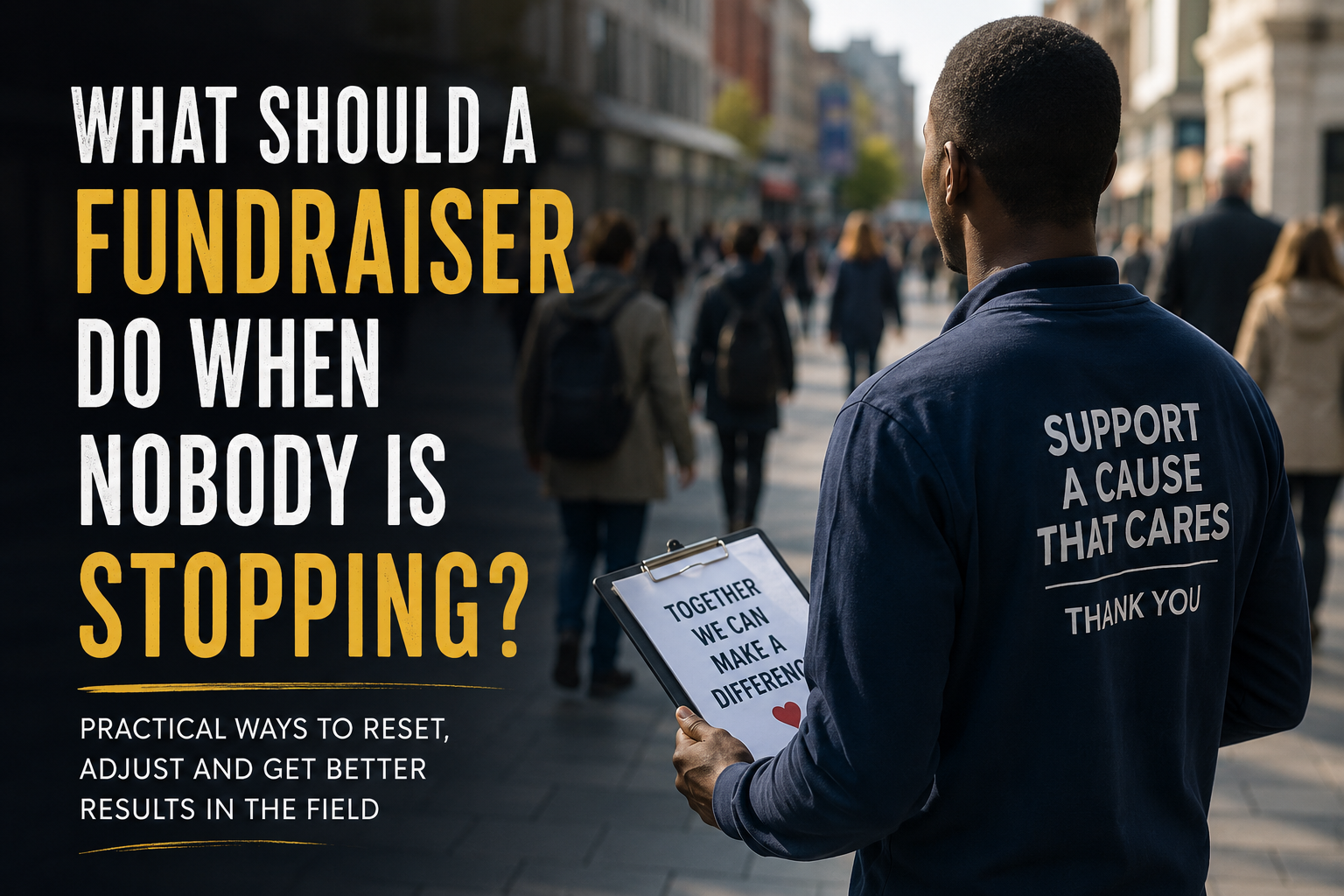
  • What Should a Fundraiser Do When Nobody Is Stopping?

    What Should a Fundraiser Do When Nobody Is Stopping?


    You have your uniform on, your materials are ready, and you know the cause you’re representing. You’ve prepared your pitch and you’re standing in the right place.

    But nobody is stopping.

    Five people walk past. Then ten. Twenty.

    Someone says they’re in a hurry. Another doesn’t even make eye contact. After a while, a familiar question begins to creep into your mind:

    “What am I doing wrong?”

    It’s one of the most frustrating experiences in face-to-face fundraising. But a slow period doesn’t automatically mean you’re a bad fundraiser.

    Sometimes the problem isn’t your ability. It may be the location, the timing, your body language, your opening—or simply the people you’re approaching.

    The important thing is not to panic.

    Stop. Observe. Adjust. Try again.

    Don’t Take Every “No” Personally

    Rejection is part of face-to-face fundraising. People are busy, distracted, rushing somewhere or simply not interested in having a conversation.

    Their response isn’t necessarily a judgement of you.

    The danger comes when you carry one rejection into the next approach. After several “nos”, your confidence can begin to change. Your voice becomes less energetic. Your body language becomes hesitant. You start expecting the next person to reject you before you’ve even spoken.

    Remind yourself:

    They said no to the conversation. They did not say no to my worth.

    Then approach the next person.

    Look at the Environment

    Before changing your entire pitch, look around you.

    Are people actually in a position to stop?

    If everyone is rushing to work, catching transport or focused on where they’re going, you may be fighting the environment rather than your own technique.

    A good fundraiser learns to read the crowd. Look for natural moments when people have time to pause and engage.

    If campaign rules allow it, speak to your team leader about your positioning. Sometimes a small change in where you stand can make a significant difference.

    Check Your Timing and Body Language

    Not every person is approachable at every moment.

    Someone carrying several bags, running towards transport or clearly distracted may not be the best person to engage. That doesn’t mean your pitch failed. The timing may simply have been wrong.

    Then look at yourself.

    Are you smiling? Do you look approachable? Are you standing confidently? Are you moving towards people too quickly? Does your body language communicate energy—or desperation?

    Fundraising begins before the first words are spoken.

    Keep Your Opening Simple

    When people aren’t stopping, the temptation is often to say more.

    More information. More statistics. More explanation.

    But your opening doesn’t need to tell the entire story.

    Its job is simply to create enough curiosity for someone to stop and listen.

    Keep it natural. Keep it conversational. Give the person a reason to hear more.

    Once they stop, that’s when you have the opportunity to explain the cause properly.

    Let Your Team Leader Coach You

    One of the most useful things you can do when you’re struggling is ask your team leader to observe you.

    Don’t just ask, “How am I doing?”

    Ask them to watch several approaches and give you specific feedback.

    Are you approaching at the right time? Is your opening too long? Are you speaking too quickly? What does your body language communicate?

    Sometimes we cannot see our own habits.

    That’s where good coaching becomes valuable. A team leader can see something from the outside that you may not notice yourself.

    Change One Thing at a Time

    When something isn’t working, don’t change everything at once.

    Test one adjustment.

    Change your opening. Observe what happens.

    If that doesn’t help, look at your positioning.

    Then consider your body language or timing.

    Use a simple process:

    Observe → Adjust → Test → Learn → Repeat.

    That’s how improvement happens.

    Don’t Chase the Numbers

    When the numbers are low, desperation can creep in. You start trying to stop everyone, and the pressure becomes visible.

    Remember that you’re inviting someone into a conversation. You’re not forcing them into one.

    Approach people with confidence and energy, but respect their decision.

    And if you’ve had twenty difficult approaches in a row, sometimes you need a reset.

    Take a short break if your campaign environment allows it. Drink some water. Take a breath. Speak to your team leader. Then return with a clearer mind.

    A reset isn’t giving up.

    It’s recognising that your state of mind affects your performance.

    The Fundraiser’s Five-Minute Field Check

    When things aren’t working, stop and ask yourself:

    1. Where am I?

    Is this a good place for people to stop and have a conversation?

    2. Who am I approaching?

    Are these people actually in a position to engage?

    3. How am I approaching?

    What does my body language communicate?

    4. What am I saying?

    Is my opening short, natural and interesting?

    5. What can I change?

    Choose one thing to test during your next few approaches.

    Don’t change everything.

    Change one thing, observe the result, and learn from it.

    Final Thoughts

    A bad fundraising period doesn’t automatically mean you’re a bad fundraiser.

    Sometimes, something simply needs to change.

    Maybe your positioning needs adjusting. Maybe your timing is wrong. Maybe your opening needs work. Or maybe you’ve had a difficult run of rejection and simply need to reset.

    The best fundraisers aren’t necessarily the people who never hear “no.”

    They’re the people who know what to do after hearing it.

    They observe. They adjust. They ask for feedback. They learn.

    And then they try again.

    So the next time you’re standing in a busy public space wondering why nobody is stopping, don’t immediately ask:

    “What’s wrong with me?”

    Ask:

    “What is this moment teaching me?”

    Because sometimes the difference between a frustrating fundraising day and a productive one isn’t a completely new strategy.

    It’s simply the willingness to stop, adjust and try again.


    Beyond the Pitch

    Face-to-face fundraising is about more than asking for donations.

    It’s about communication, resilience, leadership and the human moments that happen between a fundraiser and a stranger.

    Through Beyond the Pitch, I share practical lessons and honest reflections from the fundraising field—looking beyond the numbers to the people who make fundraising possible.


    Continue the Conversation

    Have you ever had a day when nobody seemed to want to stop?

    What did you change—and did it work?

    Share your experience in the comments.

    If you enjoy practical insights about face-to-face fundraising, leadership and team development, follow Reflections in Motion for more articles from Beyond the Pitch.

    📘 Want to go deeper?

    My book, Beyond the Pitch: The Human Art of Face-to-Face Fundraising, explores the communication, psychology and human connection behind successful fundraising.

    Explore my books on Amazon:
    Kgalalelo Ntumelang – Amazon Author Page

    Work With Me

    If your organisation or fundraising team needs support with fundraising communication, team development, coaching or practical fundraising insights, I’d love to hear from you.

    Email: lelon@reflectionsinmotion.blog

    Website: Reflections in Motion

  • From Broadcaster to Brand: Podcasting — Part 1

    From Broadcaster to Brand: Podcasting — Part 1

    So, You Want to Start a Podcast? A Broadcaster’s Guide to Getting Started


    There was a time when being a broadcaster meant having access to a radio station.

    If you wanted to speak to thousands of people, you needed airtime.

    If you wanted to interview someone, you needed a programme.

    And if you wanted to build an audience, you needed someone else to give you access to theirs.

    Podcasting has changed that.

    Today, broadcasters can create their own shows, build their own audiences and develop their own platforms without waiting for a traditional media organisation to give them a microphone.

    And that is exciting.

    But before you rush out to buy equipment, there is a more important question:

    Why do you want to start a podcast?


    Podcasting Starts With an Idea

    One of the easiest mistakes beginners make is starting with equipment.

    They research microphones.

    They buy headphones.

    They download editing software.

    They create artwork.

    And then they sit down and ask:

    “What am I actually going to talk about?”

    Your equipment matters.

    But your idea matters more.

    A podcast needs a reason to exist.

    It needs something worth saying and an audience that has a reason to listen.

    So before you press record, ask yourself:

    What do I want my podcast to be about?


    Broadcasters Already Have an Advantage

    If you’ve worked in radio or broadcasting, you’re not starting from zero.

    You’ve probably already learned how to:

    • interview people
    • ask questions
    • tell stories
    • research
    • write
    • communicate clearly
    • engage an audience
    • work with your voice
    • structure conversations

    These are podcasting skills.

    The difference is that instead of using those skills on someone else’s platform, you can begin using them to build something of your own.

    That shift is powerful.


    You Don’t Have to Be on Camera

    This is especially important for radio broadcasters.

    The digital world can sometimes make it seem as though everyone needs to be on YouTube, TikTok or Instagram Reels.

    But podcasting began with something broadcasters already understand:

    audio.

    You don’t have to become a video personality overnight.

    Your voice can still be your greatest asset.

    If you’re comfortable behind the microphone, start there.

    You can always explore video later as your confidence and strategy develop.

    Don’t let the fear of being on camera stop you from building something valuable.


    Who Are You Talking To?

    A podcast becomes much stronger when you know who you’re speaking to.

    Instead of saying:

    “My podcast is about life.”

    Ask:

    Who do I want listening?

    Maybe you’re speaking to young broadcasters trying to enter the industry.

    Maybe you’re talking to entrepreneurs.

    Maybe you’re interviewing people about relationships, careers, parenting or personal growth.

    The possibilities are endless.

    But the more clearly you understand your audience, the easier it becomes to decide what conversations belong on your podcast.


    Your Podcast Can Become More Than a Podcast

    This is where things get interesting for broadcasters.

    Your podcast doesn’t necessarily have to make money directly.

    It can become a platform that creates other opportunities.

    For example, your podcast could help you:

    • promote your expertise
    • build your personal brand
    • attract speaking opportunities
    • promote a book
    • introduce coaching services
    • connect with potential clients
    • grow an online community
    • create opportunities for partnerships

    The podcast becomes part of a bigger picture.

    You’re not simply creating episodes.

    You’re building visibility, credibility and relationships.


    Don’t Wait for Perfect

    Perhaps the biggest obstacle isn’t equipment.

    It’s fear.

    “What if nobody listens?”

    “What if I’m not good enough?”

    “What if my first episode is terrible?”

    Your first episode probably won’t sound like your hundredth.

    And that’s okay.

    You are allowed to learn.

    You are allowed to improve.

    You are allowed to start small.

    The goal isn’t to create a perfect podcast on day one.

    The goal is to create something worth improving.


    Before You Press Record

    Before launching your podcast, answer these five questions:

    1. Why am I starting this podcast?

    2. Who am I creating it for?

    3. What will listeners get from it?

    4. Why am I the right person to have these conversations?

    5. What do I ultimately want this podcast to help me build?

    Your answers will shape everything that comes next.


    Your Voice Can Build More Than an Audience

    For broadcasters, podcasting is more than another content trend.

    It is an opportunity to take skills developed behind the microphone and use them to build something you own.

    You already know how to communicate.

    You already understand audiences.

    You already know how to tell stories.

    Now you have an opportunity to take those skills beyond traditional broadcasting.

    But deciding to start a podcast is only the beginning.

    What equipment do you actually need?

    How do you structure your first episodes?

    Where should you publish?

    How do you get people to listen?

    And perhaps the question every broadcaster eventually asks:

    How can a podcast actually make money?

    That’s where we go next.


    Coming in Part 2

    From Microphone to Money: How to Build, Launch and Monetise Your Podcast

    In Part 2, we’ll move from the idea to the practical side of podcasting.

    We’ll explore:

    • choosing your podcast format
    • the equipment you actually need
    • planning your first episodes
    • recording and editing
    • publishing your podcast
    • promoting your show
    • finding your first listeners
    • building an audience
    • creating multiple income opportunities
    • finding sponsors and partnerships
    • using your podcast to build a personal brand
    • turning your broadcasting skills into a sustainable creative business

    Part 1 is about deciding to start.

    Part 2 is about building it.


    A Quiet Reminder

    You don’t need to become someone else to become a podcaster.

    You don’t need a television studio.

    You don’t need thousands of followers.

    And you don’t need to be perfect.

    You need a voice.

    You need an idea.

    And you need the courage to press record.

    The microphone that helped you build your broadcasting career can become the microphone that helps you build something of your own.


    Continue the Conversation

    Are you a broadcaster thinking about starting a podcast?

    What’s stopping you?

    Is it the equipment, finding an idea, fear of starting, building an audience—or something else?

    I’d love to hear from you in the comments.

    If you’re enjoying From Broadcaster to Brand, subscribe to Reflections in Motion for more practical reflections on broadcasting, personal branding and building a career beyond traditional media.


    📘 Take Your Broadcasting Career Beyond the Microphone

    My book, From Broadcaster to Brand: Turning Your Skills into a Creative Business, explores how broadcasters can turn their experience and communication skills into new opportunities, build personal brands and create additional income streams.

    👉🏽 Explore my books on Amazon


    🤝 Work With Me

    Are you looking for support with podcasting, broadcasting, communication, content creation or building your professional brand?

    I’d love to hear about what you’re working on.

    📧 Email: lelon@reflectionsinmotion.blog

    🌐 Website: Reflections in Motion

    Let’s talk about what you’re building.

    LELO