Tag: face-to-face fundraising

  • Why Fundraisers Understand Money Better Than Most Professionals

    Why Fundraisers Understand Money Better Than Most Professionals

    When people hear the word “fundraising,” they often think of donations, causes, and charity work.

    What they don’t realise is this:
    fundraising teaches you more about money than most traditional jobs ever will.

    Not because you’re handling large amounts of money —
    but because you’re constantly learning how money moves.


    1. Money Follows Emotion, Not Logic

    One of the first lessons in fundraising is that people don’t give because something makes sense.

    They give because something makes them feel.

    You can present facts, statistics, and logical arguments —
    but without emotional connection, nothing happens.

    This applies everywhere:

    • Customers don’t buy based on logic alone
    • Employers don’t hire based on qualifications alone
    • Opportunities don’t come from facts alone

    Money follows emotion.


    2. Value Must Be Communicated Clearly

    In fundraising, you have seconds to explain:

    • what the cause is
    • why it matters
    • why someone should care

    If your message is unclear, you lose the opportunity.

    The same applies to your career and income:
    If people don’t understand your value quickly, they move on.


    3. Rejection Teaches You Resilience Around Money

    Most professionals avoid rejection.

    Fundraisers experience it daily.

    This builds something powerful:

    • emotional resilience
    • confidence
    • persistence

    And these are directly linked to earning potential.

    Because making money requires:

    • putting yourself out there
    • hearing “no”
    • continuing anyway

    4. Money Is About Trust

    People don’t just give money.
    They give trust.

    In fundraising, if people don’t trust you, they won’t contribute — no matter how good the cause is.

    The same applies to:

    • clients
    • employers
    • audiences

    Trust is what unlocks money.


    5. You Learn That Money Is Everywhere

    Fundraising shifts your mindset.

    You stop thinking:

    “There is no money”

    And start seeing:

    “Money exists — I just need to communicate value better”

    This is one of the most powerful mental shifts anyone can have.


    The Hidden Advantage

    Many professionals underestimate fundraising experience.

    But the truth is:
    it teaches real-world skills that directly influence income:

    • persuasion
    • communication
    • confidence
    • positioning

    Final Thoughts

    Fundraisers don’t just understand causes.

    They understand people.
    They understand value.
    And ultimately, they understand money.

    The question is:
    Are you using those lessons beyond fundraising?


    Want to Go Further?

    If you’re interested in using communication and real-world experience to create income, I share more practical strategies in my eBooks.

    📘 Explore here: [https://www.amazon.com/author/kgalalelontumelang]


    Work With Me

    I help professionals turn their communication skills into income through storytelling, branding, and positioning.

    📧 Contact: [lelon@reflectionsinmotion.blog]

    LELO

  • Listening Is the Real Skill: Why Talking Less Makes You a Better Fundraiser

    Listening Is the Real Skill: Why Talking Less Makes You a Better Fundraiser

    In face-to-face fundraising, it’s easy to believe that success comes from saying the right thing.

    The perfect pitch.
    The right words.
    The ability to explain the cause clearly and confidently.

    So we focus on talking.

    We prepare what to say.
    We refine how we say it.
    We try to say it better, faster, and smoother.

    But over time, the field teaches you something unexpected:

    Talking is not the most important skill.

    Listening is.


    The Pressure to Fill the Silence

    There’s a moment in almost every conversation that feels uncomfortable.

    A pause.

    The other person hasn’t responded yet.
    They’re thinking.
    Or maybe they’re unsure.

    And instinctively, we react.

    We start talking again.

    We explain more.
    Add more details.
    Try to “save” the moment.

    Because silence can feel like losing control.

    But what I’ve learned is this:

    Not every silence needs to be filled.

    Sometimes, silence is where the real conversation begins.


    When Talking Too Much Gets in the Way

    I remember a time when I was so focused on explaining the cause that I didn’t realise I wasn’t actually connecting.

    I was clear.
    Confident.
    Structured.

    But the conversation felt one-sided.

    The person listened politely, nodded, and eventually said no.

    There was nothing wrong with what I said.

    But something was missing.

    I hadn’t given them space.

    Space to think.
    Space to respond.
    Space to feel part of the conversation.

    That’s when it became clear:

    Talking can inform —
    but it doesn’t always connect.


    What Real Listening Looks Like

    Listening is not just staying quiet.

    It’s active. Intentional. Aware.

    It looks like:

    • Paying attention to tone, not just words
    • Noticing body language and energy
    • Allowing someone to finish their thoughts without interruption
    • Asking questions that show genuine curiosity
    • Responding to what is said — not just returning to your script

    Real listening shifts the dynamic.

    It turns a pitch into a conversation.


    A Moment That Changed My Approach

    There was a conversation where I decided — intentionally — to slow down.

    Instead of moving quickly through my usual structure, I asked a simple question and paused.

    The person responded.

    And instead of jumping in, I listened.

    The conversation unfolded differently.

    They shared more.
    They asked questions.
    They became more engaged.

    It didn’t feel like I was leading.

    It felt like we were building something together.

    That moment stayed with me.

    Because it reminded me:

    People don’t need more information.
    They need to feel understood.


    Why Listening Builds Trust

    When people feel heard, something shifts.

    They relax.

    They open up.

    They engage more honestly.

    Listening communicates:

    • respect
    • patience
    • presence

    And those qualities build trust faster than any well-rehearsed explanation.

    Because, at the core of it, fundraising is not just about presenting a cause.

    It’s about connecting with a person.


    The Discipline of Saying Less

    Talking less is not always easy.

    Especially when:

    • You feel pressure to perform
    • You want to make a good impression
    • You’re trying to reach a target

    But restraint is a skill.

    It requires you to:

    • trust the process
    • be comfortable with pauses
    • resist the urge to control the conversation

    And over time, you realise:

    Saying less often leads to more meaningful interactions.


    Beyond Fundraising

    This lesson applies far beyond the field.

    In Leadership

    People don’t just want direction — they want to be heard.

    In Relationships

    Listening strengthens understanding more than advice ever could.

    In Interviews

    Listening carefully allows you to respond thoughtfully.

    In Media & Broadcasting

    Great communicators don’t just speak well — they listen well.

    Listening is a universal skill.

    And yet, it’s often overlooked.


    Reflection: How Do You Listen?

    Take a moment to think about your own conversations:

    • Do you listen to respond, or to understand?
    • Do you feel uncomfortable in silence?
    • How often do you interrupt without realising it?
    • When was the last time someone felt truly heard by you?

    These small habits shape the quality of your interactions.


    The Real Skill

    Face-to-face fundraising teaches you something simple, but powerful:

    Being effective with people is not about how much you say.

    It’s about how well you listen.

    Because when you listen, you:

    • understand better
    • respond better
    • connect more deeply

    And that’s where meaningful conversations begin.


    Final Thought

    Anyone can learn a script.

    But not everyone learns how to listen.

    And in a space built on human interaction, that difference matters.

    Because people don’t connect with how much you say.

    They connect with how well you listen.


    📘 Continue the Conversation

    If this resonated with you, these human-centred lessons are explored more deeply in my ebook:

    Beyond the Pitch: The Human Art of Face-to-Face Fundraising

    👉 Explore my books here:
    https://www.amazon.com/author/kgalalelontumelang

    If you enjoy reflections on communication, leadership, and the psychology of human interaction, consider subscribing to the blog.

    And I’d love to hear from you:

    Do you find it easier to talk — or to truly listen?

    Share your experience in the comments. Your perspective might help someone else become more aware of how they communicate.

    LELO

  • The Hidden Challenges of Leading a Fundraising Team (No One Talks About)

    The Hidden Challenges of Leading a Fundraising Team (No One Talks About)

    Leadership often looks confident from the outside.

    People see direction.
    They see energy.
    They see someone who seems to have things under control.

    But what they don’t always see is the weight behind it.

    Because leading a fundraising team — especially in a face-to-face environment — is not just about performance.

    It’s about people.

    And people are not predictable.


    The Pressure Comes From Both Sides

    One of the most difficult parts of leadership is standing in the middle.

    Above you, there are expectations:

    • Targets to meet
    • Performance to maintain
    • Results to deliver

    Below you, there are people:

    • Tired
    • Discouraged
    • Trying to stay motivated
    • Facing rejection daily

    And somehow, you are expected to carry both.

    To push for results —
    while protecting morale.

    To stay focused —
    while staying human.

    That balance is not easy.

    And most days, no one teaches you how to manage it.


    You’re Expected to Be the Stable One

    There are days when you don’t feel your best.

    Your energy is low.
    Your confidence is off.
    Your own performance might not be where you want it to be.

    But as a leader, you don’t always have the luxury of showing that.

    Because your team is watching.

    They look to you for:

    • reassurance
    • direction
    • emotional stability

    And so, you learn to steady yourself — even when you feel uncertain.

    Not by pretending everything is perfect,
    but by choosing how you show up despite how you feel.


    Motivating Others While Managing Yourself

    Motivation is not always natural.

    Especially in a job where rejection is constant.

    You may have a team member who is:

    • losing confidence
    • disengaging
    • questioning whether they belong

    And in that moment, your role is to lift them.

    But what happens when you are also tired?

    That’s one of the hidden challenges of leadership.

    You are managing:

    • your own mindset
    • your team’s energy
    • the environment around you

    All at once.

    It requires emotional awareness — not just strategy.


    When You Don’t Have the Answers

    Leadership is often associated with certainty.

    But in reality, there are many moments where you simply don’t know.

    • You don’t know why performance has dropped
    • You don’t know the perfect way to motivate someone
    • You don’t know how the day will turn out

    And yet, you still have to lead.

    That’s where growth happens.

    Because leadership is not about always having answers.

    It’s about:

    • staying present
    • staying calm
    • making the best decision you can with what you have

    A Moment That Stays With Me

    I remember a day when the team was struggling.

    Energy was low across the board. Conversations weren’t landing. The usual rhythm just wasn’t there.

    I could feel the pressure building — not just in them, but in myself.

    There was a part of me that wanted to push harder:
    “Let’s pick it up.”
    “We need to move faster.”
    “We can’t let the day go like this.”

    But something told me to pause.

    Instead, I gathered the team and simply acknowledged it:

    “This is a tough day. And that’s okay. Let’s focus on showing up well, not forcing outcomes.”

    The shift wasn’t immediate.

    But the tension eased.

    And slowly, people began to reset.

    That day didn’t become extraordinary.

    But it became honest.

    And sometimes, that’s what leadership looks like.


    The Emotional Weight No One Talks About

    Leadership is not just a responsibility.

    It’s emotional weight.

    You carry:

    • expectations
    • responsibility for others
    • the desire to support your team
    • the pressure to perform

    And often, you carry it quietly.

    Because leadership is not always about speaking.

    Sometimes it’s about holding space.


    What This Teaches You

    Over time, you begin to understand:

    Leadership is not about control.
    It’s about awareness.

    It’s not about being perfect.
    It’s about being consistent.

    It’s not about always being strong.
    It’s about being grounded.

    And most importantly:

    Leadership is not just about guiding others —
    it’s about managing yourself while doing it.


    Beyond Fundraising

    These lessons don’t stay in the field.

    They apply everywhere:

    In business

    Leaders are not just measured by results, but by how they handle pressure.

    In teams

    People don’t just need direction — they need understanding.

    In life

    Responsibility often comes with emotional weight, not just decision-making.

    Face-to-face fundraising simply accelerates these lessons.


    Reflection: The Reality of Leadership

    Take a moment to reflect:

    • What has leadership required from you emotionally?
    • When have you felt the weight of responsibility?
    • How do you manage pressure while supporting others?

    These are not easy questions.

    But they are necessary ones.


    Final Thought

    Leadership is often seen as a position.

    But in reality, it is a practice.

    It’s built in moments of uncertainty.
    In days that don’t go as planned.
    In decisions that require both strength and empathy.

    And sometimes, the most powerful leadership is not loud.

    It’s steady.


    📘 Continue the Conversation

    If this resonated with you, these real, human experiences are explored more deeply in my ebook:

    Beyond the Pitch: The Human Art of Face-to-Face Fundraising

    👉 Explore my books here:
    https://www.amazon.com/author/kgalalelontumelang

    If you enjoy reflections on leadership, communication, and the human side of performance, consider subscribing to the blog.

    And I’d love to hear from you:

    What has been the most challenging part of leadership for you?

    Share your experience in the comments — your insight might help someone else navigate their own leadership journey.

    LELO

  • Confidence vs. Competence: What Really Makes a Great Fundraiser?

    Confidence vs. Competence: What Really Makes a Great Fundraiser?

    In face-to-face fundraising, confidence is often seen as the defining trait of success.

    The ability to approach strangers.
    To speak clearly.
    To hold attention.
    To handle rejection without hesitation.

    It looks powerful.

    And for a long time, I believed the same thing:

    If I were more confident, I would perform better.

    But the field has a way of challenging what we think we know.

    Because over time, something becomes clear:

    Confidence is visible.
    But competence is what delivers results.


    The Confidence Illusion

    Confidence can be convincing.

    A confident fundraiser walks with certainty.
    Speaks smoothly.
    Approaches without hesitation.

    From the outside, it looks like they have everything under control.

    But confidence can sometimes create a false sense of effectiveness.

    Because being confident doesn’t always mean:

    • You’re listening
    • You’re adapting
    • You’re connecting

    It simply means you’re comfortable expressing yourself.

    And in fundraising, expression is only part of the work.


    What Competence Really Looks Like

    Competence is quieter.

    It doesn’t always stand out immediately.

    But it shows up in the way a fundraiser:

    • Reads body language
    • Adjusts their approach
    • Listens more than they speak
    • Knows when to pause
    • Respects when someone isn’t ready

    A competent fundraiser understands that every interaction is different.

    They don’t rely on one script.
    They respond to the moment.

    And that’s where real connection happens.


    A Lesson From the Field

    I remember a period where I focused heavily on sounding confident.

    I worked on my tone.
    My delivery.
    My approach.

    And while it helped me start more conversations, something felt off.

    Some interactions didn’t go beyond the surface.

    People listened — but they didn’t engage.

    That’s when I realised:

    I was focused on how I sounded,
    not on how the interaction felt.

    So I shifted.

    I started listening more.
    Observing more.
    Adjusting more.

    And slowly, the quality of my conversations changed.

    Not because I became more confident —
    but because I became more aware.


    How Confidence Is Actually Built

    Here’s the irony:

    Confidence doesn’t come first.

    It’s built through competence.

    Through:

    • Repeated conversations
    • Missed opportunities
    • Learning what works — and what doesn’t
    • Sitting with discomfort instead of avoiding it

    Real confidence is not loud.

    It’s steady.

    It comes from knowing:

    I may not control the outcome, but I understand the process.


    When Confidence Isn’t Enough

    There are moments in the field where confidence alone falls short.

    When someone challenges you.
    When a conversation becomes emotional.
    When someone hesitates or pushes back.

    In those moments, confidence without competence can feel empty.

    But competence gives you something to rely on:

    • Awareness
    • Patience
    • Adaptability

    It allows you to stay grounded, even when the interaction is uncertain.


    The Balance That Matters

    This is not about choosing one over the other.

    The best fundraisers develop both.

    Confidence helps you start.
    Competence helps you continue.

    Confidence opens the door.
    Competence builds the connection.

    And over time, they begin to support each other.


    Beyond Fundraising

    This lesson doesn’t stay in the field.

    In the workplace

    Confidence may get attention — but competence earns trust.

    In leadership

    People don’t follow confidence alone — they follow consistency and understanding.

    In everyday life

    How you engage matters more than how you appear.


    A Quick Reflection

    Take a moment to think about your own experience:

    • Have you ever felt confident but struggled to connect?
    • Have you ever doubted yourself but still handled a situation well?
    • What do you rely on more — how you present, or how you understand?

    These questions can reveal where your real strength lies.


    The Real Work

    Face-to-face fundraising teaches you something many environments don’t:

    Being good with people is not about performance.

    It’s about awareness.

    It’s about being present enough to respond, not just react.

    Confidence may draw people in.

    But competence is what makes the interaction meaningful.


    Final Thought

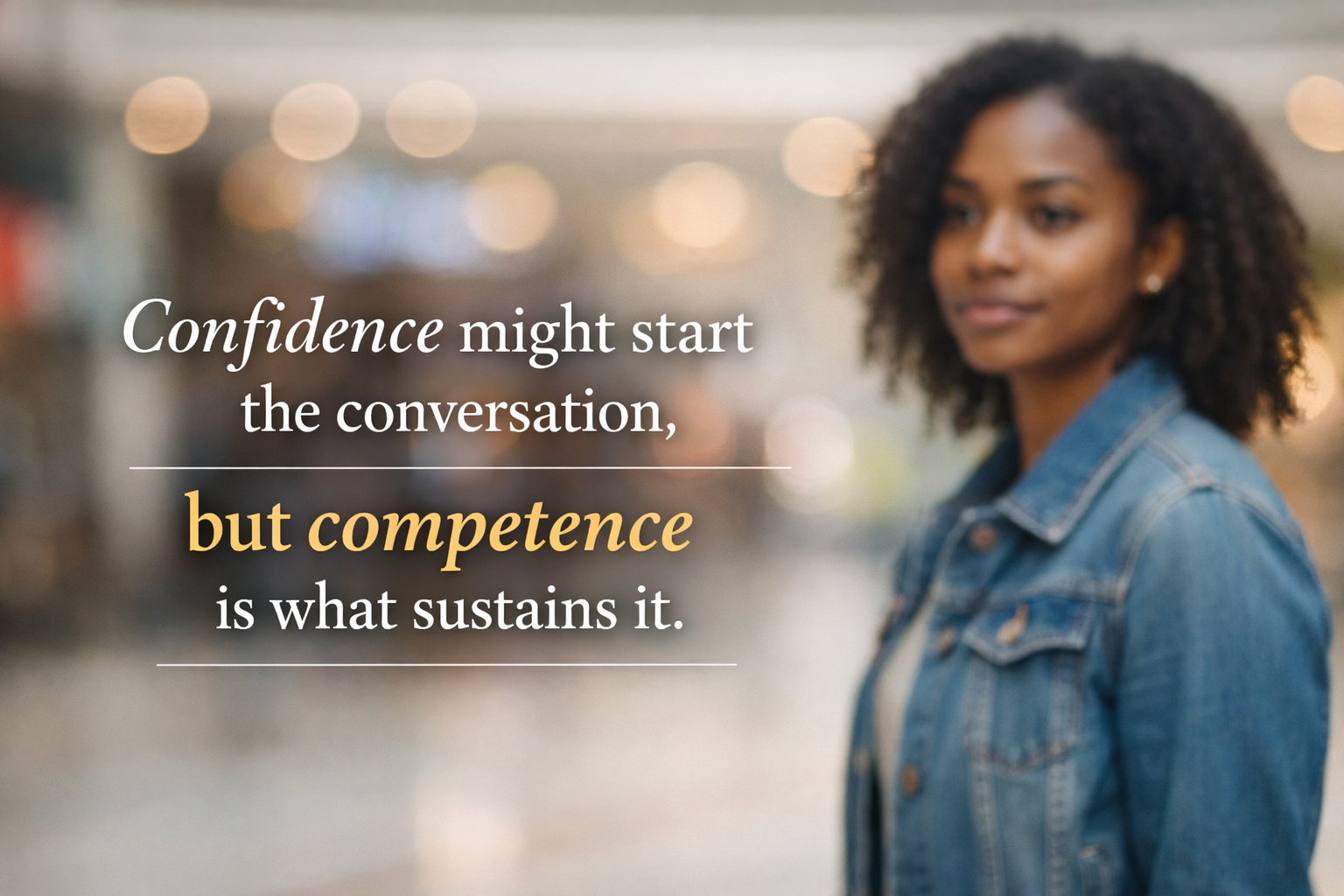
    Confidence might start the conversation.

    But competence is what sustains it.

    And in a space where human connection matters, that difference is everything.


    📘 Continue the Conversation

    If this resonates with you, these human-centered lessons are explored more deeply in my ebook:

    Beyond the Pitch: The Human Art of Face-to-Face Fundraising

    👉 Explore my books here:
    https://www.amazon.com/author/kgalalelontumelang

    If you enjoy reflections on communication, confidence, and the psychology behind human interaction, consider subscribing to the blog so you don’t miss future posts.

    And I’d love to hear from you:

    Do you think confidence or competence has shaped your journey more?

    Share your experience in the comments — your perspective might help someone else see their own growth differently.

    LELO

  • Redefining Leadership Beyond Numbers

    Redefining Leadership Beyond Numbers

    Leadership doesn’t start in a boardroom.

    It doesn’t start with a title, a promotion, or a team meeting.

    Sometimes, it begins in a mall.
    Standing for hours.
    Facing rejection.
    Trying to keep your energy steady while helping others do the same.

    Face-to-face fundraising has a way of revealing what leadership really is — not in theory, but in practice.

    And often, it’s not what people expect.


    Leadership Is Not Just About Targets

    At first, it’s easy to think leadership is about numbers.

    How many sign-ups?
    How much was raised?
    Who is performing?

    But when you’re leading a team in the field, you quickly realise:

    Numbers don’t tell the full story.

    Behind every number is a person:

    • Someone dealing with rejection
    • Someone losing confidence
    • Someone questioning whether they’re good enough
    • Someone having an off day

    Leadership shifts from:
    “How do we hit target?”
    to
    “How do I support people while we aim for target?”

    That shift changes everything.


    You’re Leading People Who Hear “No” All Day

    There’s something unique about leading in face-to-face fundraising.

    Your team isn’t sitting behind desks.
    They’re in public spaces.
    They’re being ignored, dismissed, and sometimes challenged — repeatedly.

    And yet, they are expected to:

    • Stay positive
    • Stay professional
    • Stay motivated

    That’s not easy.

    As a leader, you’re not just managing performance.
    You’re managing emotional energy.

    You start to notice:

    • Who shuts down after rejection
    • Who pushes too hard
    • Who hides their frustration
    • Who needs encouragement but won’t ask for it

    Leadership becomes observation.
    And response.


    The Balance Between Performance and Humanity

    This is where leadership gets tested.

    You have targets to meet.
    Expectations to manage.
    Results to deliver.

    But you also have people.

    And people are not machines.

    Push too hard, and you create pressure.
    Pull back too much, and performance drops.

    So you learn to balance:

    • Accountability with empathy
    • Structure with flexibility
    • Direction with trust

    It’s not about choosing one over the other.

    It’s about knowing when to lean into each.


    A Moment That Changed How I Lead

    I remember a team member who was struggling on the field.

    Their energy had dropped. Their confidence was low. Conversations weren’t landing.

    The easiest response would have been to focus on performance:
    “Try harder.”
    “Adjust your pitch.”
    “Be more confident.”

    But something told me to pause.

    Instead of correcting, I asked:
    “Are you okay?”

    That question changed the tone completely.

    What followed wasn’t about technique.
    It was about how they were feeling.

    And once that was addressed, everything else began to improve naturally.

    That moment taught me:

    Sometimes leadership is not about fixing performance.
    It’s about understanding the person behind it.


    Leadership Is Often Quiet

    We often associate leadership with visibility.

    Speaking loudly.
    Directing clearly.
    Taking charge.

    But in the field, some of the most powerful leadership moments are quiet.

    • Checking in without making it obvious
    • Encouraging without putting pressure
    • Leading by example through consistency
    • Staying grounded when others feel overwhelmed

    Your team watches more than they listen.

    Your energy becomes their reference point.


    What This Taught Me Beyond Fundraising

    The lessons from the field don’t stay there.

    They apply everywhere.

    In Business

    People don’t perform well under constant pressure — they perform well when they feel supported.

    In Media & Broadcasting

    Strong teams aren’t built through control, but through trust and clarity.

    In Leadership Roles

    Titles don’t create leaders.
    Presence, consistency, and emotional intelligence do.

    Face-to-face fundraising accelerates these lessons because everything is immediate, visible, and human.


    Reflection: The Kind of Leader You Are Becoming

    Take a moment to think about your own leadership — whether formal or informal.

    • Do people feel safe around you?
    • Do you listen as much as you direct?
    • Do you respond to performance — or to people?
    • How do you show up when your team is struggling?

    Leadership is not a fixed identity.

    It’s something you practice daily.


    The Bigger Picture

    Face-to-face fundraising is often seen as a temporary job.

    A stepping stone.
    A numbers game.

    But what it really builds is something deeper:

    Resilient individuals.
    Emotionally aware communicators.
    And, if you pay attention, thoughtful leaders.


    Final Thought

    Leadership in face-to-face fundraising is not about being the loudest voice.

    It’s about being the most grounded one.

    It’s about holding space for others while managing your own pressure.

    It’s about remembering that behind every target is a team. Behind every team are human beings trying their best.

    And that understanding changes the way you lead.


    📘 Continue the Conversation

    If this resonated with you, these real, human lessons are explored more deeply in my ebook:

    Beyond the Pitch: The Human Art of Face-to-Face Fundraising

    👉 Explore my books here:
    https://www.amazon.com/author/kgalalelontumelang

    If you enjoy reflections on leadership, communication, and the human side of performance, consider subscribing to the blog. This way, you won’t miss future posts.

    And I’d love to hear from you:

    What has leadership taught you about people?

    Or, if you’re leading a team, what has challenged you the most?

    Share your thoughts in the comments. Your experience might help someone else grow into their leadership role.

    LELO

  • Mastering First Impressions in Fundraising

    Mastering First Impressions in Fundraising

    In face-to-face fundraising, something important happens long before the pitch begins.

    It happens in seconds.

    Sometimes even less.

    Before you say hello…
    Before you explain the cause…
    Before you even finish your first sentence…

    People have already made a decision about you.

    Should they stop?
    Should they trust you?
    Or should they keep walking?

    This is the 10-second judgment — the quiet psychological moment where people decide whether you are worth their attention.

    And it has very little to do with your script.


    The Moment Before the Conversation

    Anyone who has worked in face-to-face fundraising understands this moment.

    You notice someone approaching.
    They notice you.

    There’s a brief exchange of eye contact.

    In that split second, both of you are reading signals.

    You are thinking:

    Do they seem open to conversation?

    They are thinking:

    Is this someone I feel comfortable talking to?

    No words have been spoken yet.
    But a decision is already forming.

    Sometimes people stop.
    Sometimes they walk past.

    And often, that decision happens before the pitch even begins.


    What People Notice Before You Speak

    Human beings are incredibly good at reading subtle signals.

    In public spaces like malls, people are constantly assessing their surroundings. Safety, trust, and comfort are evaluated quickly.

    When someone approaches you, they are often noticing things like:

    • Your posture
    • Your facial expression
    • Your energy
    • Your eye contact
    • The way you approach their space

    A tense posture can create distance.

    A relaxed smile can create openness.

    A rushed approach can make someone feel pressured.

    But a calm presence invites curiosity.

    Most of the time, people aren’t rejecting your cause.
    They’re reacting to how the interaction feels.


    A Lesson I Learned on the Field

    There was a day I remember clearly while fundraising in a mall.

    I focused heavily on my pitch. I made sure the words were right. I ensured I explained the cause well.

    But my results were inconsistent.

    At some point, I noticed something interesting.

    People were responding before I even started speaking.

    Some would smile and slow down.

    Others would avoid eye contact and continue walking.

    That’s when it clicked.

    The conversation was starting before the conversation.

    It wasn’t just about what I said.
    It was about how I showed up.

    My energy, my posture, my presence — all of that was communicating something long before the pitch began.

    And once I became aware of that, everything changed.


    Presence Is More Powerful Than the Perfect Pitch

    Many fundraisers spend a lot of time perfecting the script.

    But presence matters just as much — sometimes more.

    Presence is the combination of:

    • Calm confidence
    • Approachability
    • Genuine interest in people
    • Respect for someone’s space

    When people sense that you are grounded and respectful, they feel safer engaging.

    And when people feel safe, they listen.

    Not every conversation will lead to a sign-up.
    But presence creates the opportunity for a real interaction.


    This Happens Far Beyond Fundraising

    The 10-second judgment doesn’t only happen on fundraising shifts.

    It happens everywhere.

    In Job Interviews

    People form impressions within the first moments of meeting you.

    In Leadership

    Teams respond to a leader’s presence long before formal authority takes effect.

    In Networking

    Your energy often determines whether someone wants to continue a conversation.

    In Media and Broadcasting

    Audiences sense authenticity quickly — often before they consciously process what is being said.

    First impressions may not tell the whole story, but they often determine whether the story gets heard.


    A Quick Reflection

    Think about your own experiences.

    • When have you instantly trusted someone you just met?
    • What signals made you feel comfortable?
    • When have you felt hesitant about someone before they even spoke?

    These small moments shape our interactions more than we realise.

    Becoming aware of them can change how we show up in the world.


    The Real Art Behind the Pitch

    Face-to-face fundraising is often misunderstood as simply delivering a persuasive message.

    But the real work begins earlier.

    It begins in the moment someone sees you.

    It lives in the way you approach people. It is also in the energy you carry. The respect you show before a single word is spoken matters as well.

    The pitch matters.

    But the human connection that comes before it matters even more.


    📘 Continue the Conversation

    If reflections like this resonate with you, you’ll find many of these lessons explored more deeply in my ebook:

    Beyond the Pitch: The Human Art of Face-to-Face Fundraising

    👉 Explore my books here:
    https://www.amazon.com/author/kgalalelontumelang

    If you enjoy reflections on communication, confidence, and the psychology behind human interactions, consider subscribing to the blog. This way, you won’t miss future posts.

    And I’d love to hear from you:

    Have you ever formed an instant impression about someone before they spoke?

    What made you feel comfortable — or uncomfortable — in that moment?

    Share your thoughts in the comments. Your perspective might help someone else think differently about how they show up.

    LELO

  • When the Day Is Slow: How to Stay Motivated Without Compromising Your Integrity

    When the Day Is Slow: How to Stay Motivated Without Compromising Your Integrity

    There’s a particular kind of silence that only fundraisers understand.

    It’s not physical silence.
    It’s the silence of momentum.

    You’ve been standing for hours.
    You’ve started conversations.
    You’ve smiled.
    You’ve delivered your pitch.

    And still — nothing.

    No sign-ups.
    No breakthroughs.
    Just polite refusals and people walking past.

    Slow days test more than your skill.
    They test your character.


    The Emotional Weight of a Slow Shift

    I remember one afternoon in a mall where everything felt heavy.

    The foot traffic was steady, but engagement wasn’t. People were distracted. Some avoided eye contact. Others cut conversations short before they began.

    After a while, it wasn’t just about performance.

    It became personal.

    You start questioning:

    • Is it my energy?
    • Am I losing my touch?
    • Should I change my tone?
    • Should I push harder?

    That last question is the dangerous one.

    Because slow days don’t just tempt you to improve.

    They tempt you to compromise.


    When Motivation Turns Into Desperation

    There’s a subtle shift that can happen when numbers are low.

    You start to:

    • Talk faster.
    • Over-explain.
    • Lean into urgency.
    • Resist “no” more than you should.

    Not because you’re unethical.

    But because you’re anxious.

    Anxiety is often what turns persuasion into pressure.

    And if you’re not careful, your internal fear begins to drive the conversation instead of your values.


    The Discipline of Staying Ethical

    Integrity isn’t tested when everything is going well.

    It’s tested when:

    • You’re tired.
    • You’re behind target.
    • You feel invisible.
    • You need a win.

    Staying ethical on a slow day requires emotional regulation.

    It requires reminding yourself:

    My job is to invite — not to force.
    My responsibility is to represent the cause well — not to manufacture outcomes.

    That mindset doesn’t always give you immediate results.

    But it protects your long-term credibility.


    What I Do on Slow Days

    Over time, I’ve developed quiet rules for myself when momentum drops.

    1️⃣ I Reset My Energy, Not My Standards

    Instead of changing my ethics, I adjust my posture, breathing, and tone. Sometimes fatigue shows up subtly.

    2️⃣ I Focus on the Quality of Conversations

    Even if no one signs up, I aim for meaningful exchanges. Respectful engagement still matters.

    3️⃣ I Separate Effort from Outcome

    You can control effort.
    You cannot control timing.

    That separation reduces emotional spiraling.

    4️⃣ I Take Micro Breaks

    Even two minutes of stillness can reset your nervous system.

    Slow days require composure, not aggression.


    This Lesson Goes Beyond Fundraising

    “Slow days” exist everywhere.

    • Writers have low-traffic weeks.
    • Entrepreneurs have quiet sales periods.
    • Leaders experience stalled progress.
    • Creators post content that gets little engagement.

    The temptation is the same:

    Push harder.
    Force outcomes.
    Abandon process.

    But sustainable success isn’t built through desperation.

    It’s built through consistency with integrity.

    In any discipline, pressure-driven decisions often create short-term wins and long-term damage.

    Integrity-driven decisions may feel slower — but they compound.


    Reflection: What Do You Do When Momentum Drops?

    Take a moment to think about your own work or goals.

    • How do you respond when progress slows?
    • Do you become impatient?
    • Do you lower your standards?
    • Or do you double down on discipline?

    Awareness is powerful.

    Because the real growth often happens on the quiet days.


    The Hidden Gift of Slow Days

    Slow days teach you something fast days never will.

    They reveal:

    • Your internal dialogue
    • Your emotional triggers
    • Your relationship with results
    • Your tolerance for discomfort

    They expose whether you are driven by purpose — or by panic.

    And that awareness strengthens you.


    Final Thought

    Anyone can stay motivated when the numbers are high.

    But true professionalism shows up when they’re not.

    When the day is slow, your greatest task isn’t to increase pressure.

    It’s to protect your integrity.

    Because how you behave in the quiet seasons determines who you become in the successful ones.


    📘 Continue the Conversation

    If this resonated, you’ll find these real, behind-the-scenes lessons explored more deeply in my ebook:

    Beyond the Pitch: The Human Art of Face-to-Face Fundraising

    👉 Explore my books here:
    https://www.amazon.com/author/kgalalelontumelang

    If you appreciate reflections on ethical influence, emotional resilience, and the unseen psychology behind performance, consider subscribing to the blog.

    And I’d love to hear from you:

    What do slow seasons reveal about you?

    Share your experience in the comments — your insight might encourage someone navigating their own quiet period.

    LELO

  • The Fine Line Between Persuasion and Pressure

    The Fine Line Between Persuasion and Pressure

    There’s a question that quietly follows every face-to-face fundraiser:

    “Isn’t this just pressure?”

    It’s a fair question.
    And if we’re honest, it’s one we should never avoid.

    Because there is a line.

    A thin one.

    And crossing it changes everything.


    The Day I Almost Crossed It

    I remember a particular afternoon on the field.

    It had been a slow day. Conversations were short. Rejections were piling up. My energy was dipping — and so was my confidence.

    Then someone stopped.

    They listened carefully. Asked thoughtful questions. They clearly cared about the cause. I could see the possibility of a “yes.”

    But when it came time to commit, they hesitated.

    And I felt it — that internal urge to push just a little harder.

    To emphasize urgency.
    To lean into the emotional weight.
    To secure the sign-up.

    Instead, I paused.

    And I said, “It’s completely okay if today isn’t the right time.”

    They exhaled. Smiled. Thanked me.

    And walked away.

    I didn’t get the sign-up.
    But I kept something far more important — my integrity.

    That moment taught me this:

    You can win a sign-up and lose your integrity.
    Or lose a sign-up and strengthen your integrity.

    Only one builds a sustainable career.


    Persuasion Invites. Pressure Controls.

    Let’s define the difference clearly.

    Persuasion:

    • Respects autonomy
    • Shares information honestly
    • Creates space for reflection
    • Accepts “no” without resistance

    Pressure:

    • Leans on guilt
    • Creates urgency that overrides comfort
    • Minimizes hesitation
    • Treats “no” as something to overcome

    The words may sound similar.
    The intention is not.

    One says:
    “Here is something meaningful. Would you like to be part of it?”

    The other says:
    “You should feel uncomfortable if you don’t.”

    That subtle shift changes the emotional atmosphere of the entire interaction.


    The Pressure No One Talks About

    Here’s what makes this complicated.

    Sometimes the pressure doesn’t come from the public.

    It comes from:

    • Targets
    • Performance metrics
    • Team expectations
    • Slow days
    • Internal fear of failure

    And this is where emotional maturity is tested.

    Because ethical fundraising isn’t just about how you manage other people.
    It’s about how you manage yourself.

    Can you separate:

    • Your need to perform
      from
    • Their right to choose?

    That separation requires discipline.


    A Self-Check Before Every Conversation

    If you work in fundraising, try this quick internal audit before you speak. This applies to any field that involves influence.

    Before You Persuade, Ask Yourself:

    • Am I here to inform — or to push?
    • Would I feel comfortable if this interaction were recorded?
    • If they say no, will I respect it immediately?
    • Am I speaking from clarity — or from anxiety?

    If your answer to any of these questions makes you pause, that pause is valuable.

    It protects you.


    When I Saw the Line Crossed

    I once observed a colleague continue pushing after someone had clearly declined.

    The tone shifted.
    The energy tightened.
    The conversation stopped feeling mutual.

    The potential donor grew visibly uncomfortable.

    Nothing dramatic happened. But something subtle did: trust eroded.

    That interaction reminded me that persuasion is delicate. Once it turns into pressure, people don’t just reject the offer — they reject the experience.

    And in face-to-face fundraising, experience is everything.


    Why This Matters Beyond Fundraising

    The persuasion versus pressure line exists everywhere.

    In Leadership

    Pressure creates compliance.
    Persuasion builds buy-in.

    One produces short-term obedience.
    The other produces long-term commitment.

    In Parenting

    Pressure produces fear.
    Persuasion builds understanding.

    In Media & Broadcasting

    Pressure pushes narratives.
    Persuasion builds trust.

    Trust is slower.
    But it lasts longer.

    In every discipline, integrity is the multiplier.


    The Power of Letting People Walk Away

    Here’s the irony.

    The moment you become truly comfortable with “no,” your persuasion becomes stronger.

    Why?

    Because people feel when they are safe.

    When someone knows:

    • They won’t be judged
    • They won’t be cornered
    • They won’t be guilted

    They relax.

    And relaxed people think clearly.

    Safety builds trust.
    Trust builds commitment.
    Commitment outlasts pressure every time.


    Reflection: Where Do You Stand?

    Take a moment to consider your own experiences.

    • Have you ever felt pressured into a decision?
    • What made it uncomfortable — the message or the lack of space?
    • Have you ever realised you were the one applying pressure?
    • What was driving that behavior — fear, urgency, insecurity?

    There’s no judgment here. Only awareness.

    And awareness is where growth begins.


    The Bigger Picture

    The art of face-to-face fundraising is not about mastering scripts.

    It’s about mastering intention.

    It’s about recognising that every interaction shapes public trust — not just in you, but in the cause you represent.

    Integrity may cost you short-term numbers.

    But it builds long-term credibility.

    And credibility compounds.


    Final Thought

    Persuasion is powerful.

    But pressure is loud.

    One invites participation.
    The other demands compliance.

    And in human-centered work — whether fundraising, leadership, media, or relationships — how you influence is important. It matters just as much as the outcome you achieve.


    📘 Continue the Conversation

    These ethical tensions — the psychology, the internal battles, the unseen emotional discipline behind the work — are explored more deeply in my ebook:

    Beyond the Pitch: The Human Art of Face-to-Face Fundraising

    👉 Explore my books here:
    https://www.amazon.com/author/kgalalelontumelang

    If this resonated with you, I invite you to subscribe to the blog. You will find more reflections on confidence, communication, and the human side of influence.

    And I genuinely want to hear from you:

    Where have you seen the line between persuasion and pressure crossed — either by someone else or by yourself?

    Share your experience in the comments.
    Your story might help someone else reflect more honestly about theirs.

    LELO

  • Fear of Rejection: How Fundraising Forces You to Face It

    Fear of Rejection: How Fundraising Forces You to Face It

    The fear of rejection doesn’t always arrive dramatically.
    Sometimes it shows up quietly. It appears in the breath you take before speaking. It is in the second thoughts before approaching someone. It happens in the way your body hesitates, even when your mind says go.

    Face-to-face fundraising doesn’t allow you to hide from that fear. It places you in public spaces. You stand in front of strangers. It asks you to start conversations with people who didn’t plan to talk to you that day.

    And in doing so, it forces you to meet rejection head-on.

    My First Rejection Wasn’t Cruel — Just Honest

    I still remember one of my earliest days on the field.

    I had rehearsed my pitch.
    Straightened my posture.
    Smiled before I even opened my mouth.

    The person stopped, listened for a few seconds, then calmly said, “No, thank you,” and walked away.

    No anger.
    No explanation.
    No apology.

    Just a no.

    What surprised me wasn’t the rejection itself—it was how loudly my inner voice reacted.
    Did I sound foolish? Did I do something wrong? Should I have said it differently?

    That moment taught me something important very early on: rejection feels personal even when it isn’t.

    Fundraising Removes the Illusion of Control

    In many parts of life, rejection is softened.

    Emails go unanswered.
    Applications disappear quietly.
    Opportunities fade without explanation.

    Fundraising removes that buffer.

    You get an answer instantly.
    You don’t get to edit.
    You don’t get to hide behind silence.

    At first, this feels brutal. But over time, it becomes clearer. You stop obsessing over outcomes and start focusing on what you can control:

    • How you show up
    • How you speak
    • How you listen
    • How to exit a conversation with dignity

    Your job is no longer to convince.
    Your job is to invite.

    When Rejection Stops Feeling Like a Verdict

    After dozens—then hundreds—of interactions, something shifts.

    You start to recognize patterns:

    • The rushed no from someone late for work
    • The polite no from someone already stretched financially
    • The hesitant maybe from someone who wants to help but is unsure
    • The yes that surprises both of you

    You realise rejection has layers.
    Context.
    Emotion.

    And slowly, fear loosens its grip—not because rejection disappears, but because you stop attaching your self-worth to it.

    A Simple Exercise: Reframing Rejection

    Here’s a practice fundraising taught me that applies far beyond the street:

    After a rejection, ask yourself three questions:

    1. What actually happened (fact, not feeling)?
    2. What story am I telling myself about it?
    3. What other explanation could also be true?

    Most of the time, rejection has nothing to do with your value, intelligence, or ability. This exercise trains you to separate emotion from reality.

    Confidence Is Built in Public, Not in Theory

    There is no private way to build public confidence.

    Standing in front of strangers teaches you things no workshop can:

    • You can recover from awkwardness
    • You can keep going after being ignored
    • You can speak even when your voice shakes
    • You can reset and try again

    Confidence doesn’t come from getting it right.
    It comes from surviving getting it wrong.

    Emotional Resilience Is the Real Skill

    One of the most underrated lessons in face-to-face fundraising is emotional regulation.

    You learn how to:

    • Shake off a difficult interaction
    • Stay attentive instead of defensive
    • Treat people with respect, even when they dismiss you
    • Carry yourself professionally despite disappointment

    These skills don’t stay on the pavement.
    They follow you into interviews, negotiations, leadership spaces, and personal relationships.

    Fundraising trains you to remain human under pressure.

    Why This Matters Beyond Fundraising

    Fear of rejection keeps many people stuck:

    • Afraid to pitch ideas
    • Afraid to ask for opportunities
    • Afraid to be visible
    • Afraid to start

    Face-to-face fundraising forces you to confront that fear daily—and in doing so, it breaks its power slowly, honestly, and permanently.

    You don’t become fearless.
    You become braver.

    A Reflection for You

    Take a moment and think about this:

    • Where has fear of rejection stopped you from speaking up?
    • What conversation have you been avoiding?
    • What’s one small “approach” you can make this week?

    Growth often begins with a single uncomfortable step.

    Final Thought

    Rejection in fundraising is not proof that you are failing.
    It is proof that you are participating.

    Sometimes, the greatest thing you gain from the work isn’t money.
    It’s courage.


    📘 Continue the Conversation

    If this resonated with you, you’ll find these themes explored more deeply in my ebook. It is called Beyond the Pitch: The Human Art of Face-to-Face Fundraising.

    👉 Explore my books here:
    https://www.amazon.com/author/kgalalelontumelang

    If you enjoy reflections on confidence, communication, and the human side of work, subscribe to the blog. This way, you won’t miss future posts.

    And I’d really love to hear from you 👇
    How have you experienced rejection—and what did it teach you?
    Share your thoughts in the comments.

    LELO

  • “Face-to-Face Fundraising Taught Me More Than Media Ever Did”

    “Face-to-Face Fundraising Taught Me More Than Media Ever Did”

    For years, media shaped how I understood communication.

    I learned how to speak clearly, structure stories, ask the right questions, and hold an audience’s attention. Broadcasting trained me to be composed, articulate, and intentional with words.

    And then I stepped into face-to-face fundraising — and everything I thought I knew about communication was tested.


    Media Gives You a Platform. Fundraising Removes It.

    In media, you are protected by structure.

    There’s a microphone.
    A script.
    A role.
    An audience that has already chosen to listen.

    Face-to-face fundraising strips all of that away.

    There’s no platform — only presence.
    No script — only responsiveness.
    No guaranteed audience — only a human being deciding, in real time, whether to engage or walk away.

    That’s when communication becomes honest.


    Rejection Becomes Immediate — and Personal (At First)

    In media, feedback is delayed or filtered.
    In fundraising, rejection happens in your face.

    People say no with their words, their body language, and their silence. At first, it feels personal. Uncomfortable. Exposing.

    But over time, something shifts.

    You start to understand that rejection isn’t about you — it’s about timing, context, priorities, and capacity. It becomes information, not failure.

    That lesson alone reshapes how you communicate everywhere else.


    Presence Matters More Than Performance

    Media rewards performance.

    Fundraising rewards presence.

    You can’t hide behind polished delivery in a face-to-face interaction. People sense when you’re reciting instead of listening, pushing instead of connecting.

    The most effective fundraisers aren’t the most persuasive. They’re the most attentive.

    They notice tone.
    They adjust their pace.
    They respond instead of react.

    This is emotional intelligence in motion.


    Curiosity Builds Trust Faster Than Confidence

    One of the biggest lessons fundraising taught me is this:
    confidence doesn’t build trust — curiosity does.

    When you approach someone with genuine interest rather than an agenda, the interaction changes. People soften. Conversations deepen.

    Selling stops feeling like taking.
    It starts feeling like understanding.

    That lesson reshaped how I communicate — not just in fundraising, but in writing, teaching, and everyday conversations.


    Fundraising Turns Communication Into a Life Skill

    Media taught me how to communicate well.
    Fundraising taught me how to communicate humanely.

    It accelerated my emotional awareness, resilience, and empathy in ways no studio environment ever could. It forced me to regulate myself, read people accurately, and respect boundaries.

    These aren’t just sales skills.
    They’re life skills.

    And they apply everywhere — branding, leadership, relationships, and work.


    What This Changed for Me

    Face-to-face fundraising reframed communication from performance to connection.

    It reminded me that persuasion isn’t about control — it’s about trust. That listening is more powerful than speaking. And that presence is the most underrated communication skill we have.

    That lesson stayed with me.


    Want to Go Deeper?

    I explore these lessons in detail — including practical techniques and mindset shifts — in my ebook
    Beyond the Pitch: The Art of Face-to-Face Fundraising, available on Amazon.

    👉 [Buy Beyond the Pitch on Amazon](https://www.amazon.com/author/kgalalelontumelang)

    Stay Connected

    If you enjoy reflections on communication as a practical life skill — from personal branding to face-to-face persuasion — you can subscribe to get new posts directly in your inbox.

    No spam. Just thoughtful writing, sent occasionally.

    Let’s Talk

    Have you ever had an experience that challenged how you thought about communication, confidence, or selling?

    I’d love to hear what it taught you — feel free to share your thoughts in the comments.

    Lelo