Tag: face-to-face fundraising

  • When Shopping Malls Close Their Doors to Fundraising

    When Shopping Malls Close Their Doors to Fundraising

    Are shopping centres protecting the customer experience, or unintentionally making charitable fundraising more difficult?

    Shopping malls have become important spaces for face-to-face fundraising. They bring together people from different backgrounds, creating opportunities for nonprofit organisations to introduce their causes, raise awareness and invite members of the public to contribute.

    But for some organisations, securing a space inside a shopping centre is becoming increasingly difficult.

    Some malls decline fundraising requests altogether. Others offer exhibition spaces under strict conditions, limiting how fundraisers may interact with shoppers.

    Fundraisers may be required to remain behind their stands, avoid greeting passers-by or wait for shoppers to approach them. These restrictions are often intended to protect the shopping experience and prevent unwanted solicitation.

    The intention is understandable. But it raises an important question.

    Can face-to-face fundraising remain effective when fundraisers are prevented from initiating conversations?

    The Difference Between Engagement and Harassment

    Face-to-face fundraising begins with a conversation. A fundraiser approaches a potential donor, introduces a cause and invites the person to learn more.

    Sometimes the person stops. Sometimes they decline. And sometimes they simply continue walking.

    A respectful fundraiser understands that every individual has the right to decide whether to engage.

    A polite greeting or invitation to hear about a cause is not, by itself, the same as harassment. The distinction lies in how the interaction unfolds.

    Following someone who has declined, repeatedly pressuring them, blocking their path or refusing to accept a clear rejection crosses an important boundary.

    Shopping centres have legitimate reasons to protect their visitors from such behaviour. But preventing every form of proactive engagement risks treating respectful fundraising and inappropriate solicitation as though they are the same thing.

    The challenge should be to establish clear boundaries for engagement, rather than eliminate engagement altogether.

    When the Space Doesn’t Support the Purpose

    For nonprofit organisations, access to shopping centres can involve significant costs. Exhibition fees, staffing and operational expenses all form part of the investment.

    Yet the value of a fundraising location depends on more than simply being inside a mall.

    Foot traffic matters. Visibility matters. And so does the ability to engage people who may not already know about the cause.

    A fundraising stand positioned away from busy pedestrian routes may struggle to attract attention. If fundraisers are also prohibited from greeting or approaching shoppers, the opportunity becomes even more limited.

    Unlike a retail outlet selling a product someone has already decided to purchase, a fundraising stand often introduces people to a cause they were not actively seeking.

    A potential donor may have no intention of approaching the stand until someone starts a conversation.

    This creates a difficult commercial reality. An NGO may pay for access to a space without receiving a meaningful opportunity to engage the public.

    And when the fundraising income does not justify the expenditure, resources intended to support charitable work may instead be absorbed by operational costs.

    Offering a fundraising space is not necessarily the same as creating an environment in which fundraising can succeed.

    Two Responsibilities, One Shared Space

    Shopping centres are commercial environments. Management must consider tenant interests, pedestrian movement, safety, customer complaints and the overall shopping experience.

    These responsibilities cannot simply be dismissed.

    But nonprofit organisations also have legitimate objectives. They depend on public engagement to raise awareness, attract support and secure resources for their work.

    The interests of malls and NGOs need not be mutually exclusive.

    Shopping centres are also part of the communities they serve. They provide spaces where people gather, interact and encounter organisations working on social challenges.

    That creates opportunities for meaningful collaboration.

    Some malls support charitable initiatives through donated space, reduced exhibition fees or promotional assistance. Such partnerships are valuable.

    However, access alone does not resolve every challenge.

    A well-positioned stand may still struggle if the rules prevent fundraisers from engaging people appropriately. Equally, allowing unrestricted approaches without clear professional standards could create problems for shoppers and mall management.

    The answer may lie in a more considered partnership.

    A Conversation Worth Having

    Perhaps shopping centre management and nonprofit organisations need more opportunities to understand one another’s operating realities.

    Malls need assurance that fundraisers will respect shoppers, follow agreed procedures and represent their causes professionally. NGOs need spaces and conditions that make meaningful donor engagement possible.

    This requires more than negotiating exhibition fees. It requires conversations about suitable locations, acceptable approaches, boundaries, complaints and shared expectations.

    Fundraising organisations also have a responsibility to train their representatives properly.

    Fundraisers should understand the difference between inviting someone into a conversation and pressuring them to participate. A person who declines must be free to walk away without being followed, challenged or made uncomfortable.

    But a respectful invitation to learn about a charitable cause should not automatically be treated as inappropriate behaviour.

    Where concerns arise, constructive engagement between mall management and NGOs may produce better outcomes than blanket restrictions.

    Public education could also play a role in helping shoppers understand how legitimate face-to-face fundraising works, what they can expect from fundraisers and their right to decline an invitation.

    The goal should not be to choose between protecting shoppers and supporting charitable fundraising. It should be to find responsible ways of doing both.

    Beyond the Pitch

    Face-to-face fundraising relies on something simple but powerful: human connection.

    A person who has never heard of an organisation may become interested because someone took a moment to introduce its work. That conversation may lead to a donation, a lasting relationship or greater awareness of a cause.

    But the conversation must first be allowed to happen.

    Shopping centres have every reason to insist on respectful conduct and a positive visitor experience. Nonprofit organisations have an equally important responsibility to ensure that their fundraisers operate professionally.

    Between those responsibilities lies an opportunity for cooperation.

    Perhaps the future of face-to-face fundraising in shopping malls should not be defined by increasingly restrictive rules or unrestricted access. It should be shaped by partnerships that recognise both the rights of shoppers and the importance of charitable engagement.

    Protecting the shopping experience and creating space for meaningful fundraising should not have to be opposing goals.


    Continue the Conversation

    Should shopping malls allow fundraisers to approach shoppers respectfully, or should engagement be limited to people who approach fundraising stands themselves?

    How can shopping centres and nonprofit organisations work together to create environments that protect shoppers while supporting charitable causes?

    Share your thoughts in the comments.

    Explore Beyond the Pitch

    Face-to-face fundraising depends on more than securing donations. It requires an understanding of donor behaviour, professional communication and the environments in which fundraising takes place.

    Beyond the Pitch: The Art of Face-to-Face Fundraising explores the conversations, challenges and professional realities behind this work.

    Explore Beyond the Pitch and other resources:

    Reflections In Motion Shop:
    https://reflectionsinmotion.blog/shop/

    Amazon Author Page — Lelo:
    https://www.amazon.com/author/lelo

    Work With Me

    I offer support in face-to-face fundraising, fundraiser development, team coaching, communication and leadership through Rebieth Productions and Entertainment CC.

    Email: lelon@reflectionsinmotion.blog

    Website: https://reflectionsinmotion.blog

    Reflections In Motion — Ideas • Insight • Impact


  • When the Crowd Changes, the Approach Should Too

    When the Crowd Changes, the Approach Should Too

    Why a good fundraiser can thrive in one mall and struggle in another

    You can be a great fundraiser in one mall and struggle in another. Same fundraiser. Same cause. Same pitch. Completely different result.

    If you’ve worked in face-to-face fundraising long enough, you’ve probably experienced it. At one location, people stop easily, conversations flow, and you find your rhythm. Then you move to another mall and suddenly it feels as though you’re invisible. People rush past, some avoid eye contact and others say no before you’ve even finished saying hello.

    After a while, you start wondering: Have I suddenly forgotten how to fundraise?

    Maybe not.

    Maybe the crowd changed.

    Every Mall Has Its Own Rhythm

    We often talk about “the public” as though we’re approaching the same audience everywhere. We’re not. A mall filled with office workers during lunch behaves differently from one filled with families spending a Saturday afternoon shopping. A commuter crowd moves differently from a browsing crowd. Even the same mall can change throughout the day.

    The fundraiser who understands this stops simply labelling a location difficult and starts observing it. Are people rushing? Are they willing to make eye contact but reluctant to stop? Are they stopping but leaving conversations quickly? Is everyone on the team struggling, or has one fundraiser found a way through?

    Those details matter because sometimes the problem isn’t necessarily the fundraiser or the pitch. It is the way the approach fits—or doesn’t fit—the crowd in front of them.

    Read Before You React

    A difficult crowd can tempt you to push harder: talk louder, approach more aggressively or desperately try to make somebody stop. But sometimes a resistant crowd doesn’t need more from you. It needs different.

    A fast-moving crowd may need a shorter opening. A relaxed crowd may give you more room for conversation. A crowd tired of being approached by promoters may respond better to something natural rather than something that immediately sounds like another sales pitch.

    The cause hasn’t changed. Your integrity shouldn’t change. But your approach can.

    Adaptability isn’t about becoming a different fundraiser every time you change locations. It is about understanding that good communication responds to the person and environment in front of you.

    Sometimes the Best Lesson Is Standing Next to You

    If most of the team is struggling but one fundraiser keeps getting conversations, don’t only look at their numbers. Watch them. Who are they approaching? Where are they standing? How are they opening? What are they doing that the crowd seems to respond to?

    This is where teams can learn from one another. Instead of always asking, “How many did you get?” perhaps another useful question is:

    “What are you noticing about this crowd?”

    That question shifts the conversation from performance alone to understanding what is actually happening on the floor.

    It can also help team leaders coach more effectively. If everybody is struggling, repeatedly correcting individual fundraisers may miss the bigger picture. If one person is succeeding while everyone else struggles, there may be something worth observing and sharing.

    And Sometimes, It Really Is a Difficult Crowd

    Not every slow day is a coaching problem, and not every struggling fundraiser needs their pitch corrected. Sometimes foot traffic is poor. Sometimes people are rushing. Sometimes the position isn’t working. Sometimes the crowd simply isn’t responding.

    Good leadership means looking at both the fundraiser and the environment before deciding what needs fixing.

    That distinction matters because constantly treating environmental problems as individual performance problems can damage confidence without solving anything. At the same time, blaming the crowd for everything can prevent fundraisers from recognising where they genuinely need to adapt.

    Experience teaches you to look at both.

    Beyond the Pitch

    One difficult mall doesn’t erase your ability, but it may expose something you still need to learn.

    Face-to-face fundraising isn’t only about memorising the right words. It is about reading people, movement and energy. It is knowing when to engage, when to adjust and when to let someone walk.

    The script gives you a foundation.

    Experience teaches you what to do when the environment doesn’t behave the way the script expected.

    Because eventually you learn something the script cannot teach on its own:

    A good fundraiser learns the pitch. An experienced fundraiser learns the crowd.


    Reflections In Motion — Ideas • Insight • Impact

    Continue the Conversation

    Have you ever performed well at one fundraising location and struggled at another? What differences have you noticed between the crowds you encounter?

    Share your experience in the comments.

    Want to Go Further?

    Beyond the Pitch: The Art of Face-to-Face Fundraising explores the realities behind donor conversations, fundraiser development and the work that happens beyond simply delivering the pitch.

    Explore Beyond the Pitch and my other resources →
    https://reflectionsinmotion.blog/shop/

    Work With Me

    I work with fundraising teams and organisations around face-to-face fundraising, fundraiser development, team coaching, communication and leadership.

    📧 lelon@reflectionsinmotion.blog
    🌐 https://reflectionsinmotion.blog

  • When the Team Leader Is Also Competing With the Team

    When the Team Leader Is Also Competing With the Team

    What happens when the person responsible for developing the team is also expected to compete for individual results?

    A fundraiser is struggling. Their approaches aren’t working, their confidence has dropped and their numbers are behind. The team leader notices and steps away from their own fundraising to observe, listen and coach. Perhaps they conduct a one-on-one, help the fundraiser adjust their approach or simply spend enough time understanding what has gone wrong.

    Eventually, the fundraiser improves. Their confidence returns and their numbers begin to move again. The coaching worked.

    But while the fundraiser was improving their numbers, the team leader wasn’t building theirs.

    In some face-to-face fundraising structures, that matters because the same person expected to develop the team may also be expected to achieve an individual fundraising target. If commission or income is tied to that target, helping someone else succeed can come at a personal financial cost.

    It creates an uncomfortable question: What happens when the person responsible for developing the team is also competing with the team?

    When Leadership and Production Collide

    There is value in having a team leader who still fundraises. They understand what rejection feels like, remain connected to changing donor behaviour and can demonstrate good approaches rather than simply talking about them. A leader who understands the reality of the stand can have enormous credibility with a team.

    But there is a difference between remaining connected to fundraising and being expected to operate simultaneously as a full fundraiser and a full team leader. Coaching takes time. So do one-on-ones, observation, conflict resolution, training new recruits, monitoring performance and rebuilding morale. Every hour spent doing those things is an hour that cannot also be spent approaching potential donors.

    This becomes particularly complicated when the leader is a strong fundraiser. If their income depends heavily on personal production, the system naturally encourages them to keep doing what made them successful: fundraising. Yet leadership sometimes requires exactly the opposite. A leader may need to step away from a strong prospect and allow a developing fundraiser to try. They may need to spend thirty minutes coaching someone instead of chasing their own target.

    These are not simply questions about whether someone is a good leader.

    They are questions about incentives.

    When Good Leadership Costs the Leader

    Imagine the leader decides to prioritise development. They conduct regular one-on-ones, observe weaker fundraisers, coach people through difficulties, intervene when morale drops and spend time helping the team improve.

    And it works.

    The team’s numbers improve. A struggling fundraiser becomes productive. Someone who was losing confidence starts performing again. A new recruit settles into the role.

    Those should be leadership successes.

    But what happens if the leader’s own numbers fall in the process? What if the people they coached now earn more commission while the leader earns less because they spent fewer hours fundraising?

    Suddenly, the organisation may have created a strange situation in which doing more of the leadership work can reduce the leader’s personal reward.

    There is also a relationship issue. A leader who aggressively protects their own prospects may be perceived as competing with the team. Yet a leader who consistently sacrifices their own opportunities to develop everyone else may carry the financial consequences themselves.

    Neither outcome is particularly sustainable.

    How Should We Measure a Team Leader?

    Individual fundraising is relatively easy to measure. If someone recruits ten donors, we can count ten donors.

    Leadership is more complicated because its results often appear under somebody else’s name.

    How do we value the one-on-one that helped a fundraiser recover from weeks of poor performance? What about the coaching that improved someone’s conversion rate, the new fundraiser who became productive, the conflict resolved before it damaged the team, or the fundraiser who stayed because someone took the time to develop them?

    A leader may personally recruit fewer donors while helping several other people recruit more.

    That does not mean personal numbers should disappear. Team leaders should remain connected to fundraising, and sometimes leading by example is exactly what the team needs. But organisations need to distinguish between a fundraiser who occasionally leads and a leader who is genuinely accountable for developing other people’s performance.

    Those are different responsibilities.

    What Does the Organisation Want From the Role?

    Perhaps the real issue is role clarity. Is the team leader primarily a fundraiser who also helps colleagues, or are they responsible for team development while maintaining some fundraising activity?

    There is no single compensation model that will work for every organisation. Some programmes may reduce individual targets for leaders, recognise team performance, provide leadership allowances, combine personal and team incentives, or create dedicated coaching time. Each approach has trade-offs.

    The important principle is simpler:

    The system should not consistently punish the behaviour the organisation says it wants.

    If leaders are expected to coach, there must be space to coach. If they are expected to develop people, development must count as work. And if they are expected to build stronger teams, their performance cannot be understood only through what they personally produce.

    Beyond the Pitch

    Face-to-face fundraising will always need people who can produce. Targets matter, donors matter and income matters. But once someone becomes responsible for other people’s performance, the nature of their job changes.

    Their contribution is no longer limited to the conversations they personally have. It can also be seen in the fundraiser who improves, the struggling team that stabilises, the new recruit who stays and the future leader who develops.

    That is one of the strange things about good leadership: the better it becomes, the more its results may appear in somebody else’s numbers.

    So perhaps the question isn’t whether team leaders should still fundraise. They should.

    The question is whether our systems recognise the difference between producing results and leading people who produce results.

    A fundraiser’s success can often be seen in their own numbers. A leader’s success may sometimes be seen in everyone else’s.


    Reflections In Motion — Ideas. Insight. Impact.

    Continue the Conversation

    How should face-to-face fundraising organisations measure working team leaders? Should individual targets remain the same, or should coaching and team development form part of how leadership performance is recognised?

    Share your experience in the comments.

    Want to Go Further?

    My book Beyond the Pitch: The Art of Face-to-Face Fundraising explores the people, leadership challenges and realities behind face-to-face fundraising.

    📘 Explore Beyond the Pitch and my other resources:
    https://reflectionsinmotion.blog/shop/

    Work With Me

    I work with fundraising teams and organisations around face-to-face fundraising, fundraiser development, team coaching, communication and leadership.

    📧 lelon@reflectionsinmotion.blog
    🌐 https://reflectionsinmotion.blog


  • When a Fundraiser Is Having a Bad Day

    When a Fundraiser Is Having a Bad Day

    The person behind the pitch doesn’t always arrive at work feeling their best

    There are days when a fundraiser arrives at the stand ready for the day.

    The energy is there. The confidence is there. Starting conversations feels natural.

    And then there are other days.

    Maybe you didn’t sleep well. Something happened at home. You’re worried about money. You’ve had an argument with someone. You’re emotionally exhausted.

    Or perhaps nothing dramatic has happened at all.

    You’re simply having a bad day.

    But the fundraising stand doesn’t disappear because you’re struggling. The targets are still there. People are still walking past. And your job still requires you to approach strangers, smile, start conversations, tell the organisation’s story and ask people to care.

    That creates a difficult reality in face-to-face fundraising:

    What happens when the person whose job is to create connection doesn’t feel connected themselves?

    Fundraisers Are People Before They Are Performers

    Face-to-face fundraising is deeply human work.

    Unlike jobs where someone can quietly work through a difficult day behind a computer, a fundraiser’s emotional state can become visible very quickly.

    It shows in your face, your voice and your body language. It can affect your willingness to approach the next person after several rejections.

    People often respond not only to what you say, but to how you make them feel.

    That creates an unspoken pressure for fundraisers to appear positive regardless of what may be happening in their lives.

    But professionalism and pretending are not the same thing.

    Being professional means managing what you are carrying so that it does not negatively affect donors, colleagues or the work.

    It does not mean becoming a person who is never allowed to struggle.

    Don’t Give the Next Person Your Previous Rejection

    A difficult day can follow you into your conversations without you even noticing.

    Your shoulders drop. Your greeting becomes mechanical. You’re approaching people because you have to rather than because you’re genuinely open to the conversation.

    Then someone says no.

    Another person ignores you.

    Someone else waves you away before you’ve finished introducing yourself.

    On a good day, you might brush those moments off. On a difficult day, each rejection can feel heavier than usual.

    And this is where emotional discipline becomes part of the profession.

    The next person walking towards you knows nothing about what happened earlier.

    They didn’t reject you.

    They weren’t rude to you.

    They didn’t waste your time.

    They deserve to meet you, not the frustration left behind by the person before them.

    Learning to reset between conversations is one of those quiet skills experienced fundraisers develop over time.

    Don’t Make One Difficult Morning the Whole Day

    Sometimes the biggest mistake happens before lunchtime.

    You decide:

    “Today is just not my day.”

    Once you believe that, you start looking for evidence.

    Every rejection confirms it. Every person who walks past confirms it. Every colleague who gets a donor while you’re struggling confirms it.

    Before long, you’re no longer simply having a difficult morning.

    You’ve mentally written off the entire day.

    Sometimes you don’t need a dramatic transformation.

    You need a reset.

    Step away briefly if you can. Drink some water. Clear your head. Stop thinking about the entire target and come back to one good conversation.

    Not ten donors.

    Not what your colleague has achieved.

    Not everything that went wrong this morning.

    Just the next person.

    Sometimes one genuine conversation is enough to change the rhythm of the day.

    Your Team Leader Cannot Support What They Cannot See

    There is another difficulty that can develop when someone is having a bad day.

    The fundraiser says nothing.

    The team leader sees someone who is unusually quiet, approaching fewer people or appearing disengaged.

    The fundraiser thinks:

    “Surely they can see I’m not okay.”

    The team leader thinks:

    “Why aren’t they working?”

    Now a personal difficulty has the potential to become a performance conflict.

    This doesn’t mean fundraisers need to disclose every detail of their private lives at work.

    They don’t.

    Sometimes a simple:

    “I’m having a difficult morning. I’m going to keep working, but I’m not quite myself today.”

    is enough to provide context.

    Good teams need enough trust for people to communicate when something is affecting them.

    Leadership Needs to Know the Difference

    This is where the team leader’s judgement matters.

    Not every drop in performance means someone has become lazy or uncommitted.

    Patterns matter.

    If someone repeatedly avoids work, ignores expectations, and consistently underperforms, that requires a performance conversation.

    But if a normally engaged fundraiser arrives one morning and is clearly not themselves, perhaps the first question shouldn’t immediately be:

    “Why are your numbers down?”

    Sometimes it should be:

    “Are you okay today?”

    This doesn’t mean targets disappear or standards suddenly stop mattering.

    It means understanding that performance is produced by people.

    And people do not operate exactly the same way every single day.

    Be Careful With Comparison

    A difficult day can feel much worse when the person standing next to you is having an excellent one.

    You’ve had nothing for two hours.

    Your colleague has already signed several donors.

    Suddenly you’re not only struggling. You’re comparing.

    “Maybe I’m not good at this anymore.”

    “Everyone is moving except me.”

    Healthy teams should learn from strong performers. But another fundraiser’s good day should not automatically become evidence of your failure.

    Fundraising results fluctuate. Timing matters. Location matters. Different fundraisers connect with different people.

    And sometimes someone simply has a better day.

    Learn where you can.

    Then return your attention to your own conversations.

    Professionalism Does Not Mean Performing Happiness

    There is an important balance here.

    Having a difficult day is not permission to treat donors badly, snap at colleagues or abandon your responsibilities.

    But neither should fundraising cultures expect people to pretend that everything is perfect every day.

    You can be struggling and still be professional.

    You can be quieter than usual and still be respectful.

    You can ask for a moment to reset.

    You can tell your leader you’re not at your best.

    And sometimes you can simply acknowledge:

    Today I may not be operating at 100%, but I can still give what I reasonably have.

    Tomorrow Is Another Stand

    One of the dangers of a difficult fundraising day is carrying it home and turning it into a judgement about yourself.

    “I was terrible today.”

    “Maybe I can’t do this anymore.”

    “I’ve lost my touch.”

    But one day’s numbers cannot tell the whole story of a fundraiser.

    Review the day. Be honest about what you could have done differently. Learn what needs to be learned.

    Then allow the day to end.

    Tomorrow, the people walking past the stand will be different.

    The conversations will be different.

    And you may be different too.

    Beyond the Pitch

    Face-to-face fundraising asks people to do something emotionally demanding.

    Approach strangers. Accept rejection. Stay present. Tell stories with conviction. Ask people to care.

    Then repeat the process throughout the day.

    We talk a lot about techniques, targets and performance.

    We should also talk about the person doing the work.

    A fundraiser having a difficult day does not automatically need lower standards.

    Sometimes they need perspective.

    Sometimes they need a reset.

    Sometimes they need support.

    And sometimes they simply need someone to recognise that behind the branded shirt, the target and the pitch is a human being.

    Fundraisers spend their days asking strangers to care.

    Sometimes we need to remember to care about the person doing the asking.


    Continue the Conversation

    If you work in face-to-face fundraising, how do you reset when you’re having one of those days?

    And if you lead fundraisers, how do you balance supporting someone who is struggling with maintaining the standards the job requires?

    Share your experience in the comments.

    Want to Go Further?

    Face-to-face fundraising is about far more than learning the perfect pitch.

    My book Beyond the Pitch: The Art of Face-to-Face Fundraising explores the people, conversations, leadership challenges and realities behind the work.

    📘 Find Beyond the Pitch and my other resources on Reflections In Motion:
    https://reflectionsinmotion.blog/shop/

    Work With Me

    I work with fundraising teams and organisations around face-to-face fundraising, fundraiser development, team coaching, communication and leadership.

    If your organisation wants to strengthen the people behind the pitch through practical training and development:

    📧 lelon@reflectionsinmotion.blog

    🌐 https://reflectionsinmotion.blog

    Reflections In Motion — Ideas. Insight. Impact.

  • Handling Conflict at the Face-to-Face Fundraising Stand

    Handling Conflict at the Face-to-Face Fundraising Stand

    The fundraising stand is quiet.

    Then a potential donor approaches.

    Two fundraisers believe the person was theirs to approach. A disagreement begins. Words are exchanged. Voices become louder.

    Suddenly, a conflict between colleagues is happening in front of the very people they are supposed to be engaging.

    Conflict is inevitable in face-to-face fundraising. Targets, competition, rejection, long hours and different personalities can create tension even within strong teams.

    The real test is not whether conflict happens.

    It is how the team handles it when it does.

    Conflict Is Normal. Public Conflict Is the Problem.

    Face-to-face fundraising can be intense. Fundraisers work under performance pressure, experience rejection throughout the day and often share relatively small working spaces for hours at a time.

    Add individual targets, commission structures and different personalities, and disagreements are hardly surprising.

    But a disagreement becomes something more serious when it begins affecting the donor experience.

    Fundraisers arguing at the stand, criticising one another in front of the public or visibly refusing to cooperate not only damage their own working relationships. They can change how people perceive the organisation they represent.

    The fundraising stand is a public-facing workplace. Professionalism therefore matters even when colleagues disagree.

    Small Arguments Are Not Always About Small Things

    Conflict may begin with something as simple as:

    “That was my donor.”

    “You keep approaching people on my side.”

    “Why am I always placed in the difficult position?”

    But the real issue may have been developing for weeks.

    Perhaps someone believes the rotation system is unfair. Maybe a fundraiser feels another colleague receives preferential treatment. Perhaps individual targets have created unhealthy competition.

    This is why repeatedly telling people to “get over it” rarely solves anything.

    Unresolved frustration has a habit of returning.

    Protect the Donor Experience First

    When disagreement happens during fundraising hours, the first priority should not be deciding who is right.

    It should be protecting the professionalism of the stand.

    If a fundraiser is already engaging a donor, allow that interaction to continue. The disagreement can be addressed privately afterwards.

    Walking away from an argument temporarily does not mean ignoring the issue. Sometimes it simply means recognising that the fundraising stand is not the place to resolve it.

    The donor should never become an audience—or worse, a participant—in an internal team dispute.

    Don’t Turn Two People’s Conflict Into the Whole Team’s Conflict

    One disagreement can quickly spread.

    Someone tells a colleague what happened. Opinions are offered. People choose sides. Previous frustrations are added to the conversation.

    Before long, the original problem has become a team problem.

    Not every conflict needs an audience.

    Where possible, the people directly involved should address the matter with the appropriate leader rather than recruiting colleagues to support their side.

    Strong teams can support one another without turning every disagreement into a group battle.

    The Team Leader Should Listen Before Judging

    Conflict at the stand is one of those moments when leadership becomes particularly important.

    The leader’s responsibility is not simply to identify a winner and a loser.

    Sometimes two people genuinely experienced the same situation differently. Sometimes one person has information the other does not. And sometimes the argument everyone can see is only a symptom of something much bigger.

    Instead of:

    “You always do this.”

    bring the conversation back to:

    “What happened? What was our agreement? What needs to change going forward?”

    One attacks a person.

    The other addresses behaviour and creates room for a solution.

    Good conflict management requires accountability, but accountability does not require humiliation.

    Sometimes the System Is Creating the Conflict

    This is something leaders should pay particular attention to.

    When the same conflict keeps happening, the problem may not simply be difficult personalities.

    If fundraisers repeatedly argue over prospects, are approach rules clear?

    If there is constant disagreement about positioning, is the rotation system understood?

    If commission repeatedly causes tension, does the incentive structure unintentionally encourage people to compete against their own teammates?

    If people believe there is favouritism, are leadership decisions being explained consistently?

    Before labelling people “difficult”, leaders should sometimes ask:

    Are we dealing with a people problem—or is our system helping to create the problem?

    Clear expectations cannot prevent every disagreement.

    But unclear expectations can create conflicts that never needed to exist.

    Competition Should Never Destroy the Team

    There is nothing wrong with wanting to perform well.

    Healthy competition can raise standards and bring energy to a fundraising team.

    But when colleagues begin seeing one another as obstacles rather than teammates, something has gone wrong.

    People stop sharing ideas. Fundraisers become protective over prospects. Someone else’s success begins to feel like your loss.

    Individual performance matters.

    So does collective trust.

    A strong fundraising culture should celebrate excellent individual performance without creating an environment where people have to undermine one another to succeed.

    Resolve the Issue, Not Just the Argument

    Stopping an argument is not the same as resolving conflict.

    People can become quiet and still remain angry.

    Where an issue matters, there eventually needs to be a conversation about what happened, what contributed to it and what needs to change.

    Sometimes a rule needs clarification.

    Sometimes communication needs improvement.

    Sometimes one person needs to take responsibility.

    Sometimes both do.

    The goal is not to determine who “won” the argument.

    The goal is to make it possible for people to work together professionally again.

    Beyond the Pitch

    A strong fundraising team is not one that never disagrees.

    It learns how to disagree without destroying trust, professionalism or the donor experience.

    Because at a fundraising stand, people are always watching.

    They see how we approach donors.

    They see how we represent the organisation.

    And sometimes, they see how we treat one another when things become difficult.

    How a fundraising team handles conflict is also part of how it represents the cause.


    Continue Beyond the Pitch

    Face-to-face fundraising is about much more than approaching donors and meeting targets. It is also about communication, leadership, resilience, teamwork and learning how to navigate the human realities of the job.

    If you work in fundraising—or lead people who do—my book Beyond the Pitch: The Art of Face-to-Face Fundraising explores the lessons, challenges and realities that exist beyond the fundraising conversation.

    📘 Find my books on Amazon:
    https://www.amazon.com/author/kgalalelontumelang

    🌐 Read more on Reflections in Motion:
    https://reflectionsinmotion.blog

    Work With Me

    I also work with fundraising teams and organisations around face-to-face fundraising, fundraiser development, communication, team leadership and practical training informed by frontline experience.

    For training, workshops, speaking or collaboration enquiries:

    📧 lelon@reflectionsinmotion.blog

    🌐 https://reflectionsinmotion.blog

    Join the Conversation

    What causes the most conflict in face-to-face fundraising teams—and what have you found actually works when resolving it?

    Share your experience in the comments. Someone else in the fundraising sector may be dealing with exactly the same challenge.


  • How an Organisation’s Brand Affects Face-to-Face Fundraising

    How an Organisation’s Brand Affects Face-to-Face Fundraising


    A fundraiser approaches someone in a shopping centre.

    Before they can finish introducing themselves, the person notices the logo on their shirt.

    “Oh, I know that organisation.”

    Sometimes that recognition makes the conversation easier.

    Sometimes it makes it much harder.

    Because a face-to-face fundraiser never represents only themselves.

    They carry the organisation’s brand into every conversation.

    Long before the fundraiser says a word, the person standing in front of them may already have an opinion—shaped by news coverage, social media, advertising, personal experience or something they heard from someone else.

    And on the frontline, that reputation matters.

    Being Known Is Not the Same as Being Trusted

    Working for a recognised organisation can be a tremendous advantage.

    People may already understand the mission, have seen its work or even supported it before. The fundraiser doesn’t have to spend the first few minutes establishing who the organisation is.

    Recognition creates familiarity.

    And familiarity can help open the door to trust.

    But there is an important distinction:

    Being known does not necessarily mean being trusted.

    A well-known organisation can also attract criticism.

    A potential donor might ask:

    “Where does the money actually go?”

    “I heard something about your organisation.”

    “Why should I donate when money is being spent on fundraising?”

    Suddenly, the fundraiser is dealing with a conversation they did not create.

    How they respond can either strengthen trust—or damage it further.

    Don’t Fight the Donor

    When someone criticises an organisation you represent, the instinct may be to defend it immediately.

    That is understandable.

    But fundraising is not about winning arguments.

    Sometimes the most professional response begins with listening.

    “I understand why you’d want to ask about that.”

    Or:

    “That’s a fair question. Let me explain what I know.”

    Acknowledging someone’s concern doesn’t mean agreeing with everything they say.

    It means recognising that donors have the right to ask questions before deciding where to put their money.

    And sometimes, what sounds like criticism is actually a request for reassurance.

    Never Invent an Answer

    This is where good organisational training becomes essential.

    Fundraisers need more than a strong pitch. They need enough knowledge to represent the organisation accurately.

    But they also need to know the limits of that knowledge.

    If you don’t know the answer, don’t invent one simply because you feel pressure to defend the organisation.

    There is nothing wrong with saying:

    “I don’t want to give you incorrect information. I can show you where to find the organisation’s official information.”

    That isn’t weakness.

    It is credibility.

    Fundraisers should also avoid making promises or commenting on organisational decisions, investigations or financial matters they have not been authorised to discuss.

    Sometimes the most professional answer is knowing when to refer the question.

    What Happens When Nobody Knows the Brand?

    For smaller or newer organisations, the challenge is different.

    Instead of criticism, the fundraiser may hear:

    “I’ve never heard of you.”

    Now the fundraiser has another job to do.

    They must establish credibility.

    Who is the organisation? What does it do? Who does it serve? What difference has it made? Why should this person trust it?

    This is where storytelling becomes especially important.

    When the organisation’s name cannot create immediate recognition, the fundraiser begins building that recognition one conversation at a time.

    The Relationship Works Both Ways

    An organisation’s reputation affects the fundraiser.

    But the fundraiser also affects the organisation’s reputation.

    For some members of the public, a face-to-face fundraiser may be the only representative of that organisation they ever meet.

    That interaction becomes part of the brand.

    A fundraiser who is respectful, knowledgeable and professional can strengthen trust—even when the person chooses not to donate.

    An aggressive, dismissive or poorly informed fundraiser can do the opposite.

    One bad interaction may travel much further than that conversation.

    That person can tell friends. They can post about it online. They can decide never to support the organisation again.

    This means face-to-face fundraising is not only donor acquisition.

    It is also brand experience.

    Organisations Must Prepare the People Wearing Their Logo

    Giving someone a branded shirt and teaching them a pitch is not enough.

    Fundraisers should understand the organisation’s mission, programmes and impact. They should know how donations are used, the common questions donors ask and the criticism they are likely to encounter.

    Most importantly, they should understand what they are authorised to explain—and when a question should be referred to an official source.

    Because when an organisation sends a fundraiser into a public space wearing its name, that person becomes part of its public communication.

    The fundraiser shouldn’t have to discover the organisation’s reputational challenges from a stranger in the middle of a pitch.

    They should be prepared before they enter the field.

    Final Thoughts

    Face-to-face fundraising puts an organisation’s brand directly into the hands of people.

    Not through an advertisement.

    Not through a press release.

    Not through a social media post.

    Through another human being.

    A strong reputation can open conversations. A damaged reputation can make those conversations more difficult. And an unknown brand requires fundraisers to work harder to establish trust.

    But the responsibility cannot sit with the fundraiser alone.

    Organisations must give their frontline teams the knowledge, training and support they need to represent the brand confidently and honestly.

    Because every fundraiser standing in a public space is doing more than asking for donations.

    They are representing your brand.

    And every conversation is an opportunity either to strengthen it—or weaken it.


    Beyond the Pitch

    Face-to-face fundraising is about far more than asking for donations.

    It’s about trust, communication, leadership, resilience and the human relationships behind every fundraising conversation.

    Through Beyond the Pitch, I explore the realities of face-to-face fundraising and the lessons organisations, leaders and fundraisers can learn from the field.


    Continue the Conversation

    I’d love to hear from fundraisers and fundraising leaders:

    Have you ever had a donor challenge you because of something they had heard about the organisation you represented? How did you handle the conversation?

    Share your experience in the comments.

    If you enjoy practical conversations about fundraising, leadership and developing stronger fundraising teams, subscribe to Reflections in Motion for more from Beyond the Pitch.

    Want to Go Further?

    My book, Beyond the Pitch: The Art of Face-to-Face Fundraising, explores the communication, psychology and human connection behind successful face-to-face fundraising.

    Explore my books on Amazon:
    https://www.amazon.com/author/kgalalelontumelang

    Work With Me

    If your organisation or fundraising team needs support with face-to-face fundraising, fundraiser development, team coaching, communication or leadership, I’d love to hear from you.

    Email: lelon@reflectionsinmotion.blog
    Website: https://reflectionsinmotion.blog


  • When Fundraising Becomes More Than a Job: The Identity of the Fundraiser

    When Fundraising Becomes More Than a Job: The Identity of the Fundraiser


    You start fundraising because you need a job.

    Maybe you need an income. Maybe you’re between opportunities. Maybe someone told you about an opening and you thought, Why not?

    You put on the branded shirt, learn the organisation’s story and head into the field.

    Then you approach your first stranger.

    They say no.

    Then another person says no. And another.

    At first, rejection feels personal. You wonder whether you’re doing something wrong. You question whether you’re confident enough or whether you’re even suited to the job.

    But eventually, something changes.

    You approach the next person. Then the next.

    You learn that a “no” doesn’t have to stop you. You learn to smile and move on. You learn to start conversations with people you’ve never met, read body language and listen carefully.

    And without necessarily realising it, you start becoming a different person.

    Fundraising Teaches You to Speak to Strangers

    Most people aren’t naturally comfortable approaching strangers. We tend to stay within familiar circles—friends, family and colleagues.

    Face-to-face fundraising removes that comfort zone.

    You have to walk up to someone you’ve never met and create enough connection for them to stop and listen. That takes courage.

    Over time, the stranger who once intimidated you becomes simply another person you can have a conversation with.

    And that confidence doesn’t necessarily disappear when you leave the fundraising environment.

    You take it with you.

    You Learn That Rejection Isn’t Always About You

    This may be one of the most valuable lessons fundraising teaches.

    Someone can listen to your entire pitch and still say no. And sometimes, there is absolutely nothing wrong with your pitch.

    They may not have the money. They may already support another organisation. They may be rushing. They may simply not be interested.

    Learning to understand that distinction is powerful.

    Once you stop interpreting every rejection as a judgement of your worth, you become more resilient. And that lesson applies far beyond fundraising—to job interviews, business proposals, relationships, entrepreneurship and everyday life.

    Not every “no” means you failed.

    Sometimes it simply means: not this person, not this time.

    You Become Better at Reading People

    Fundraising teaches you to pay attention.

    You begin noticing who is rushing and who has time. Who wants more information and who wants a quick conversation. Who is curious, who is sceptical and who needs more explanation.

    You learn that communication isn’t simply about what you say. It’s also about what the other person is showing you.

    That is emotional intelligence.

    And it is a valuable skill in almost every profession.

    You Learn the Difference Between Persuasion and Pressure

    A good fundraiser eventually discovers that you cannot force someone to care.

    You can explain the cause. You can tell the story. You can answer questions and invite someone to become involved.

    But the decision ultimately belongs to them.

    That teaches an important lesson about influence.

    Real persuasion isn’t about talking someone into something they don’t want. It is about understanding what matters to them and communicating your message honestly.

    That skill can be transferred into sales, marketing, communications, management and business.

    You Develop Resilience Without Realising It

    There are difficult days in fundraising.

    Days when the numbers don’t move. Days when people don’t stop. Days when you question whether you’re making any difference.

    And then you come back the next day.

    You try again.

    You learn something.

    You improve.

    That repeated cycle builds resilience.

    Not the kind of resilience that means pretending everything is fine, but the ability to experience disappointment without allowing it to permanently define your behaviour.

    You learn to recover.

    And recovery is a skill.

    You May Discover a Leader Inside Yourself

    Something else can happen to experienced fundraisers.

    They begin helping others.

    A new fundraiser struggles with their opening, so you show them how you approach people. Someone has a terrible day, so you encourage them. A colleague asks how you consistently get people to stop, and you share what you’ve learned.

    Without realising it, you are coaching.

    You are leading.

    And sometimes that becomes the beginning of a new career path.

    Fundraising can become the place where someone discovers that they aren’t only good at raising funds.

    They’re good at developing people.

    But We Don’t Always Recognise These Skills

    This is where the fundraising profession has an opportunity to do better.

    A fundraiser may leave face-to-face fundraising after two or three years and apply for a completely different position.

    Perhaps the new employer simply sees:

    “Fundraiser.”

    But behind that job title is someone who has developed communication, persuasion, resilience, public engagement, relationship-building, target management and problem-solving skills.

    Those skills have value.

    The challenge is learning how to recognise them—and communicate them.

    Fundraisers need to understand that their experience is not disposable.

    It is part of their professional development.

    Fundraising Can Be a Chapter, Not a Dead End

    Not everyone will spend their entire career in face-to-face fundraising.

    And that’s okay.

    Some people will move into management. Others will move into sales, marketing, communications, customer experience or nonprofit management. Some will start businesses. Others may discover an entirely different career path.

    But leaving fundraising doesn’t mean the experience was wasted.

    You take the confidence with you.

    You take the ability to communicate, the resilience, the understanding of people and the experience of standing in public spaces trying to convince a complete stranger that something matters.

    Those experiences become part of who you are professionally.

    The Identity We Give Fundraisers Matters

    Perhaps we need to stop describing fundraising only as something people do.

    We should also talk about what fundraising helps people become.

    A fundraiser can become a better communicator. A stronger listener. A more confident speaker. A more resilient professional. A better leader.

    And sometimes, a person who discovers possibilities they didn’t know existed.

    That is bigger than a daily target.

    Final Thoughts

    Maybe you started fundraising because you needed a job.

    There is nothing wrong with that.

    But perhaps the job gave you something you didn’t expect.

    It taught you how to approach people, handle rejection, communicate, listen, persuade without forcing and keep going after difficult days.

    And perhaps, somewhere along the way, you discovered that you were capable of more than you thought.

    That is the hidden value of face-to-face fundraising.

    The organisation receives donations. The cause receives support. But the fundraiser can also walk away with something that cannot be measured on a campaign report:

    a stronger sense of who they are and what they are capable of becoming.

    Maybe that’s why fundraising is more than a job.

    It can be a school for life.


    Beyond the Pitch

    Face-to-face fundraising is about more than asking for donations.

    It’s about communication, resilience, leadership, relationships and the people behind every conversation.

    Through Beyond the Pitch, I share practical lessons and honest reflections from the fundraising field—looking beyond the numbers to the people, skills and experiences that make fundraising possible.


    Continue the Conversation

    If you’ve worked in face-to-face fundraising, I’d love to hear from you:

    What has fundraising taught you about yourself that you didn’t know when you started?

    Share your experience in the comments.

    If you enjoy practical insights and honest reflections about face-to-face fundraising, leadership and professional development, follow Reflections in Motion for more from Beyond the Pitch.

    📘 Want to go further?

    My book, Beyond the Pitch: The Art of Face-to-Face Fundraising, explores the communication, psychology and human connection behind successful fundraising.

    Explore my books on Amazon:
    Kgalalelo Ntumelang – Amazon Author Page

    Work With Me

    If your organisation or fundraising team needs support with fundraising communication, team development, coaching or practical fundraising insights, I’d love to hear from you.

    Email: lelon@reflectionsinmotion.blog

    Website: Reflections in Motion

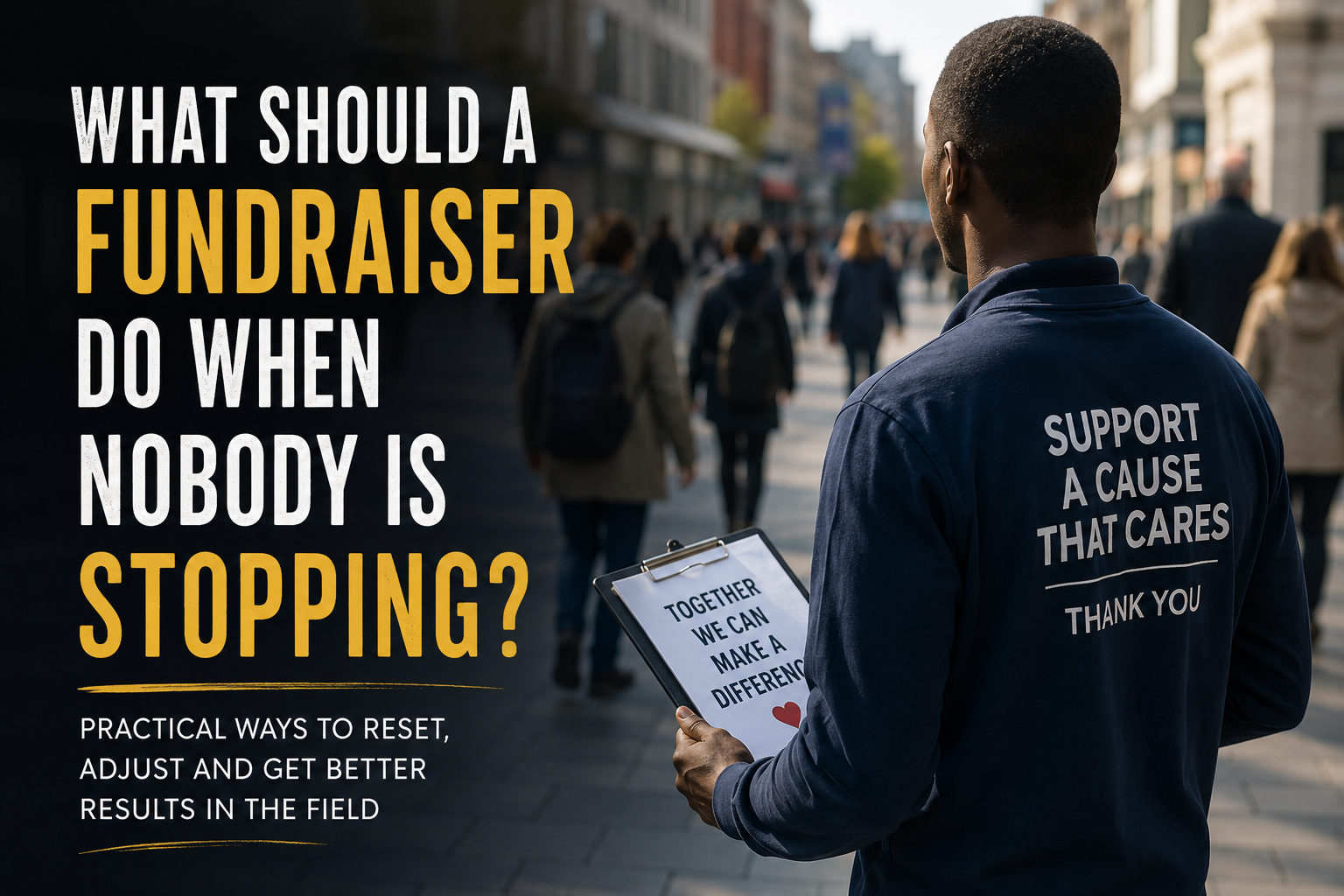
  • What Should a Fundraiser Do When Nobody Is Stopping?

    What Should a Fundraiser Do When Nobody Is Stopping?


    You have your uniform on, your materials are ready, and you know the cause you’re representing. You’ve prepared your pitch and you’re standing in the right place.

    But nobody is stopping.

    Five people walk past. Then ten. Twenty.

    Someone says they’re in a hurry. Another doesn’t even make eye contact. After a while, a familiar question begins to creep into your mind:

    “What am I doing wrong?”

    It’s one of the most frustrating experiences in face-to-face fundraising. But a slow period doesn’t automatically mean you’re a bad fundraiser.

    Sometimes the problem isn’t your ability. It may be the location, the timing, your body language, your opening—or simply the people you’re approaching.

    The important thing is not to panic.

    Stop. Observe. Adjust. Try again.

    Don’t Take Every “No” Personally

    Rejection is part of face-to-face fundraising. People are busy, distracted, rushing somewhere or simply not interested in having a conversation.

    Their response isn’t necessarily a judgement of you.

    The danger comes when you carry one rejection into the next approach. After several “nos”, your confidence can begin to change. Your voice becomes less energetic. Your body language becomes hesitant. You start expecting the next person to reject you before you’ve even spoken.

    Remind yourself:

    They said no to the conversation. They did not say no to my worth.

    Then approach the next person.

    Look at the Environment

    Before changing your entire pitch, look around you.

    Are people actually in a position to stop?

    If everyone is rushing to work, catching transport or focused on where they’re going, you may be fighting the environment rather than your own technique.

    A good fundraiser learns to read the crowd. Look for natural moments when people have time to pause and engage.

    If campaign rules allow it, speak to your team leader about your positioning. Sometimes a small change in where you stand can make a significant difference.

    Check Your Timing and Body Language

    Not every person is approachable at every moment.

    Someone carrying several bags, running towards transport or clearly distracted may not be the best person to engage. That doesn’t mean your pitch failed. The timing may simply have been wrong.

    Then look at yourself.

    Are you smiling? Do you look approachable? Are you standing confidently? Are you moving towards people too quickly? Does your body language communicate energy—or desperation?

    Fundraising begins before the first words are spoken.

    Keep Your Opening Simple

    When people aren’t stopping, the temptation is often to say more.

    More information. More statistics. More explanation.

    But your opening doesn’t need to tell the entire story.

    Its job is simply to create enough curiosity for someone to stop and listen.

    Keep it natural. Keep it conversational. Give the person a reason to hear more.

    Once they stop, that’s when you have the opportunity to explain the cause properly.

    Let Your Team Leader Coach You

    One of the most useful things you can do when you’re struggling is ask your team leader to observe you.

    Don’t just ask, “How am I doing?”

    Ask them to watch several approaches and give you specific feedback.

    Are you approaching at the right time? Is your opening too long? Are you speaking too quickly? What does your body language communicate?

    Sometimes we cannot see our own habits.

    That’s where good coaching becomes valuable. A team leader can see something from the outside that you may not notice yourself.

    Change One Thing at a Time

    When something isn’t working, don’t change everything at once.

    Test one adjustment.

    Change your opening. Observe what happens.

    If that doesn’t help, look at your positioning.

    Then consider your body language or timing.

    Use a simple process:

    Observe → Adjust → Test → Learn → Repeat.

    That’s how improvement happens.

    Don’t Chase the Numbers

    When the numbers are low, desperation can creep in. You start trying to stop everyone, and the pressure becomes visible.

    Remember that you’re inviting someone into a conversation. You’re not forcing them into one.

    Approach people with confidence and energy, but respect their decision.

    And if you’ve had twenty difficult approaches in a row, sometimes you need a reset.

    Take a short break if your campaign environment allows it. Drink some water. Take a breath. Speak to your team leader. Then return with a clearer mind.

    A reset isn’t giving up.

    It’s recognising that your state of mind affects your performance.

    The Fundraiser’s Five-Minute Field Check

    When things aren’t working, stop and ask yourself:

    1. Where am I?

    Is this a good place for people to stop and have a conversation?

    2. Who am I approaching?

    Are these people actually in a position to engage?

    3. How am I approaching?

    What does my body language communicate?

    4. What am I saying?

    Is my opening short, natural and interesting?

    5. What can I change?

    Choose one thing to test during your next few approaches.

    Don’t change everything.

    Change one thing, observe the result, and learn from it.

    Final Thoughts

    A bad fundraising period doesn’t automatically mean you’re a bad fundraiser.

    Sometimes, something simply needs to change.

    Maybe your positioning needs adjusting. Maybe your timing is wrong. Maybe your opening needs work. Or maybe you’ve had a difficult run of rejection and simply need to reset.

    The best fundraisers aren’t necessarily the people who never hear “no.”

    They’re the people who know what to do after hearing it.

    They observe. They adjust. They ask for feedback. They learn.

    And then they try again.

    So the next time you’re standing in a busy public space wondering why nobody is stopping, don’t immediately ask:

    “What’s wrong with me?”

    Ask:

    “What is this moment teaching me?”

    Because sometimes the difference between a frustrating fundraising day and a productive one isn’t a completely new strategy.

    It’s simply the willingness to stop, adjust and try again.


    Beyond the Pitch

    Face-to-face fundraising is about more than asking for donations.

    It’s about communication, resilience, leadership and the human moments that happen between a fundraiser and a stranger.

    Through Beyond the Pitch, I share practical lessons and honest reflections from the fundraising field—looking beyond the numbers to the people who make fundraising possible.


    Continue the Conversation

    Have you ever had a day when nobody seemed to want to stop?

    What did you change—and did it work?

    Share your experience in the comments.

    If you enjoy practical insights about face-to-face fundraising, leadership and team development, follow Reflections in Motion for more articles from Beyond the Pitch.

    📘 Want to go deeper?

    My book, Beyond the Pitch: The Human Art of Face-to-Face Fundraising, explores the communication, psychology and human connection behind successful fundraising.

    Explore my books on Amazon:
    Kgalalelo Ntumelang – Amazon Author Page

    Work With Me

    If your organisation or fundraising team needs support with fundraising communication, team development, coaching or practical fundraising insights, I’d love to hear from you.

    Email: lelon@reflectionsinmotion.blog

    Website: Reflections in Motion

  • The Fundraiser Needs Support Too: Why Team Leaders Matter in Face-to-Face Fundraising

    The Fundraiser Needs Support Too: Why Team Leaders Matter in Face-to-Face Fundraising


    A fundraiser can have a great script.

    They can understand the cause.

    They can be confident, energetic, and passionate.

    But sometimes, that isn’t enough.

    Because face-to-face fundraising is not easy.

    Every day, fundraisers approach strangers.

    They hear “no.”

    They are ignored.

    They have difficult conversations.

    They deal with pressure to perform.

    And then they are expected to do it all again the next day.

    We often talk about what fundraisers need to do better.

    Improve their pitch.

    Increase their approaches.

    Build confidence.

    Hit their targets.

    But perhaps we should ask another question:

    What support does the fundraiser receive while trying to do all of this?

    This is where the team leader becomes incredibly important.

    A Team Leader Is More Than a Supervisor

    A team leader is sometimes viewed simply as the person responsible for checking numbers and reporting performance.

    But effective team leadership goes far beyond monitoring targets.

    A good team leader is a coach.

    A mentor.

    A problem-solver.

    A motivator.

    A listener.

    And sometimes, the person who helps a fundraiser believe in themselves again after a difficult day.

    The frontline fundraiser experiences the rejection.

    The team leader has an opportunity to help them process it, learn from it, and return the next day stronger.

    Fundraising Can Be Emotionally Exhausting

    Imagine approaching dozens of people every day.

    Some walk past without acknowledging you.

    Others tell you they are not interested.

    Some may be impatient or even rude.

    Eventually, that rejection can affect confidence.

    A fundraiser may start wondering:

    “Am I doing something wrong?”

    “Maybe I’m not good at this.”

    “Why is everyone saying no?”

    This is where leadership matters.

    A good team leader can help the fundraiser understand that rejection is not necessarily a reflection of their ability.

    Sometimes people are simply not interested.

    Sometimes they are in a hurry.

    Sometimes they have financial commitments.

    Sometimes the timing is wrong.

    The fundraiser needs someone who can help them separate the outcome from their self-worth.

    Coaching Is Different From Criticism

    There is a significant difference between telling someone they are underperforming and helping them understand how to improve.

    “Your numbers are low” is information.

    “What do you think is making it difficult to get people to stop?” is coaching.

    A strong team leader observes performance, asks questions, listens, and provides practical guidance.

    They might identify that a fundraiser is approaching too aggressively.

    Or perhaps they are speaking too quickly.

    Maybe their opening is too long.

    Maybe their body language communicates nervousness.

    These are things that can be coached.

    The goal is not to make the fundraiser feel inadequate.

    The goal is to help them become better.

    Every Fundraiser Needs Different Support

    One of the challenges of leadership is recognising that people are different.

    One fundraiser may need encouragement.

    Another may need more structure.

    Someone else may need help with communication.

    Another person may simply need someone to listen.

    Treating everyone exactly the same does not necessarily mean treating everyone fairly.

    Effective leaders learn their people.

    They understand their strengths.

    They identify their challenges.

    And they adapt their coaching accordingly.

    Recognition Matters

    Fundraisers don’t only need to hear when they are doing something wrong.

    They also need to know when they are doing something right.

    Perhaps someone who struggled with approaching people finally became more confident.

    Perhaps a fundraiser handled a difficult donor professionally.

    Perhaps someone helped a colleague.

    Perhaps their numbers improved significantly from the previous week.

    These moments matter.

    Recognition reinforces positive behaviour.

    It reminds people that their progress is visible.

    And sometimes a simple:

    “I can see your improvement.”

    can mean more than a motivational speech.

    Team Leaders Need Support Too

    There is another side to this conversation.

    We cannot expect team leaders to continuously support their fundraisers if the leaders themselves are unsupported.

    Team leaders also experience pressure.

    They are responsible for team performance.

    They have reporting responsibilities.

    They deal with conflict.

    They manage underperformance.

    They motivate people who may be discouraged.

    And they are often caught between organisational expectations and the realities of the field.

    If we want team leaders to support their people effectively, organisations must also support their leaders.

    That means providing appropriate training, clear expectations, regular feedback, realistic resources, and opportunities for professional development.

    Leadership should not mean carrying everything alone.

    The Relationship Between Support and Performance

    It is easy to look at fundraising performance and ask:

    “How many donations did this person generate?”

    But perhaps we should also ask:

    “What environment are we creating for this person to succeed?”

    Performance is influenced by many factors.

    Training.

    Leadership.

    Morale.

    Communication.

    Resources.

    Confidence.

    Team culture.

    And personal motivation.

    A fundraiser who feels supported is more likely to ask questions, seek feedback, learn from mistakes, and continue trying after rejection.

    That doesn’t mean support removes accountability.

    It means accountability happens within an environment designed to help people succeed.

    Strong Leaders Don’t Do the Work for Their Teams

    Supporting a fundraiser does not mean lowering standards.

    It does not mean making excuses for poor performance.

    And it certainly does not mean doing the fundraiser’s job for them.

    Good leadership creates the conditions for people to take responsibility for their own performance.

    The leader provides direction.

    The fundraiser applies it.

    The leader provides feedback.

    The fundraiser makes the adjustment.

    The leader creates opportunities.

    The fundraiser takes them.

    That is how development happens.

    Build People, Not Just Numbers

    Fundraising organisations need numbers.

    Donations matter.

    Targets matter.

    Campaign performance matters.

    But behind every number is a person.

    And if organisations want consistent performance over time, they must invest in those people.

    A fundraiser who develops confidence today may become a team leader tomorrow.

    A team leader who receives proper development may become a campaign manager in the future.

    This is how a profession grows.

    Not simply by recruiting more people.

    But by developing the people already inside it.

    Final Thoughts

    Face-to-face fundraising is often described as a numbers-driven profession.

    But it is also a people-driven profession.

    People approach donors.

    People build trust.

    People experience rejection.

    People motivate teams.

    And people need support.

    The fundraiser needs more than a script and a target.

    They need training.

    They need feedback.

    They need encouragement.

    They need leadership.

    And sometimes, they simply need someone to remind them that one difficult day does not define their ability.

    That is why team leaders matter.

    A strong team leader doesn’t just ask:

    “Did you hit your target?”

    They also ask:

    “What do you need to succeed?”

    Because when fundraisers are supported, they are better positioned to support the causes they represent.

    And when organisations invest in the people on the frontline—and the leaders supporting them—they don’t just build better fundraising campaigns.

    They build stronger professionals.

    They build stronger teams.

    And ultimately, they build a stronger fundraising sector.


    Beyond the Pitch

    Face-to-face fundraising is about far more than asking for donations.

    It is about people, communication, resilience, leadership, relationships, and the human stories behind every conversation.

    Through Beyond the Pitch, I share honest reflections from the fundraising field—lessons about leadership, coaching, performance, teamwork, and the human side of inspiring generosity.

    Continue the Conversation

    If this reflection resonated with you, I’d love to hear your perspective.

    What kind of support has made the biggest difference to you as a fundraiser?

    And if you are a team leader:

    What do you believe fundraisers need most from their leaders?

    Join the conversation in the comments and share your experience.

    Want to Go Further?

    If you’re interested in the human side of face-to-face fundraising, my book Beyond the Pitch: The Art of Face-to-Face Fundraising explores the realities of fundraising, donor conversations, resilience, communication, and the skills needed to succeed in the field.

    📘 Explore my books on Amazon:
    Kgalalelo Ntumelang on Amazon

    Work With Me

    If your organisation or fundraising team needs support with fundraising communications, team development, leadership, training, or improving how fundraisers connect with people, I’d love to hear from you.

    Let’s talk about how I can support your team.

    📩 Email: lelon@reflectionsinmotion.blog

    🌐 Visit Reflections in Motion:
    Reflections in Motion


    LELO

  • People Don’t Leave Fundraising—They Leave When They Stop Seeing a Future

    People Don’t Leave Fundraising—They Leave When They Stop Seeing a Future


    Every year, passionate fundraisers walk away from the profession.

    Some move into sales.

    Some join the corporate world.

    Others leave the nonprofit sector altogether.

    It’s easy to assume they were no longer passionate about fundraising.

    Or that they simply wanted a change.

    Sometimes that’s true.

    But often, there is another reason.

    They stopped seeing a future.

    Not because they stopped believing in the cause.

    But because they could no longer see how they could grow within it.

    This is one of the biggest challenges facing face-to-face fundraising today.

    If organisations want to retain talented people, they must offer more than a job.

    They must offer a career.

    Passion Starts the Journey

    Most people do not enter face-to-face fundraising because they expect it to be easy.

    They know they will face rejection.

    They know they will work outdoors.

    They know they will be expected to engage strangers and represent important causes with professionalism.

    They choose the profession because they believe they can make a difference.

    That passion is powerful.

    It gives people the courage to approach the first donor.

    It helps them recover after difficult days.

    It reminds them why the work matters.

    But passion alone is rarely enough to sustain a career.

    People also need hope.

    Hope that tomorrow offers new opportunities.

    Hope that their efforts will be recognised.

    Hope that they can continue to grow.

    A Career Should Have Direction

    Imagine joining an organisation and asking yourself:

    “Where could I be in five years?”

    If the answer is unclear, motivation can begin to fade.

    People are naturally inspired when they can see progress.

    In fundraising, that progress might include opportunities to become:

    • A senior fundraiser.
    • A mentor for new recruits.
    • A team leader.
    • A campaign manager.
    • A regional leader.
    • A specialist in training, quality assurance, or donor engagement.

    Not every organisation will have every role.

    But every organisation can communicate a vision for growth.

    People stay longer when they can see where they are going.

    Growth Is More Than a Promotion

    Career development is not only about moving into management.

    Some people want to become exceptional fundraisers.

    Others want to specialise in coaching, training, or donor experience.

    Growth can include:

    • Leadership training.
    • Communication workshops.
    • Public speaking opportunities.
    • Mentoring relationships.
    • Project leadership.
    • Cross-functional experience.

    When organisations invest in learning, they send a powerful message:

    “We believe in your future.”

    That message builds loyalty.

    Recognition Fuels Commitment

    One of the quickest ways to lose talented people is to make them feel invisible.

    Recognition should not be reserved only for the highest fundraising totals.

    Celebrate the fundraiser who mentors a colleague.

    Recognise the team leader who improves morale.

    Acknowledge the person who consistently represents the organisation with professionalism and integrity.

    When people know their contribution matters, they become more connected to the organisation’s mission.

    Recognition reminds people that they are valued not only for what they achieve, but also for how they achieve it.

    Leadership Shapes the Future

    Managers play an important role in whether people stay or leave.

    A supportive leader helps employees see possibilities.

    They provide feedback.

    They encourage learning.

    They identify strengths.

    They create opportunities for people to take on new challenges.

    Most importantly, they have conversations about the future.

    Sometimes a simple question can change someone’s perspective:

    “Where do you see yourself growing?”

    That conversation communicates that the organisation cares about more than this month’s targets.

    It cares about the person’s long-term success.

    Retention Is an Investment

    Recruiting and training new fundraisers takes time, money, and energy.

    Retaining experienced people often delivers greater value.

    Experienced fundraisers understand donor engagement.

    They know the organisation’s culture.

    They mentor new colleagues.

    They help maintain consistency and stability.

    When talented people leave because they cannot see a future, organisations lose more than an employee.

    They lose experience, relationships, and leadership potential.

    Build Careers, Not Just Campaigns

    Campaigns have beginning and end dates.

    Careers have journeys.

    Organisations that focus only on campaign results may achieve short-term success.

    Those that invest in people build long-term success.

    When fundraisers can imagine a future within the organisation, they are more likely to remain committed during difficult seasons.

    They become ambassadors for the profession.

    They inspire others to grow.

    And they contribute to a culture where people believe they can build meaningful careers.

    Final Thoughts

    Face-to-face fundraising changes lives.

    It connects generous people with causes that strengthen communities and create hope.

    The profession deserves passionate, skilled, and committed people.

    Those people deserve opportunities to grow.

    When organisations invest in career development, mentorship, leadership, and recognition, they send a clear message:

    “We don’t just value what you do today. We believe in who you can become tomorrow.”

    People don’t always leave fundraising because they stop believing in the mission.

    Sometimes they leave because they stop believing there is a place for them in its future.

    If we want to build a stronger fundraising profession, we must build organisations where people can see a future worth staying for.


    Beyond the Pitch

    Face-to-face fundraising is about far more than asking for donations.

    It’s about leadership, resilience, relationships, career growth, and the people who dedicate themselves to creating meaningful change.

    Through Beyond the Pitch, I share honest reflections from the field—exploring leadership, fundraising, teamwork, and the human side of inspiring generosity.


    Continue the Conversation

    If this reflection resonated with you, I’d love to invite you to continue the conversation.

    My eBook, Beyond the Pitch: The Human Art of Face-to-Face Fundraising, explores the people behind the targets and the lessons that shape successful fundraising teams. It offers practical insights on leadership, resilience, communication, motivation, and building a sustainable career in face-to-face fundraising.

    📘 Explore my books on Amazon:
    https://www.amazon.com/author/kgalalelontumelang

    If you enjoy thoughtful conversations about fundraising leadership, team culture, and professional growth, consider subscribing to Reflections in Motion so you never miss a new article.

    Work With Me

    If you’re a nonprofit organisation, fundraising agency, or face-to-face fundraising leader looking to strengthen your team, I’d love to work with you.

    I offer:

    • Face-to-face fundraising leadership coaching
    • Team leader mentoring and development
    • Team motivation and performance workshops
    • Communication and leadership training
    • Speaking engagements on fundraising, leadership, and team culture

    📧 Email: lelon@reflectionsinmotion.blog

    🌐 Website: https://reflectionsinmotion.blog

    📚 Explore my books on Amazon:
    https://www.amazon.com/author/kgalalelontumelang

    Whether you’re looking to develop stronger leaders, improve team culture, or inspire your fundraising team, I’d love to hear from you.

    💬 I’d love to hear your thoughts in the comments:

    What do you think is the biggest reason talented fundraisers leave the profession? What can organisations do differently to help people see a future in fundraising?

    LELO