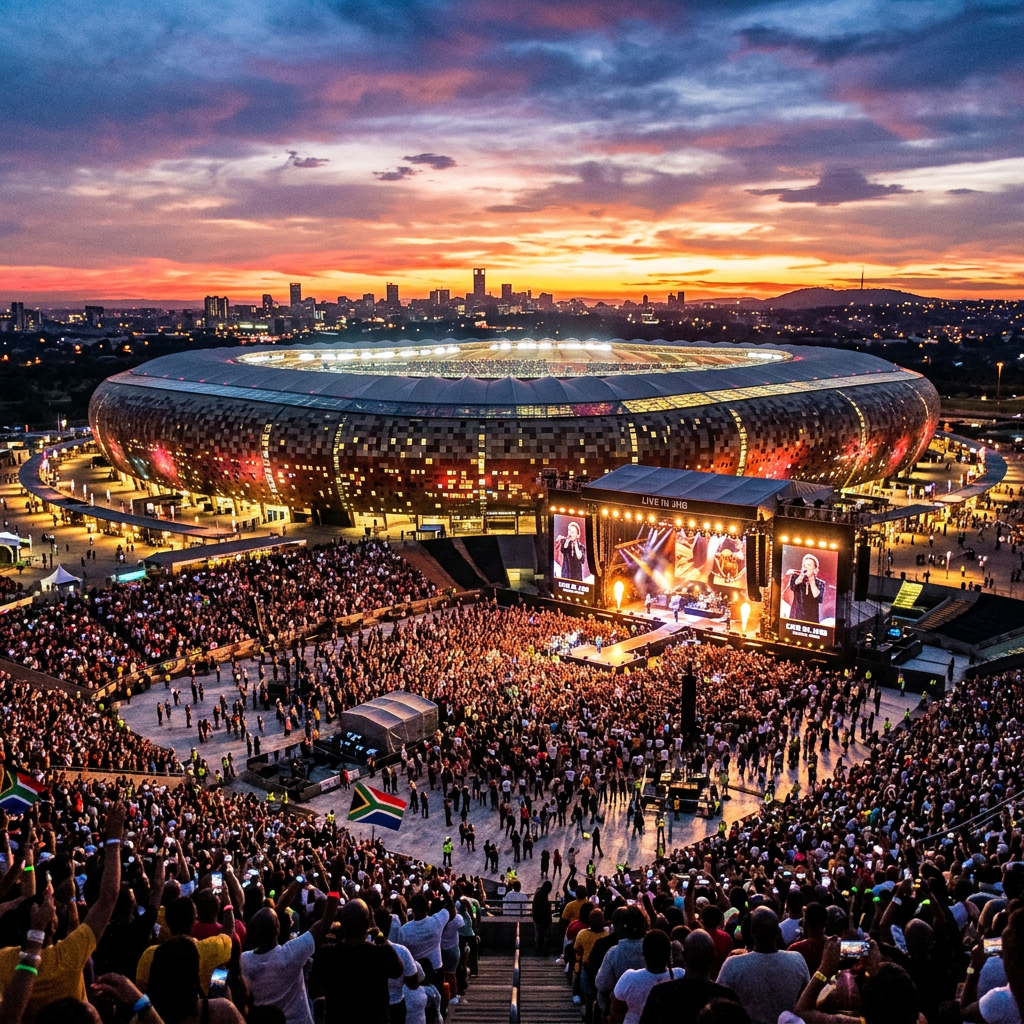
Every year, global touring circuits follow the same geography: North America, Europe, parts of Asia, and, increasingly, Latin America. The routing is familiar, predictable—and, from a risk perspective, safe. But in prioritising certainty, the live entertainment industry may be overlooking one of its most commercially viable growth opportunities: Africa’s stadium-scale market, with South Africa as its most immediate entry point.
For acts operating at the level of BTS, managed by HYBE Corporation and promoted globally through partners such as Live Nation, touring is no longer just about visibility—it’s about maximising revenue across established and emerging markets. The question is no longer whether demand exists in Africa. The question is whether the industry has underestimated how monetisable that demand has become.
South Africa, in particular, presents a compelling case. It combines developed event infrastructure, proven capacity to host global artists, and a concentrated consumer base capable of supporting premium ticket pricing. Venues such as FNB Stadium are not theoretical options—they are operational assets with a history of large-scale international events. The gap, then, is not infrastructure. It is strategic attention.
Beyond infrastructure, the most persistent misconception about Africa as a touring destination is that demand is uncertain. In reality, the data signals—while often fragmented—tell a different story. Global streaming platforms consistently show strong engagement with international acts across African markets, with South Africa leading in both consumption and digital participation. For a group like BTS, whose audience is digitally native and highly engaged, this matters. Touring demand no longer begins at the box office; it begins in streaming behaviour, online communities, and visible repeat engagement patterns.
The commercial question, then, is not whether an audience exists—but how that audience converts. Stadium tours at this level, under HYBE Corporation and Big Hit Music, are built on layered revenue models: ticket sales, VIP experiences, merchandise, and brand partnerships. In a market like South Africa, where there is a demonstrated appetite for premium live experiences, even a conservative conversion rate of an engaged fan base can translate into significant revenue. When aligned with the right pricing strategy—balancing accessibility with high-value tiers—the result is not a compromised market, but a diversified one.
There is also a tendency to evaluate African markets in isolation, rather than as regional anchors. South Africa’s advantage lies not only in its domestic audience but in its position as a travel hub. A major event in Johannesburg has the potential to draw audiences from across Southern Africa and beyond, effectively expanding the catchment area without requiring additional tour stops. This regional pull strengthens the overall business case, particularly for acts capable of commanding multi-night performances.
Risk, of course, remains part of the equation. Long-haul logistics, currency fluctuations, and operational costs are all valid considerations. However, these are not unique barriers—they are variables that the live entertainment industry navigates routinely in other emerging markets. The difference lies in perception. Where markets in Latin America and parts of Asia have benefited from sustained touring investment, Africa has yet to receive the same level of strategic commitment. As a result, the risk is often overstated, while the opportunity remains underexplored.
For global promoters such as Live Nation and established local players like Big Concerts, this presents a familiar scenario: a market that appears uncertain on the surface, but reveals strong fundamentals upon closer examination. The decision, ultimately, is not about whether Africa can support a stadium tour. It is whether the industry is prepared to test a market that, by several indicators, is already primed for it.
The opportunity in Africa is not speculative—it is structural. The fundamentals that typically justify tour expansion—audience engagement, infrastructure, and revenue potential—are already present in markets like South Africa. What has been missing is not capability, but prioritisation.
For global acts operating at stadium scale, expansion into new territories is rarely about proving demand from the ground up. It is about recognising when existing signals are strong enough to justify a calculated entry. In this context, Africa does not represent an unknown—it represents a delayed decision.
The implication for artists such as BTS and the promoters who support them is straightforward. Entering the African market is not simply an additional tour stop; it is a strategic move into a region where early engagement can establish long-term dominance. As touring continues to globalise, the next phase of growth will not come from repeating established circuits, but from extending them.
The question, then, is no longer whether Africa can support a stadium tour. It is which artist or promoter will be the first to treat it as a serious market—and in doing so, define its commercial potential for the rest of the industry.
📣 CTA
If you’d like to see more insights on the business of media, entertainment, and audience engagement, subscribe to the blog and join the conversation in the comments:
Is Africa the next major touring frontier—or will it continue to be overlooked?
LELO
Leave a Reply