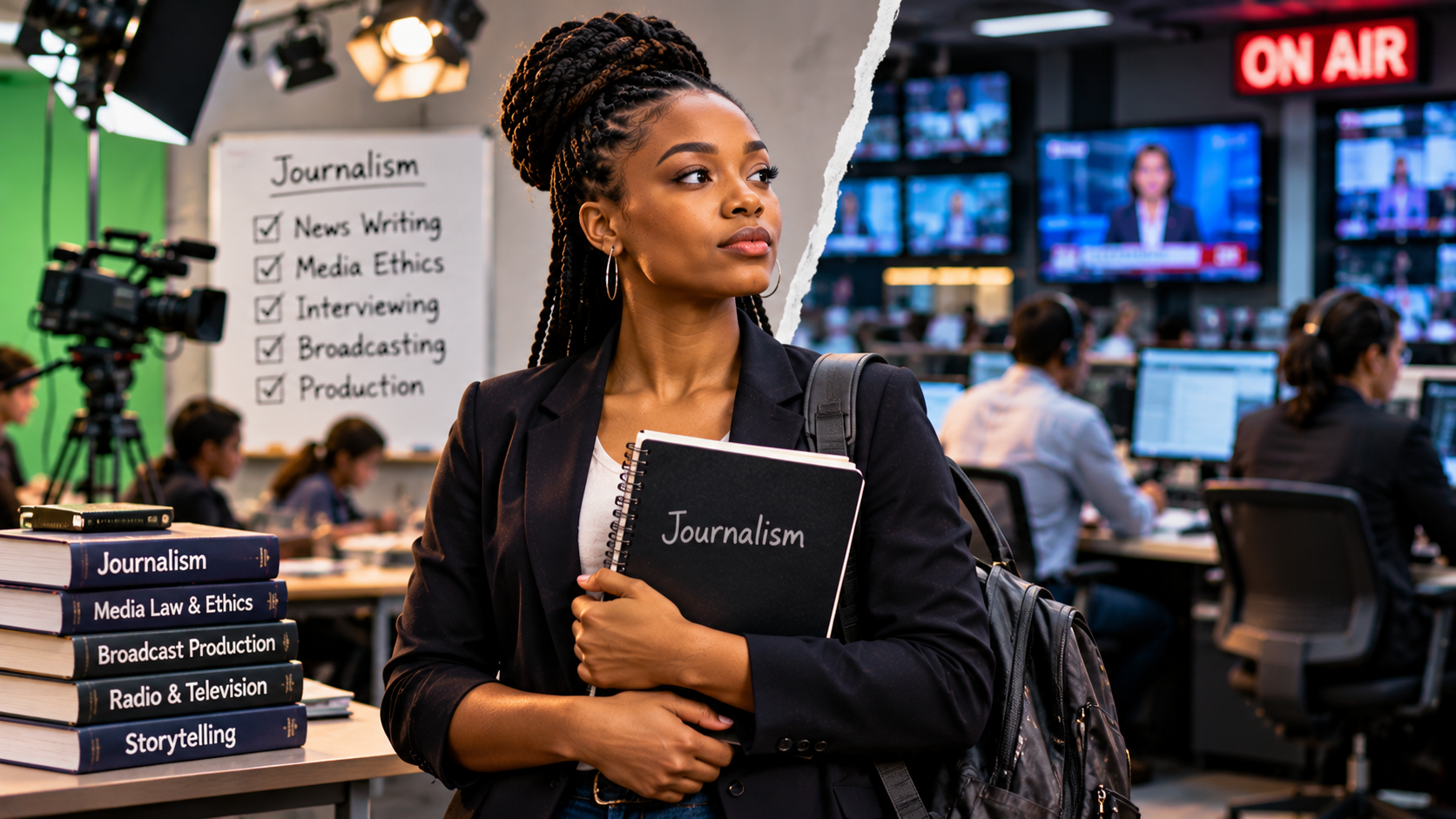
From classroom theory to live broadcasting, are journalism institutions preparing students for the realities of radio and television?
A journalism graduate walks into a radio studio for the first time.
They have studied news values, media ethics, interviewing techniques and the principles of journalism. They understand what makes a story newsworthy and why accuracy matters.
But now the microphone is live.
The bulletin is approaching, the producer is counting down, and suddenly the graduate must communicate clearly, confidently and accurately while managing the pressure of a working broadcast.
Elsewhere, another graduate is preparing for a television news presentation. There are cameras, studio lights, an autocue and instructions coming through an earpiece. The script is ready, but delivering it naturally while looking into a camera is proving more difficult than expected.
Both graduates may understand journalism. But are they prepared for the practical demands of broadcasting?
And perhaps the more important question is whether we have given them enough opportunities to become prepared.
When Theory Meets the Studio
Journalism education provides an important foundation for understanding the profession.
Students learn about ethics, research, news writing, interviewing, verification and the responsibilities that come with informing the public. These are essential skills.
But broadcasting also requires the ability to apply that knowledge in environments where decisions must sometimes be made within seconds.
In radio, a presenter or reporter must communicate through voice, timing and sound. They must listen carefully, respond naturally and remain composed when an interview takes an unexpected turn.
Television introduces another dimension. A reporter may need to deliver information while standing in front of a camera, manage visual presentation, respond to production cues and maintain concentration despite the activity happening around them.
And behind both radio and television broadcasts are producers, researchers, editors and technical teams making decisions under equally demanding conditions.
These are skills that develop through practice.
A student can understand the principles of broadcasting without yet having the confidence to perform under professional pressure.
That does not necessarily mean their education has failed. It may mean the transition between learning and doing requires greater attention.
The First Broadcast Should Not Be the First Real Test
Imagine learning about live reporting without having opportunities to practise delivering a report under realistic conditions.
Or studying television production without experiencing the pressure of coordinating a programme as it approaches transmission.
The challenge is not simply whether students have access to microphones, cameras or editing software. It is whether they have meaningful opportunities to use those tools in situations that resemble the realities of professional broadcasting.
Can they respond when a planned interview falls through? Can they adjust when breaking news changes the running order? Can they recognise when information has not been sufficiently verified, even when a deadline is approaching?
And can they recover professionally when something goes wrong during a recording or live production?
These are not questions that can always be answered through written assessments alone.
Practical exercises, student productions, simulations and workplace exposure can help bridge the distance between academic understanding and professional performance.
But practical preparation should not be reduced to confidence in front of a microphone or camera.
Not every journalism graduate will become a presenter. Some will become exceptional reporters, producers, researchers, editors or investigative journalists whose work is rarely seen by the audience.
Workplace readiness must recognise those roles too.
Whose Responsibility Is Workplace Readiness?
It would be unfair to place the entire responsibility on educational institutions.
Many journalism programmes already incorporate practical assignments, production facilities and workplace learning opportunities.
At the same time, broadcasting organisations have a role to play in developing the professionals they hope to employ.
A graduate entering a newsroom should arrive with foundational knowledge and an understanding of professional expectations. But employers must also recognise that an entry-level journalist is still developing.
There is a difference between being prepared to enter the profession and having the experience to perform every responsibility independently.
Internships, mentorship and meaningful workplace exposure can help graduates make that transition.
Experienced journalists and producers often become an important part of this learning process, helping newcomers understand newsroom routines, editorial decisions and the pressures that cannot always be recreated in a classroom.
Their contribution deserves recognition, just as graduates deserve structured opportunities to learn.
Perhaps stronger relationships between journalism educators and broadcasting organisations could help ensure that students understand not only what the profession requires, but what working within it actually feels like.
The classroom and the newsroom should not be treated as entirely separate worlds.
They are part of the same professional journey.
Preparing Journalists for the Reality of Broadcasting
The broadcasting industry continues to change.
Radio and television journalists are increasingly expected to understand digital platforms, multimedia storytelling and the different ways audiences consume information.
But even as technology evolves, the fundamental demands of journalism remain.
Accuracy matters. Editorial judgement matters. Preparation matters. And the ability to communicate responsibly under pressure matters.
A qualification may demonstrate that someone has acquired the knowledge required to enter the profession.
Practical experience helps them develop the confidence and judgement to apply that knowledge.
Neither should be dismissed.
Perhaps the question is not whether journalism graduates are good enough for the workplace.
It is whether the journey from education to employment gives them a fair opportunity to develop the skills the workplace will demand.
Because the first time a journalism graduate experiences the pressure of a live microphone or television camera should not have to be the first day their professional reputation is on the line.
Continue the Conversation
Are journalism graduates receiving enough practical preparation for the realities of radio and television broadcasting?
And what more could educational institutions and broadcasting organisations do to make the transition into professional newsrooms easier?
Share your thoughts in the comments.
So You Want to Be a News Producer?
Behind every successful news bulletin is a process that requires preparation, editorial judgement and production skills.
So You Want to Be a News Producer? explores the work, responsibilities and professional thinking involved in news production.
Explore the book and other broadcasting resources:
Reflections In Motion Shop:
https://reflectionsinmotion.blog/shop/
Amazon Author Page — Lelo:
https://www.amazon.com/author/lelo
Work With Me
I offer broadcasting, podcasting, content development, and language-editing services through Rebieth Productions and Entertainment.
Email: lelon@reflectionsinmotion.blog
Website: https://reflectionsinmotion.blog
Reflections In Motion — Ideas • Insight • Impact