Tag: personal development

  • The Loneliness Behind the Microphone

    The Loneliness Behind the Microphone

    A Personal Reflection

    After almost a decade in broadcasting, I’ve come to realise that one of the greatest misconceptions about the profession is that constant communication automatically creates connection.

    People hear your voice every day. They recognise your name. They may even feel like they know you personally.

    Yet behind every familiar voice is a human being navigating the same emotions, uncertainties, and challenges as everyone else.

    Some of the most important lessons I learned in broadcasting had very little to do with speaking into a microphone. They were about understanding people, building meaningful relationships, and recognising that genuine connection begins long before the “On Air” light comes on.

    This reflection is for every broadcaster who has ever felt that while the world heard their voice, very few people truly knew the person behind it.


    From the outside, broadcasting looks like one of the most connected professions in the world.

    Every day, broadcasters speak to hundreds or even thousands of people.

    They interview guests.

    They engage with callers.

    They laugh with co-hosts.

    They become familiar voices in homes, cars, and workplaces.

    It seems impossible that someone surrounded by so much interaction could ever feel lonely.

    Yet for many broadcasters, loneliness is one of the least talked-about realities of the profession.

    Not because they lack people around them.

    But because genuine connection is very different from constant communication.

    Being heard by thousands isn’t the same as being deeply known by a few.


    Always Talking, But Not Always Being Heard

    Broadcasting is built on communication.

    Every day, broadcasters share stories, ask questions, deliver information, and create conversations for their audiences.

    Ironically, many spend so much time communicating professionally that they have very few opportunities to simply be themselves.

    The microphone amplifies their voice.

    It doesn’t always create space for their own.

    Behind every polished broadcast is a person with fears, hopes, frustrations, and dreams—just like everyone else.

    Sometimes those parts remain unheard.


    When Recognition Doesn’t Equal Connection

    One of the unique experiences of broadcasting is being recognised by people you’ve never met.

    Someone might stop you at the supermarket and say they enjoy your show.

    A listener may tell you they feel like they’ve known you for years.

    Those moments are encouraging.

    They remind you that your work matters.

    But recognition is not the same as relationship.

    Many broadcasters are widely known without feeling deeply known.

    People recognise the voice.

    Few know the person behind it.


    The Pressure to Always Be “On”

    Broadcasters often become known for their energy, confidence, and composure.

    Listeners tune in expecting a familiar voice.

    A positive attitude.

    A calm presence.

    Even after the programme ends, that expectation can continue.

    At industry events, public appearances, or even everyday encounters, there can be an unspoken pressure to remain “on.”

    To be approachable.

    To be engaging.

    To always have something interesting to say.

    While professionalism is important, constantly performing can become emotionally exhausting.

    Everyone needs spaces where they can simply exist without feeling the need to entertain or inspire.


    Success Doesn’t Eliminate Loneliness

    It’s easy to assume that successful broadcasters have everything they need.

    Recognition.

    Respect.

    A loyal audience.

    But professional success and personal fulfilment are not the same thing.

    You can host a popular programme and still long for deeper conversations.

    You can interview remarkable people every day and still struggle to find someone who truly understands your own experiences.

    Loneliness does not disappear simply because your career is going well.


    The Changing Nature of Broadcasting

    Today’s broadcasting industry looks very different from what it did a decade ago.

    Many professionals work on short-term contracts.

    Some freelance across multiple organisations.

    Others balance broadcasting with content creation, voice-over work, or consulting.

    While these changes create exciting opportunities, they can also reduce the sense of belonging that once came from working in a close-knit team.

    As careers become more flexible, building intentional relationships becomes even more important.


    Building Community Beyond the Studio

    Perhaps one of the most valuable investments a broadcaster can make is not another piece of equipment or another professional qualification.

    It’s community.

    That might mean:

    • Staying connected with former colleagues.
    • Finding mentors who understand the industry.
    • Supporting younger broadcasters.
    • Joining professional networks.
    • Making time for friendships that have nothing to do with broadcasting.

    Careers are important.

    But they should never become our only source of connection.


    The Strength in Saying, “I’m Not Okay”

    For many broadcasters, vulnerability feels uncomfortable.

    After all, the profession often rewards confidence and composure.

    But there is strength in acknowledging that even the voices people admire sometimes need encouragement too.

    Looking after your wellbeing is not a sign of weakness.

    It’s part of building a sustainable career.

    The strongest broadcasters are not those who never struggle.

    They are the ones who recognise when they need support and dare to seek it.


    A Different Way to Think

    Perhaps the greatest gift broadcasting gives us is the ability to connect with people.

    The challenge is remembering to nurture those same connections in our own lives.

    Because while audiences may know our voices, the people closest to us should know our hearts.


    A Quiet Reminder

    The microphone amplifies your voice. It should never silence your need for genuine human connection.


    A Quiet Reflection

    Every broadcaster has a story beyond the microphone.

    This series is my invitation to reflect on the profession we love—the lessons it teaches us, the challenges it presents, and the opportunities it creates.

    Because building a meaningful career isn’t just about finding your voice.

    It’s about discovering who you are when the microphone is switched off.


    Continue the Conversation

    If this reflection resonated with you, it may be because you’ve discovered that broadcasting is about far more than what happens behind the microphone.

    It’s about people.

    It’s about purpose.

    And it’s about building a career that allows you to grow professionally without losing yourself personally.

    The conversations we have with our audiences are important—but so are the conversations we have with ourselves, our colleagues, and the people who truly know us.

    📘 Continue the Journey

    If you’re a broadcaster who wants to build a career that extends beyond traditional media, my book, From Broadcaster to Brand, explores how to transform your broadcasting experience into a personal brand, create new opportunities, and build a future you truly own.

    Whether you’re thinking about podcasting, content creation, entrepreneurship, or developing multiple income streams, this book will help you take the next step with confidence.

    📘 Get your copy on Amazon:

    👉🏽 https://www.amazon.com/author/kgalalelontumelang

    🤝 Work With Me

    I work with broadcasters, media professionals, and aspiring communicators who want to grow their careers and create opportunities beyond traditional broadcasting.

    My services include:

    • 🎙️ Podcast Coaching
    • 📻 Broadcasting & Personal Brand Coaching
    • 🎤 Voice-Over Services
    • ✍🏽 Language Editing & Proofreading
    • 🎓 Media Training & Communication Coaching

    Whether you’re launching your first podcast, building your personal brand, or preparing for your next career move, I’d love to help you unlock new opportunities. lelon@reflectionsinmotion.blog

    📩 Subscribe to Reflections in Motion

    If you enjoy thoughtful conversations about broadcasting, personal branding, career growth, leadership, and communication, consider subscribing to Reflections in Motion.

    New articles are published regularly to encourage broadcasters and media professionals to build meaningful careers, embrace change, and create opportunities that last far beyond the microphone.

    💬 I’d Love to Hear From You

    Have you ever experienced loneliness in a profession that seems so connected from the outside?

    What helped you build meaningful relationships again?

    Share your thoughts in the comments below. Your story may encourage someone else who needs to know they aren’t alone.

    LELO

  • Why Fundraisers Understand Money Better Than Most Professionals

    Why Fundraisers Understand Money Better Than Most Professionals

    When people hear the word “fundraising,” they often think of donations, causes, and charity work.

    What they don’t realise is this:
    fundraising teaches you more about money than most traditional jobs ever will.

    Not because you’re handling large amounts of money —
    but because you’re constantly learning how money moves.


    1. Money Follows Emotion, Not Logic

    One of the first lessons in fundraising is that people don’t give because something makes sense.

    They give because something makes them feel.

    You can present facts, statistics, and logical arguments —
    but without emotional connection, nothing happens.

    This applies everywhere:

    • Customers don’t buy based on logic alone
    • Employers don’t hire based on qualifications alone
    • Opportunities don’t come from facts alone

    Money follows emotion.


    2. Value Must Be Communicated Clearly

    In fundraising, you have seconds to explain:

    • what the cause is
    • why it matters
    • why someone should care

    If your message is unclear, you lose the opportunity.

    The same applies to your career and income:
    If people don’t understand your value quickly, they move on.


    3. Rejection Teaches You Resilience Around Money

    Most professionals avoid rejection.

    Fundraisers experience it daily.

    This builds something powerful:

    • emotional resilience
    • confidence
    • persistence

    And these are directly linked to earning potential.

    Because making money requires:

    • putting yourself out there
    • hearing “no”
    • continuing anyway

    4. Money Is About Trust

    People don’t just give money.
    They give trust.

    In fundraising, if people don’t trust you, they won’t contribute — no matter how good the cause is.

    The same applies to:

    • clients
    • employers
    • audiences

    Trust is what unlocks money.


    5. You Learn That Money Is Everywhere

    Fundraising shifts your mindset.

    You stop thinking:

    “There is no money”

    And start seeing:

    “Money exists — I just need to communicate value better”

    This is one of the most powerful mental shifts anyone can have.


    The Hidden Advantage

    Many professionals underestimate fundraising experience.

    But the truth is:
    it teaches real-world skills that directly influence income:

    • persuasion
    • communication
    • confidence
    • positioning

    Final Thoughts

    Fundraisers don’t just understand causes.

    They understand people.
    They understand value.
    And ultimately, they understand money.

    The question is:
    Are you using those lessons beyond fundraising?


    Want to Go Further?

    If you’re interested in using communication and real-world experience to create income, I share more practical strategies in my eBooks.

    📘 Explore here: [https://www.amazon.com/author/kgalalelontumelang]


    Work With Me

    I help professionals turn their communication skills into income through storytelling, branding, and positioning.

    📧 Contact: [lelon@reflectionsinmotion.blog]

    LELO

  • Listening Is the Real Skill: Why Talking Less Makes You a Better Fundraiser

    Listening Is the Real Skill: Why Talking Less Makes You a Better Fundraiser

    In face-to-face fundraising, it’s easy to believe that success comes from saying the right thing.

    The perfect pitch.
    The right words.
    The ability to explain the cause clearly and confidently.

    So we focus on talking.

    We prepare what to say.
    We refine how we say it.
    We try to say it better, faster, and smoother.

    But over time, the field teaches you something unexpected:

    Talking is not the most important skill.

    Listening is.


    The Pressure to Fill the Silence

    There’s a moment in almost every conversation that feels uncomfortable.

    A pause.

    The other person hasn’t responded yet.
    They’re thinking.
    Or maybe they’re unsure.

    And instinctively, we react.

    We start talking again.

    We explain more.
    Add more details.
    Try to “save” the moment.

    Because silence can feel like losing control.

    But what I’ve learned is this:

    Not every silence needs to be filled.

    Sometimes, silence is where the real conversation begins.


    When Talking Too Much Gets in the Way

    I remember a time when I was so focused on explaining the cause that I didn’t realise I wasn’t actually connecting.

    I was clear.
    Confident.
    Structured.

    But the conversation felt one-sided.

    The person listened politely, nodded, and eventually said no.

    There was nothing wrong with what I said.

    But something was missing.

    I hadn’t given them space.

    Space to think.
    Space to respond.
    Space to feel part of the conversation.

    That’s when it became clear:

    Talking can inform —
    but it doesn’t always connect.


    What Real Listening Looks Like

    Listening is not just staying quiet.

    It’s active. Intentional. Aware.

    It looks like:

    • Paying attention to tone, not just words
    • Noticing body language and energy
    • Allowing someone to finish their thoughts without interruption
    • Asking questions that show genuine curiosity
    • Responding to what is said — not just returning to your script

    Real listening shifts the dynamic.

    It turns a pitch into a conversation.


    A Moment That Changed My Approach

    There was a conversation where I decided — intentionally — to slow down.

    Instead of moving quickly through my usual structure, I asked a simple question and paused.

    The person responded.

    And instead of jumping in, I listened.

    The conversation unfolded differently.

    They shared more.
    They asked questions.
    They became more engaged.

    It didn’t feel like I was leading.

    It felt like we were building something together.

    That moment stayed with me.

    Because it reminded me:

    People don’t need more information.
    They need to feel understood.


    Why Listening Builds Trust

    When people feel heard, something shifts.

    They relax.

    They open up.

    They engage more honestly.

    Listening communicates:

    • respect
    • patience
    • presence

    And those qualities build trust faster than any well-rehearsed explanation.

    Because, at the core of it, fundraising is not just about presenting a cause.

    It’s about connecting with a person.


    The Discipline of Saying Less

    Talking less is not always easy.

    Especially when:

    • You feel pressure to perform
    • You want to make a good impression
    • You’re trying to reach a target

    But restraint is a skill.

    It requires you to:

    • trust the process
    • be comfortable with pauses
    • resist the urge to control the conversation

    And over time, you realise:

    Saying less often leads to more meaningful interactions.


    Beyond Fundraising

    This lesson applies far beyond the field.

    In Leadership

    People don’t just want direction — they want to be heard.

    In Relationships

    Listening strengthens understanding more than advice ever could.

    In Interviews

    Listening carefully allows you to respond thoughtfully.

    In Media & Broadcasting

    Great communicators don’t just speak well — they listen well.

    Listening is a universal skill.

    And yet, it’s often overlooked.


    Reflection: How Do You Listen?

    Take a moment to think about your own conversations:

    • Do you listen to respond, or to understand?
    • Do you feel uncomfortable in silence?
    • How often do you interrupt without realising it?
    • When was the last time someone felt truly heard by you?

    These small habits shape the quality of your interactions.


    The Real Skill

    Face-to-face fundraising teaches you something simple, but powerful:

    Being effective with people is not about how much you say.

    It’s about how well you listen.

    Because when you listen, you:

    • understand better
    • respond better
    • connect more deeply

    And that’s where meaningful conversations begin.


    Final Thought

    Anyone can learn a script.

    But not everyone learns how to listen.

    And in a space built on human interaction, that difference matters.

    Because people don’t connect with how much you say.

    They connect with how well you listen.


    📘 Continue the Conversation

    If this resonated with you, these human-centred lessons are explored more deeply in my ebook:

    Beyond the Pitch: The Human Art of Face-to-Face Fundraising

    👉 Explore my books here:
    https://www.amazon.com/author/kgalalelontumelang

    If you enjoy reflections on communication, leadership, and the psychology of human interaction, consider subscribing to the blog.

    And I’d love to hear from you:

    Do you find it easier to talk — or to truly listen?

    Share your experience in the comments. Your perspective might help someone else become more aware of how they communicate.

    LELO

  • Confidence vs. Competence: What Really Makes a Great Fundraiser?

    Confidence vs. Competence: What Really Makes a Great Fundraiser?

    In face-to-face fundraising, confidence is often seen as the defining trait of success.

    The ability to approach strangers.
    To speak clearly.
    To hold attention.
    To handle rejection without hesitation.

    It looks powerful.

    And for a long time, I believed the same thing:

    If I were more confident, I would perform better.

    But the field has a way of challenging what we think we know.

    Because over time, something becomes clear:

    Confidence is visible.
    But competence is what delivers results.


    The Confidence Illusion

    Confidence can be convincing.

    A confident fundraiser walks with certainty.
    Speaks smoothly.
    Approaches without hesitation.

    From the outside, it looks like they have everything under control.

    But confidence can sometimes create a false sense of effectiveness.

    Because being confident doesn’t always mean:

    • You’re listening
    • You’re adapting
    • You’re connecting

    It simply means you’re comfortable expressing yourself.

    And in fundraising, expression is only part of the work.


    What Competence Really Looks Like

    Competence is quieter.

    It doesn’t always stand out immediately.

    But it shows up in the way a fundraiser:

    • Reads body language
    • Adjusts their approach
    • Listens more than they speak
    • Knows when to pause
    • Respects when someone isn’t ready

    A competent fundraiser understands that every interaction is different.

    They don’t rely on one script.
    They respond to the moment.

    And that’s where real connection happens.


    A Lesson From the Field

    I remember a period where I focused heavily on sounding confident.

    I worked on my tone.
    My delivery.
    My approach.

    And while it helped me start more conversations, something felt off.

    Some interactions didn’t go beyond the surface.

    People listened — but they didn’t engage.

    That’s when I realised:

    I was focused on how I sounded,
    not on how the interaction felt.

    So I shifted.

    I started listening more.
    Observing more.
    Adjusting more.

    And slowly, the quality of my conversations changed.

    Not because I became more confident —
    but because I became more aware.


    How Confidence Is Actually Built

    Here’s the irony:

    Confidence doesn’t come first.

    It’s built through competence.

    Through:

    • Repeated conversations
    • Missed opportunities
    • Learning what works — and what doesn’t
    • Sitting with discomfort instead of avoiding it

    Real confidence is not loud.

    It’s steady.

    It comes from knowing:

    I may not control the outcome, but I understand the process.


    When Confidence Isn’t Enough

    There are moments in the field where confidence alone falls short.

    When someone challenges you.
    When a conversation becomes emotional.
    When someone hesitates or pushes back.

    In those moments, confidence without competence can feel empty.

    But competence gives you something to rely on:

    • Awareness
    • Patience
    • Adaptability

    It allows you to stay grounded, even when the interaction is uncertain.


    The Balance That Matters

    This is not about choosing one over the other.

    The best fundraisers develop both.

    Confidence helps you start.
    Competence helps you continue.

    Confidence opens the door.
    Competence builds the connection.

    And over time, they begin to support each other.


    Beyond Fundraising

    This lesson doesn’t stay in the field.

    In the workplace

    Confidence may get attention — but competence earns trust.

    In leadership

    People don’t follow confidence alone — they follow consistency and understanding.

    In everyday life

    How you engage matters more than how you appear.


    A Quick Reflection

    Take a moment to think about your own experience:

    • Have you ever felt confident but struggled to connect?
    • Have you ever doubted yourself but still handled a situation well?
    • What do you rely on more — how you present, or how you understand?

    These questions can reveal where your real strength lies.


    The Real Work

    Face-to-face fundraising teaches you something many environments don’t:

    Being good with people is not about performance.

    It’s about awareness.

    It’s about being present enough to respond, not just react.

    Confidence may draw people in.

    But competence is what makes the interaction meaningful.


    Final Thought

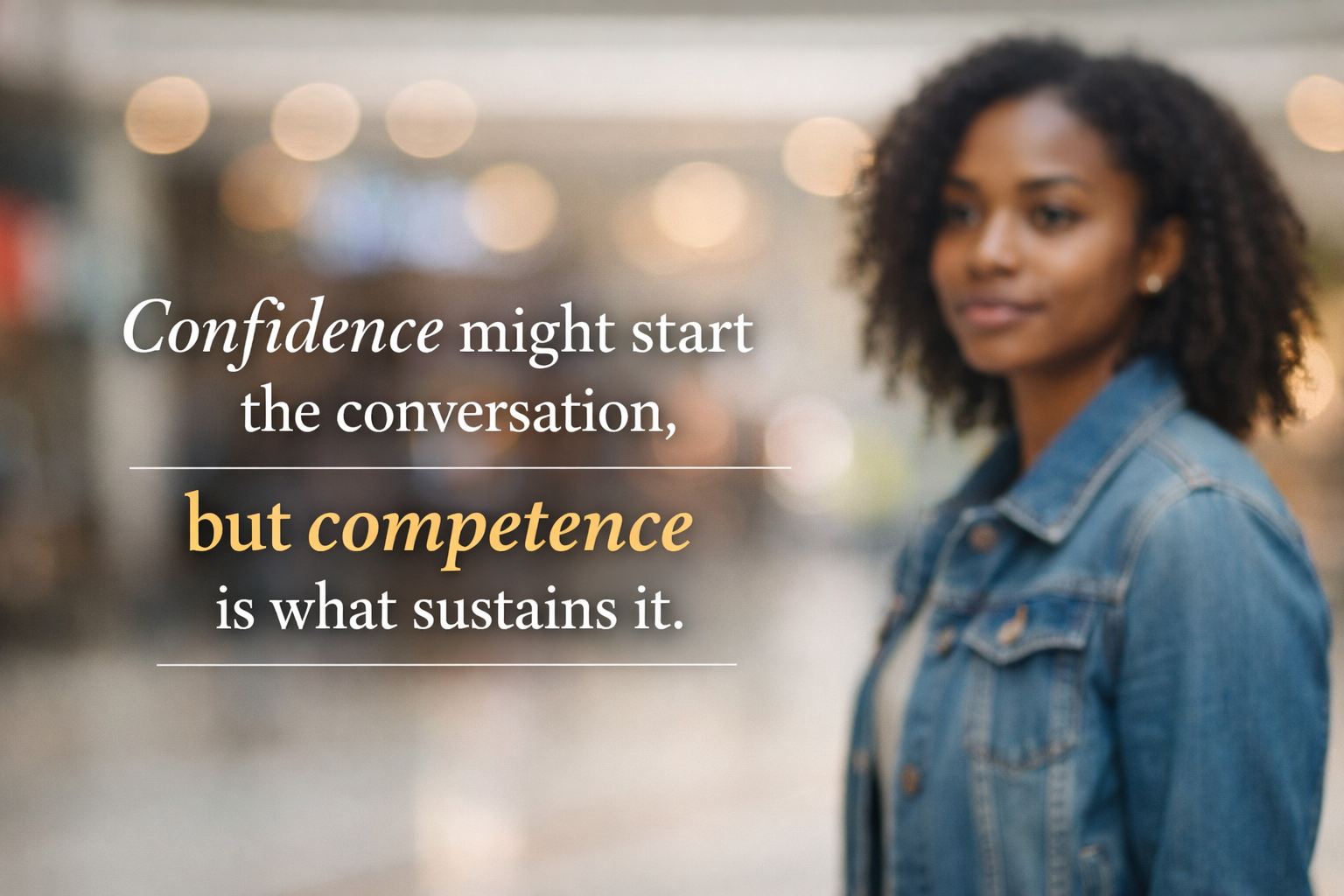
    Confidence might start the conversation.

    But competence is what sustains it.

    And in a space where human connection matters, that difference is everything.


    📘 Continue the Conversation

    If this resonates with you, these human-centered lessons are explored more deeply in my ebook:

    Beyond the Pitch: The Human Art of Face-to-Face Fundraising

    👉 Explore my books here:
    https://www.amazon.com/author/kgalalelontumelang

    If you enjoy reflections on communication, confidence, and the psychology behind human interaction, consider subscribing to the blog so you don’t miss future posts.

    And I’d love to hear from you:

    Do you think confidence or competence has shaped your journey more?

    Share your experience in the comments — your perspective might help someone else see their own growth differently.

    LELO

  • Redefining Leadership Beyond Numbers

    Redefining Leadership Beyond Numbers

    Leadership doesn’t start in a boardroom.

    It doesn’t start with a title, a promotion, or a team meeting.

    Sometimes, it begins in a mall.
    Standing for hours.
    Facing rejection.
    Trying to keep your energy steady while helping others do the same.

    Face-to-face fundraising has a way of revealing what leadership really is — not in theory, but in practice.

    And often, it’s not what people expect.


    Leadership Is Not Just About Targets

    At first, it’s easy to think leadership is about numbers.

    How many sign-ups?
    How much was raised?
    Who is performing?

    But when you’re leading a team in the field, you quickly realise:

    Numbers don’t tell the full story.

    Behind every number is a person:

    • Someone dealing with rejection
    • Someone losing confidence
    • Someone questioning whether they’re good enough
    • Someone having an off day

    Leadership shifts from:
    “How do we hit target?”
    to
    “How do I support people while we aim for target?”

    That shift changes everything.


    You’re Leading People Who Hear “No” All Day

    There’s something unique about leading in face-to-face fundraising.

    Your team isn’t sitting behind desks.
    They’re in public spaces.
    They’re being ignored, dismissed, and sometimes challenged — repeatedly.

    And yet, they are expected to:

    • Stay positive
    • Stay professional
    • Stay motivated

    That’s not easy.

    As a leader, you’re not just managing performance.
    You’re managing emotional energy.

    You start to notice:

    • Who shuts down after rejection
    • Who pushes too hard
    • Who hides their frustration
    • Who needs encouragement but won’t ask for it

    Leadership becomes observation.
    And response.


    The Balance Between Performance and Humanity

    This is where leadership gets tested.

    You have targets to meet.
    Expectations to manage.
    Results to deliver.

    But you also have people.

    And people are not machines.

    Push too hard, and you create pressure.
    Pull back too much, and performance drops.

    So you learn to balance:

    • Accountability with empathy
    • Structure with flexibility
    • Direction with trust

    It’s not about choosing one over the other.

    It’s about knowing when to lean into each.


    A Moment That Changed How I Lead

    I remember a team member who was struggling on the field.

    Their energy had dropped. Their confidence was low. Conversations weren’t landing.

    The easiest response would have been to focus on performance:
    “Try harder.”
    “Adjust your pitch.”
    “Be more confident.”

    But something told me to pause.

    Instead of correcting, I asked:
    “Are you okay?”

    That question changed the tone completely.

    What followed wasn’t about technique.
    It was about how they were feeling.

    And once that was addressed, everything else began to improve naturally.

    That moment taught me:

    Sometimes leadership is not about fixing performance.
    It’s about understanding the person behind it.


    Leadership Is Often Quiet

    We often associate leadership with visibility.

    Speaking loudly.
    Directing clearly.
    Taking charge.

    But in the field, some of the most powerful leadership moments are quiet.

    • Checking in without making it obvious
    • Encouraging without putting pressure
    • Leading by example through consistency
    • Staying grounded when others feel overwhelmed

    Your team watches more than they listen.

    Your energy becomes their reference point.


    What This Taught Me Beyond Fundraising

    The lessons from the field don’t stay there.

    They apply everywhere.

    In Business

    People don’t perform well under constant pressure — they perform well when they feel supported.

    In Media & Broadcasting

    Strong teams aren’t built through control, but through trust and clarity.

    In Leadership Roles

    Titles don’t create leaders.
    Presence, consistency, and emotional intelligence do.

    Face-to-face fundraising accelerates these lessons because everything is immediate, visible, and human.


    Reflection: The Kind of Leader You Are Becoming

    Take a moment to think about your own leadership — whether formal or informal.

    • Do people feel safe around you?
    • Do you listen as much as you direct?
    • Do you respond to performance — or to people?
    • How do you show up when your team is struggling?

    Leadership is not a fixed identity.

    It’s something you practice daily.


    The Bigger Picture

    Face-to-face fundraising is often seen as a temporary job.

    A stepping stone.
    A numbers game.

    But what it really builds is something deeper:

    Resilient individuals.
    Emotionally aware communicators.
    And, if you pay attention, thoughtful leaders.


    Final Thought

    Leadership in face-to-face fundraising is not about being the loudest voice.

    It’s about being the most grounded one.

    It’s about holding space for others while managing your own pressure.

    It’s about remembering that behind every target is a team. Behind every team are human beings trying their best.

    And that understanding changes the way you lead.


    📘 Continue the Conversation

    If this resonated with you, these real, human lessons are explored more deeply in my ebook:

    Beyond the Pitch: The Human Art of Face-to-Face Fundraising

    👉 Explore my books here:
    https://www.amazon.com/author/kgalalelontumelang

    If you enjoy reflections on leadership, communication, and the human side of performance, consider subscribing to the blog. This way, you won’t miss future posts.

    And I’d love to hear from you:

    What has leadership taught you about people?

    Or, if you’re leading a team, what has challenged you the most?

    Share your thoughts in the comments. Your experience might help someone else grow into their leadership role.

    LELO

  • Fear of Rejection: How Fundraising Forces You to Face It

    Fear of Rejection: How Fundraising Forces You to Face It

    The fear of rejection doesn’t always arrive dramatically.
    Sometimes it shows up quietly. It appears in the breath you take before speaking. It is in the second thoughts before approaching someone. It happens in the way your body hesitates, even when your mind says go.

    Face-to-face fundraising doesn’t allow you to hide from that fear. It places you in public spaces. You stand in front of strangers. It asks you to start conversations with people who didn’t plan to talk to you that day.

    And in doing so, it forces you to meet rejection head-on.

    My First Rejection Wasn’t Cruel — Just Honest

    I still remember one of my earliest days on the field.

    I had rehearsed my pitch.
    Straightened my posture.
    Smiled before I even opened my mouth.

    The person stopped, listened for a few seconds, then calmly said, “No, thank you,” and walked away.

    No anger.
    No explanation.
    No apology.

    Just a no.

    What surprised me wasn’t the rejection itself—it was how loudly my inner voice reacted.
    Did I sound foolish? Did I do something wrong? Should I have said it differently?

    That moment taught me something important very early on: rejection feels personal even when it isn’t.

    Fundraising Removes the Illusion of Control

    In many parts of life, rejection is softened.

    Emails go unanswered.
    Applications disappear quietly.
    Opportunities fade without explanation.

    Fundraising removes that buffer.

    You get an answer instantly.
    You don’t get to edit.
    You don’t get to hide behind silence.

    At first, this feels brutal. But over time, it becomes clearer. You stop obsessing over outcomes and start focusing on what you can control:

    • How you show up
    • How you speak
    • How you listen
    • How to exit a conversation with dignity

    Your job is no longer to convince.
    Your job is to invite.

    When Rejection Stops Feeling Like a Verdict

    After dozens—then hundreds—of interactions, something shifts.

    You start to recognize patterns:

    • The rushed no from someone late for work
    • The polite no from someone already stretched financially
    • The hesitant maybe from someone who wants to help but is unsure
    • The yes that surprises both of you

    You realise rejection has layers.
    Context.
    Emotion.

    And slowly, fear loosens its grip—not because rejection disappears, but because you stop attaching your self-worth to it.

    A Simple Exercise: Reframing Rejection

    Here’s a practice fundraising taught me that applies far beyond the street:

    After a rejection, ask yourself three questions:

    1. What actually happened (fact, not feeling)?
    2. What story am I telling myself about it?
    3. What other explanation could also be true?

    Most of the time, rejection has nothing to do with your value, intelligence, or ability. This exercise trains you to separate emotion from reality.

    Confidence Is Built in Public, Not in Theory

    There is no private way to build public confidence.

    Standing in front of strangers teaches you things no workshop can:

    • You can recover from awkwardness
    • You can keep going after being ignored
    • You can speak even when your voice shakes
    • You can reset and try again

    Confidence doesn’t come from getting it right.
    It comes from surviving getting it wrong.

    Emotional Resilience Is the Real Skill

    One of the most underrated lessons in face-to-face fundraising is emotional regulation.

    You learn how to:

    • Shake off a difficult interaction
    • Stay attentive instead of defensive
    • Treat people with respect, even when they dismiss you
    • Carry yourself professionally despite disappointment

    These skills don’t stay on the pavement.
    They follow you into interviews, negotiations, leadership spaces, and personal relationships.

    Fundraising trains you to remain human under pressure.

    Why This Matters Beyond Fundraising

    Fear of rejection keeps many people stuck:

    • Afraid to pitch ideas
    • Afraid to ask for opportunities
    • Afraid to be visible
    • Afraid to start

    Face-to-face fundraising forces you to confront that fear daily—and in doing so, it breaks its power slowly, honestly, and permanently.

    You don’t become fearless.
    You become braver.

    A Reflection for You

    Take a moment and think about this:

    • Where has fear of rejection stopped you from speaking up?
    • What conversation have you been avoiding?
    • What’s one small “approach” you can make this week?

    Growth often begins with a single uncomfortable step.

    Final Thought

    Rejection in fundraising is not proof that you are failing.
    It is proof that you are participating.

    Sometimes, the greatest thing you gain from the work isn’t money.
    It’s courage.


    📘 Continue the Conversation

    If this resonated with you, you’ll find these themes explored more deeply in my ebook. It is called Beyond the Pitch: The Human Art of Face-to-Face Fundraising.

    👉 Explore my books here:
    https://www.amazon.com/author/kgalalelontumelang

    If you enjoy reflections on confidence, communication, and the human side of work, subscribe to the blog. This way, you won’t miss future posts.

    And I’d really love to hear from you 👇
    How have you experienced rejection—and what did it teach you?
    Share your thoughts in the comments.

    LELO