Tag: fundraiser training

  • When Fundraising Becomes More Than a Job: The Identity of the Fundraiser

    When Fundraising Becomes More Than a Job: The Identity of the Fundraiser


    You start fundraising because you need a job.

    Maybe you need an income. Maybe you’re between opportunities. Maybe someone told you about an opening and you thought, Why not?

    You put on the branded shirt, learn the organisation’s story and head into the field.

    Then you approach your first stranger.

    They say no.

    Then another person says no. And another.

    At first, rejection feels personal. You wonder whether you’re doing something wrong. You question whether you’re confident enough or whether you’re even suited to the job.

    But eventually, something changes.

    You approach the next person. Then the next.

    You learn that a “no” doesn’t have to stop you. You learn to smile and move on. You learn to start conversations with people you’ve never met, read body language and listen carefully.

    And without necessarily realising it, you start becoming a different person.

    Fundraising Teaches You to Speak to Strangers

    Most people aren’t naturally comfortable approaching strangers. We tend to stay within familiar circles—friends, family and colleagues.

    Face-to-face fundraising removes that comfort zone.

    You have to walk up to someone you’ve never met and create enough connection for them to stop and listen. That takes courage.

    Over time, the stranger who once intimidated you becomes simply another person you can have a conversation with.

    And that confidence doesn’t necessarily disappear when you leave the fundraising environment.

    You take it with you.

    You Learn That Rejection Isn’t Always About You

    This may be one of the most valuable lessons fundraising teaches.

    Someone can listen to your entire pitch and still say no. And sometimes, there is absolutely nothing wrong with your pitch.

    They may not have the money. They may already support another organisation. They may be rushing. They may simply not be interested.

    Learning to understand that distinction is powerful.

    Once you stop interpreting every rejection as a judgement of your worth, you become more resilient. And that lesson applies far beyond fundraising—to job interviews, business proposals, relationships, entrepreneurship and everyday life.

    Not every “no” means you failed.

    Sometimes it simply means: not this person, not this time.

    You Become Better at Reading People

    Fundraising teaches you to pay attention.

    You begin noticing who is rushing and who has time. Who wants more information and who wants a quick conversation. Who is curious, who is sceptical and who needs more explanation.

    You learn that communication isn’t simply about what you say. It’s also about what the other person is showing you.

    That is emotional intelligence.

    And it is a valuable skill in almost every profession.

    You Learn the Difference Between Persuasion and Pressure

    A good fundraiser eventually discovers that you cannot force someone to care.

    You can explain the cause. You can tell the story. You can answer questions and invite someone to become involved.

    But the decision ultimately belongs to them.

    That teaches an important lesson about influence.

    Real persuasion isn’t about talking someone into something they don’t want. It is about understanding what matters to them and communicating your message honestly.

    That skill can be transferred into sales, marketing, communications, management and business.

    You Develop Resilience Without Realising It

    There are difficult days in fundraising.

    Days when the numbers don’t move. Days when people don’t stop. Days when you question whether you’re making any difference.

    And then you come back the next day.

    You try again.

    You learn something.

    You improve.

    That repeated cycle builds resilience.

    Not the kind of resilience that means pretending everything is fine, but the ability to experience disappointment without allowing it to permanently define your behaviour.

    You learn to recover.

    And recovery is a skill.

    You May Discover a Leader Inside Yourself

    Something else can happen to experienced fundraisers.

    They begin helping others.

    A new fundraiser struggles with their opening, so you show them how you approach people. Someone has a terrible day, so you encourage them. A colleague asks how you consistently get people to stop, and you share what you’ve learned.

    Without realising it, you are coaching.

    You are leading.

    And sometimes that becomes the beginning of a new career path.

    Fundraising can become the place where someone discovers that they aren’t only good at raising funds.

    They’re good at developing people.

    But We Don’t Always Recognise These Skills

    This is where the fundraising profession has an opportunity to do better.

    A fundraiser may leave face-to-face fundraising after two or three years and apply for a completely different position.

    Perhaps the new employer simply sees:

    “Fundraiser.”

    But behind that job title is someone who has developed communication, persuasion, resilience, public engagement, relationship-building, target management and problem-solving skills.

    Those skills have value.

    The challenge is learning how to recognise them—and communicate them.

    Fundraisers need to understand that their experience is not disposable.

    It is part of their professional development.

    Fundraising Can Be a Chapter, Not a Dead End

    Not everyone will spend their entire career in face-to-face fundraising.

    And that’s okay.

    Some people will move into management. Others will move into sales, marketing, communications, customer experience or nonprofit management. Some will start businesses. Others may discover an entirely different career path.

    But leaving fundraising doesn’t mean the experience was wasted.

    You take the confidence with you.

    You take the ability to communicate, the resilience, the understanding of people and the experience of standing in public spaces trying to convince a complete stranger that something matters.

    Those experiences become part of who you are professionally.

    The Identity We Give Fundraisers Matters

    Perhaps we need to stop describing fundraising only as something people do.

    We should also talk about what fundraising helps people become.

    A fundraiser can become a better communicator. A stronger listener. A more confident speaker. A more resilient professional. A better leader.

    And sometimes, a person who discovers possibilities they didn’t know existed.

    That is bigger than a daily target.

    Final Thoughts

    Maybe you started fundraising because you needed a job.

    There is nothing wrong with that.

    But perhaps the job gave you something you didn’t expect.

    It taught you how to approach people, handle rejection, communicate, listen, persuade without forcing and keep going after difficult days.

    And perhaps, somewhere along the way, you discovered that you were capable of more than you thought.

    That is the hidden value of face-to-face fundraising.

    The organisation receives donations. The cause receives support. But the fundraiser can also walk away with something that cannot be measured on a campaign report:

    a stronger sense of who they are and what they are capable of becoming.

    Maybe that’s why fundraising is more than a job.

    It can be a school for life.


    Beyond the Pitch

    Face-to-face fundraising is about more than asking for donations.

    It’s about communication, resilience, leadership, relationships and the people behind every conversation.

    Through Beyond the Pitch, I share practical lessons and honest reflections from the fundraising field—looking beyond the numbers to the people, skills and experiences that make fundraising possible.


    Continue the Conversation

    If you’ve worked in face-to-face fundraising, I’d love to hear from you:

    What has fundraising taught you about yourself that you didn’t know when you started?

    Share your experience in the comments.

    If you enjoy practical insights and honest reflections about face-to-face fundraising, leadership and professional development, follow Reflections in Motion for more from Beyond the Pitch.

    📘 Want to go further?

    My book, Beyond the Pitch: The Art of Face-to-Face Fundraising, explores the communication, psychology and human connection behind successful fundraising.

    Explore my books on Amazon:
    Kgalalelo Ntumelang – Amazon Author Page

    Work With Me

    If your organisation or fundraising team needs support with fundraising communication, team development, coaching or practical fundraising insights, I’d love to hear from you.

    Email: lelon@reflectionsinmotion.blog

    Website: Reflections in Motion
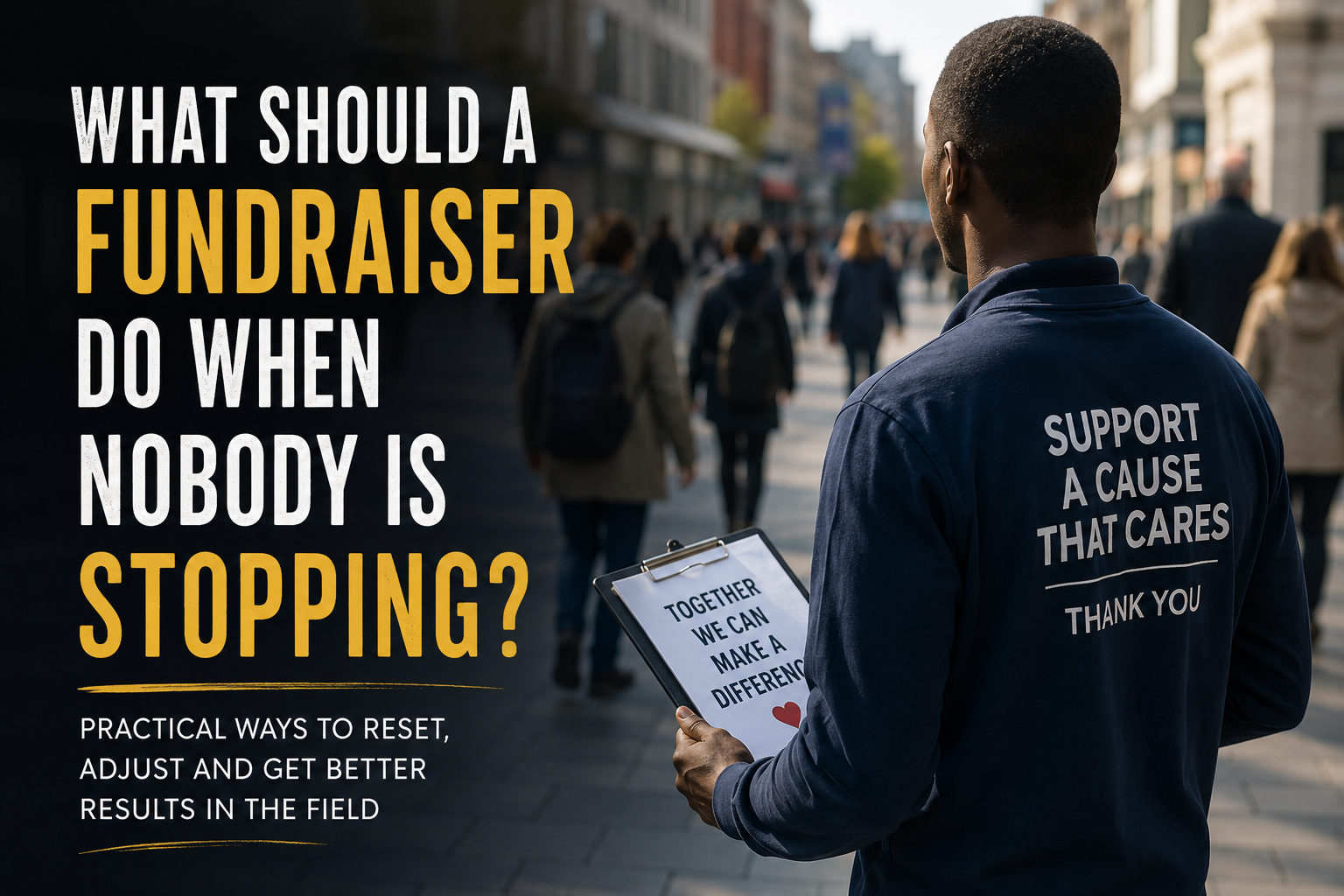
  • What Should a Fundraiser Do When Nobody Is Stopping?

    What Should a Fundraiser Do When Nobody Is Stopping?


    You have your uniform on, your materials are ready, and you know the cause you’re representing. You’ve prepared your pitch and you’re standing in the right place.

    But nobody is stopping.

    Five people walk past. Then ten. Twenty.

    Someone says they’re in a hurry. Another doesn’t even make eye contact. After a while, a familiar question begins to creep into your mind:

    “What am I doing wrong?”

    It’s one of the most frustrating experiences in face-to-face fundraising. But a slow period doesn’t automatically mean you’re a bad fundraiser.

    Sometimes the problem isn’t your ability. It may be the location, the timing, your body language, your opening—or simply the people you’re approaching.

    The important thing is not to panic.

    Stop. Observe. Adjust. Try again.

    Don’t Take Every “No” Personally

    Rejection is part of face-to-face fundraising. People are busy, distracted, rushing somewhere or simply not interested in having a conversation.

    Their response isn’t necessarily a judgement of you.

    The danger comes when you carry one rejection into the next approach. After several “nos”, your confidence can begin to change. Your voice becomes less energetic. Your body language becomes hesitant. You start expecting the next person to reject you before you’ve even spoken.

    Remind yourself:

    They said no to the conversation. They did not say no to my worth.

    Then approach the next person.

    Look at the Environment

    Before changing your entire pitch, look around you.

    Are people actually in a position to stop?

    If everyone is rushing to work, catching transport or focused on where they’re going, you may be fighting the environment rather than your own technique.

    A good fundraiser learns to read the crowd. Look for natural moments when people have time to pause and engage.

    If campaign rules allow it, speak to your team leader about your positioning. Sometimes a small change in where you stand can make a significant difference.

    Check Your Timing and Body Language

    Not every person is approachable at every moment.

    Someone carrying several bags, running towards transport or clearly distracted may not be the best person to engage. That doesn’t mean your pitch failed. The timing may simply have been wrong.

    Then look at yourself.

    Are you smiling? Do you look approachable? Are you standing confidently? Are you moving towards people too quickly? Does your body language communicate energy—or desperation?

    Fundraising begins before the first words are spoken.

    Keep Your Opening Simple

    When people aren’t stopping, the temptation is often to say more.

    More information. More statistics. More explanation.

    But your opening doesn’t need to tell the entire story.

    Its job is simply to create enough curiosity for someone to stop and listen.

    Keep it natural. Keep it conversational. Give the person a reason to hear more.

    Once they stop, that’s when you have the opportunity to explain the cause properly.

    Let Your Team Leader Coach You

    One of the most useful things you can do when you’re struggling is ask your team leader to observe you.

    Don’t just ask, “How am I doing?”

    Ask them to watch several approaches and give you specific feedback.

    Are you approaching at the right time? Is your opening too long? Are you speaking too quickly? What does your body language communicate?

    Sometimes we cannot see our own habits.

    That’s where good coaching becomes valuable. A team leader can see something from the outside that you may not notice yourself.

    Change One Thing at a Time

    When something isn’t working, don’t change everything at once.

    Test one adjustment.

    Change your opening. Observe what happens.

    If that doesn’t help, look at your positioning.

    Then consider your body language or timing.

    Use a simple process:

    Observe → Adjust → Test → Learn → Repeat.

    That’s how improvement happens.

    Don’t Chase the Numbers

    When the numbers are low, desperation can creep in. You start trying to stop everyone, and the pressure becomes visible.

    Remember that you’re inviting someone into a conversation. You’re not forcing them into one.

    Approach people with confidence and energy, but respect their decision.

    And if you’ve had twenty difficult approaches in a row, sometimes you need a reset.

    Take a short break if your campaign environment allows it. Drink some water. Take a breath. Speak to your team leader. Then return with a clearer mind.

    A reset isn’t giving up.

    It’s recognising that your state of mind affects your performance.

    The Fundraiser’s Five-Minute Field Check

    When things aren’t working, stop and ask yourself:

    1. Where am I?

    Is this a good place for people to stop and have a conversation?

    2. Who am I approaching?

    Are these people actually in a position to engage?

    3. How am I approaching?

    What does my body language communicate?

    4. What am I saying?

    Is my opening short, natural and interesting?

    5. What can I change?

    Choose one thing to test during your next few approaches.

    Don’t change everything.

    Change one thing, observe the result, and learn from it.

    Final Thoughts

    A bad fundraising period doesn’t automatically mean you’re a bad fundraiser.

    Sometimes, something simply needs to change.

    Maybe your positioning needs adjusting. Maybe your timing is wrong. Maybe your opening needs work. Or maybe you’ve had a difficult run of rejection and simply need to reset.

    The best fundraisers aren’t necessarily the people who never hear “no.”

    They’re the people who know what to do after hearing it.

    They observe. They adjust. They ask for feedback. They learn.

    And then they try again.

    So the next time you’re standing in a busy public space wondering why nobody is stopping, don’t immediately ask:

    “What’s wrong with me?”

    Ask:

    “What is this moment teaching me?”

    Because sometimes the difference between a frustrating fundraising day and a productive one isn’t a completely new strategy.

    It’s simply the willingness to stop, adjust and try again.


    Beyond the Pitch

    Face-to-face fundraising is about more than asking for donations.

    It’s about communication, resilience, leadership and the human moments that happen between a fundraiser and a stranger.

    Through Beyond the Pitch, I share practical lessons and honest reflections from the fundraising field—looking beyond the numbers to the people who make fundraising possible.


    Continue the Conversation

    Have you ever had a day when nobody seemed to want to stop?

    What did you change—and did it work?

    Share your experience in the comments.

    If you enjoy practical insights about face-to-face fundraising, leadership and team development, follow Reflections in Motion for more articles from Beyond the Pitch.

    📘 Want to go deeper?

    My book, Beyond the Pitch: The Human Art of Face-to-Face Fundraising, explores the communication, psychology and human connection behind successful fundraising.

    Explore my books on Amazon:
    Kgalalelo Ntumelang – Amazon Author Page

    Work With Me

    If your organisation or fundraising team needs support with fundraising communication, team development, coaching or practical fundraising insights, I’d love to hear from you.

    Email: lelon@reflectionsinmotion.blog

    Website: Reflections in Motion