Tag: broadcasting industry

  • Do Radio Broadcasters Need to Be on Camera to Build a Successful Brand?

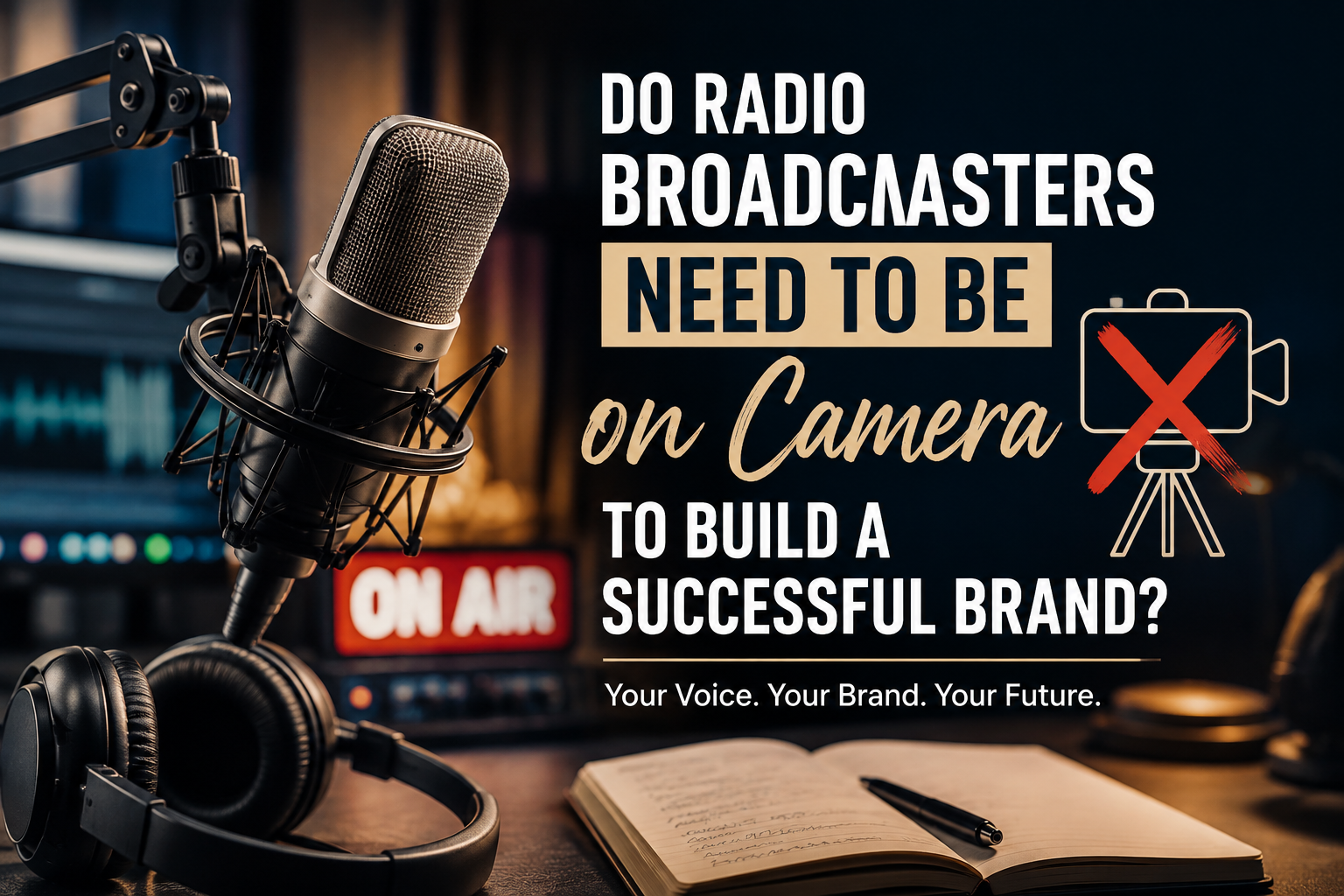
    Do Radio Broadcasters Need to Be on Camera to Build a Successful Brand?


    A Personal Reflection

    One of the biggest misconceptions about radio is that if you’re confident behind a microphone, you’ll naturally be confident in front of a camera.

    The truth is often very different.

    Many radio broadcasters are comfortable speaking to thousands of listeners every day, yet the moment a camera starts recording, their confidence disappears.

    For years, radio has been about imagination. Your audience hears your voice but never sees your face. You learn to paint pictures with words, connect through sound, and build relationships without ever stepping into the spotlight.

    Today’s digital world, however, seems to send a different message.

    “If you’re not on camera, you’re falling behind.”

    For many broadcasters, that’s an intimidating thought.

    It raises an important question:

    Can a radio broadcaster still build a successful brand without becoming a video personality?

    I believe the answer is yes.

    But like many things in broadcasting, the answer requires a shift in perspective.


    The Pressure to Be Seen

    Social media has changed the way audiences consume content.

    Everywhere you look, someone is encouraging creators to:

    • Start a YouTube channel.
    • Record video podcasts.
    • Go live on social media.
    • Post daily reels.
    • Share behind-the-scenes videos.

    It’s easy to conclude that video is now the only path to success.

    As a result, many talented radio broadcasters begin questioning themselves.

    “Maybe my career has reached its limit because I don’t enjoy being on camera.”

    That thought has stopped many people from sharing their expertise.

    Not because they lack talent.

    But because they believe they must become someone they’re not.


    Radio Has Always Been About Connection

    One of radio’s greatest strengths has never been the camera.

    It has always been connection.

    Listeners don’t return every day because they admire a broadcaster’s appearance.

    They return because they trust the voice.

    They feel understood.

    They enjoy the conversations.

    They value the stories.

    That ability to build trust through voice alone is a skill that many digital creators spend years trying to develop.

    Radio broadcasters already possess it.

    The challenge is learning how to use that strength beyond traditional broadcasting.


    Podcasts: A Natural Home for Radio Broadcasters

    If you’re a radio broadcaster who feels uncomfortable on camera, podcasting may be one of the most natural ways to expand your career.

    Podcasting allows you to build on the skills you’ve already developed:

    • interviewing
    • storytelling
    • scripting
    • active listening
    • audience engagement
    • voice presentation

    The format may be different, but the core skills remain the same.

    More importantly, podcasting gives you ownership.

    Unlike traditional broadcasting, where airtime belongs to an organisation, your podcast belongs to you.

    You choose the topics.

    You decide the format.

    You build the audience.

    And over time, you create an asset that continues to represent your expertise.


    Can You Really Make Money Without Being on Camera?

    This is one of the biggest questions broadcasters ask.

    The answer is yes—but perhaps not in the way many people imagine.

    A podcast doesn’t have to generate income directly to become financially valuable.

    Instead, it can become a platform that creates opportunities.

    Your podcast can help you:

    • attract speaking engagements
    • promote your books
    • introduce your coaching services
    • market training workshops
    • build trust with potential clients
    • grow an email newsletter
    • drive readers to your blog
    • create opportunities for sponsorships and partnerships

    In other words, your podcast becomes part of a larger personal brand.

    Sometimes the greatest value of a podcast isn’t the advertising revenue.

    It’s the credibility it builds.


    You Don’t Have to Choose Between Audio and Video

    One of the biggest mistakes creators make is believing they must choose one format forever.

    You don’t.

    Perhaps today your confidence lies behind the microphone.

    That’s perfectly acceptable.

    As your confidence grows, you might decide to record short video clips.

    Share behind-the-scenes moments.

    Film interviews.

    Or create educational content for social media.

    Growth doesn’t require abandoning your strengths.

    It requires building on them.


    Don’t Let Fear Make the Decision

    There is an important difference between making a strategic decision and making a fearful one.

    If audio is your preferred format because it aligns with your goals and your audience, that’s a strategic choice.

    If you’re avoiding every opportunity simply because you’re afraid of the camera, it may be worth asking yourself what is holding you back.

    Confidence isn’t built by waiting.

    It’s built by taking small, consistent steps outside your comfort zone.

    You don’t have to become a television presenter overnight.

    But you also don’t have to let fear decide the future of your career.


    Your Voice Is Still Your Greatest Asset

    Technology changes.

    Platforms evolve.

    Algorithms come and go.

    But one thing remains constant.

    People are drawn to authentic communication.

    As a broadcaster, your voice has always been more than a tool.

    It is how you educate.

    Encourage.

    Challenge.

    Inspire.

    Whether you use it on radio, in a podcast, on stage, or in a training room, your voice continues to have value.

    Never underestimate what years behind the microphone have taught you.


    A Quiet Reminder

    You don’t need to become someone else to build a successful broadcasting brand.

    The microphone that helped you connect with listeners yesterday can still help you build opportunities tomorrow.

    Your voice is not becoming less valuable. It simply has more places where it can be heard.


    Reflections in Motion

    Broadcasting is changing—but great communication never goes out of style.

    Through Reflections in Motion, I explore the lessons, challenges, and opportunities facing today’s broadcasters while encouraging professionals to build careers that extend beyond traditional media.


    Continue the Conversation

    If this reflection resonated with you, perhaps it’s time to start thinking beyond the microphone.

    My book, From Broadcaster to Brand, explores how broadcasters can transform their experience into sustainable opportunities by building a personal brand, creating multiple income streams, and taking ownership of their careers.

    📘 Get your copy on Amazon:
    https://www.amazon.com/author/kgalalelontumelang


    Work With Me

    If you’re a broadcaster, podcaster, media professional, or aspiring content creator looking to build your personal brand or create new opportunities beyond traditional broadcasting, I’d love to work with you.

    I offer:

    • 🎙️ Podcast coaching and launch guidance
    • 📻 Broadcasting and media career coaching
    • ✍🏽 Content writing and editing
    • 🎤 Voice-over services
    • 📚 Personal brand development for broadcasters

    🌐 Website: https://reflectionsinmotion.blog

    📧 Email: lelon@reflectionsinmotion.blog

    Let’s explore how your voice can become more than a career—it can become a brand.


    If you’ve enjoyed this article, subscribe to Reflections in Motion for weekly insights on broadcasting, personal branding, podcasting, and building a sustainable career beyond the microphone.

    💬 I’d love to hear your thoughts:

    If you’re a radio broadcaster, have you ever felt nervous about being on camera?

    Do you think podcasts give broadcasters a meaningful way to build their personal brands without relying entirely on video?

    Let’s continue the conversation in the comments.


    LELO

  • You Can Be Visible and Still Be Powerless

    You Can Be Visible and Still Be Powerless

    Visibility looks like power.

    People recognise you.
    They hear your voice.
    They engage with your content.

    From the outside, it seems like you’ve made it.

    But visibility can be misleading.

    Because being seen is not the same as being in control.


    The Illusion of Being “Out There”

    Broadcasting puts you in front of people.

    You’re heard.
    You’re followed.
    You’re part of conversations.

    And over time, it can feel like you’ve built something solid.

    But much of that visibility exists within systems you do not own.

    The station decides when you’re on air.
    The platform decides who sees your content.
    The structure shapes your reach.

    So while you are visible, your presence is still dependent.


    When Visibility Is Borrowed

    Most broadcasters operate within borrowed spaces.

    A radio station.
    A media platform.
    A social media account.

    These spaces give you reach—but they also define your limits.

    They can amplify you.
    But they can also reduce your visibility just as quickly.

    And when that happens, many realise something uncomfortable:

    The visibility was never fully theirs.


    Attention vs Power

    It’s easy to confuse attention with power.

    Attention means:

    • People are watching
    • People are listening
    • People are reacting

    Power means:

    • You can reach your audience directly
    • You control your message
    • You are not dependent on a single platform

    Attention is temporary.

    Power is sustainable.


    Why Some Visible Voices Still Feel Stuck

    Some broadcasters are widely recognised—but still feel uncertain about their future.

    Not because they lack talent.

    But because their visibility hasn’t translated into independence.

    They are known, but not in control.
    Heard, but not anchored.

    And that creates a quiet tension:

    “How can I be this visible… and still feel this limited?”


    The Shift From Being Seen to Being Positioned

    Visibility puts you in front of people.

    Positioning gives that visibility direction.

    It defines:

    • What you stand for
    • How people understand you
    • Why they should continue following you beyond one platform

    Without positioning, visibility fades when the platform changes.

    With positioning, your audience follows you—because they are connected to you, not just where you appear.


    Building Beyond Visibility

    The goal is not to reject visibility.

    It is to build beyond it.

    To move from:

    • being seen
      to
    • being established

    This is where ownership matters.

    When you create spaces where your voice lives independently—
    you begin to turn visibility into something more stable.

    Something that can grow with you.


    A Quiet Reminder

    Visibility can open doors.

    But it does not guarantee stability.

    Ownership, clarity, and direct connection are what turn visibility into something lasting.


    A Quiet Invitation

    If this resonates, it may be because you’ve experienced the gap between being seen and being in control.

    From Broadcaster to Brand explores how to move beyond visibility—towards ownership, positioning, and long-term sustainability in your career.

    📘 Find From Broadcaster to Brand on Amazon here:
    👉🏽 https://www.amazon.com/author/kgalalelontumelang

    If you’d like more reflections like this, consider subscribing to the blog. This is a space for broadcasters who want to build something that lasts—beyond attention, platforms, and temporary visibility.

    💬 I’d love to hear from you:
    Have you ever felt visible—but not in control?

    LELO

  • Why Broadcasters Need to Own Their Audience

    Why Broadcasters Need to Own Their Audience

    Many broadcasters believe they have an audience.

    But in reality, what they have is access.

    Access to listeners.
    Access to airtime.
    Access to a platform that connects them to people.

    And while that access is powerful, it can also be misleading.

    Because access is not ownership.


    The Illusion of Having an Audience

    When you’re on air, it feels like the audience belongs to you.

    They recognise your voice.
    They respond to your segments.
    They engage with your content.

    But the connection is built inside a system you do not control.

    The station owns:

    • the platform
    • the distribution
    • the relationship infrastructure

    So when your access ends, the connection weakens—sometimes instantly.

    Not because the audience disappeared.
    But because the channel did.


    Access vs Ownership

    Let’s make the distinction clear.

    Access means:

    • You can reach people through a platform
    • You can communicate within a structure
    • You benefit from an existing audience

    Ownership means:

    • You can reach your audience directly
    • You control how and when you communicate
    • Your connection does not depend on employment

    Most broadcasters build access.

    Very few build ownership.


    What Happens When You Don’t Own the Relationship

    When broadcasters rely only on platforms, they face a difficult reality when things change.

    Contracts end.
    Shows move.
    Formats shift.

    And suddenly, the question becomes:

    How do I reach the people who used to listen to me?

    Without ownership, that question has no clear answer.

    Because the connection was never fully yours to start with.


    Owning Your Audience Changes Everything

    When you begin to build direct connection, your position changes.

    You are no longer dependent on a single platform to be heard.

    You create continuity.

    Your audience can:

    • follow your thinking
    • engage with your ideas
    • grow with you beyond one space

    Ownership doesn’t mean leaving broadcasting.

    It means strengthening your independence within it.


    What Ownership Can Look Like

    Owning your audience doesn’t need a massive following.

    It requires intention.

    It can start with:

    • a personal blog
    • an email newsletter
    • a podcast you control
    • a professional platform where your ideas live

    These are not replacements for broadcasting.

    They are extensions of your voice.

    Places where your audience can find you—regardless of where you work.


    The Real Shift

    The goal is not just to be heard.

    It is to be reachable.

    Because being heard depends on the platform.

    But being reachable depends on you.


    A Quiet Invitation

    If this idea of ownership resonates, it may be because you’ve already sensed the limitations of relying only on platforms.

    From Broadcaster to Brand explores how broadcasters can move from access to ownership—building identity, connection, and sustainability beyond employment.

    📘 Find From Broadcaster to Brand on Amazon here:
    👉🏽 https://www.amazon.com/author/kgalalelontumelang

    If you’d like more reflections like this, consider subscribing to the blog. It’s a space for broadcasters who want to build something that lasts—beyond contracts, platforms, and changing industry dynamics.

    💬 I’d love to hear your thoughts:
    Can you share one method to start building a direct connection with your audience today?

    LELO

  • The Power of Silence in Broadcasting

    The Power of Silence in Broadcasting

    When people think about broadcasting, they think about talking.

    The voice.
    The energy.
    The ability to fill the air with sound.

    But experienced broadcasters know something the audience rarely notices:

    Some of the most powerful moments on air are not created by words.

    They are created by silence.

    That brief pause between sentences.
    The moment after a difficult question.
    The quiet space that allows a story to land.

    Silence is not empty.

    In broadcasting, silence is intentional communication.


    When Silence Becomes Powerful

    Think about a powerful interview moment.

    A guest shares something deeply personal. It might be the loss of a loved one. It could involve a difficult life decision or a moment of vulnerability.

    An inexperienced broadcaster might rush in with another question.

    But a skilled broadcaster allows the moment to breathe.

    That pause tells the guest and the audience something important:

    This moment matters.

    Listeners feel the weight of what was said.

    And suddenly, the conversation becomes more than content.
    It becomes human.


    The Discipline of the Pause

    Early in broadcasting, silence feels like danger.

    Dead air is treated like a mistake — something to avoid at all costs.

    So beginners fill every gap with extra words:

    • unnecessary commentary
    • repeating information
    • explaining what listeners already understand

    But with experience comes a different kind of confidence.

    You begin to realise that not every moment needs sound.

    Sometimes the most professional thing you can do is pause.

    Silence gives your words room to matter.


    What Great Broadcasters Understand

    Many respected broadcasters have spoken about the power of listening and restraint.

    The legendary interviewer Larry King once said:

    “I remind myself every morning: Nothing I say this day will teach me anything. So if I’m going to learn, I must do it by listening.”

    That principle shaped his interviewing style.

    Instead of dominating conversations, he allowed guests to speak fully.
    He let silence invite deeper responses.

    Veteran journalist Christiane Amanpour has often emphasised the importance of patience in interviews. She believes in allowing moments to unfold rather than forcing them.

    These broadcasters understood that communication is not just about speaking.

    It is about creating space for truth to appear.


    Silence Builds Authority

    There is also a quiet confidence in restraint.

    When someone speaks constantly, audiences eventually stop hearing the words.

    But when someone speaks thoughtfully — allowing pauses and moments of quiet — each sentence carries more weight.

    This applies beyond broadcasting.

    Great communicators, leaders, and storytellers know that presence is not measured by how much you say.

    It is measured by how intentionally you say it.


    Listening Is the Real Skill

    Broadcasting teaches you how to speak.

    But the longer you stay in the industry, the more you realise that the real skill is listening.

    Listening for:

    • emotion in a voice
    • hesitation in a response
    • the moment when someone has more to say

    That kind of listening can’t happen if you are constantly preparing your next sentence.

    It requires stillness.

    And stillness naturally creates silence.


    The Space Between Words

    Broadcasting is often described as the art of speaking to thousands of people you can’t see.

    But it is also the art of respecting the audience’s attention.

    Silence gives listeners time to:

    • absorb a story
    • reflect on a point
    • emotionally connect with what they have heard

    Without those spaces, communication becomes noise.

    And noise rarely builds connection.


    A Quiet Invitation

    If reflections like this resonate with you, it’s probably because broadcasting is about far more than microphones and studios. It’s about voice, presence, and the greater skills that shape meaningful communication.

    I explore many of these ideas in my ebook From Broadcaster to Brand. I reflect on how broadcasters can build identity and create lasting relevance beyond the platform.

    📘 Find the book on Amazon here:
    👉🏽 https://www.amazon.com/author/kgalalelontumelang

    If you enjoy thoughtful reflections on broadcasting, communication, and building sustainable careers, consider subscribing to the blog.

    It’s a space for broadcasters and communicators who believe their voice can matter beyond a single platform.

    💬 I’d love to hear from you:
    As a listener, have you ever noticed a moment of silence in an interview? Did it make the conversation more powerful?

    LELO

  • Understanding the Difference: Platform vs. Brand in Broadcasting

    Understanding the Difference: Platform vs. Brand in Broadcasting

    Many broadcasters confuse visibility with ownership.

    They believe that being on air means being established.
    That having a show means having a brand.
    That access equals security.

    It doesn’t.

    And that confusion is where most career panic begins.

    Before you can build sustainability in media, you must understand one foundational truth:

    A platform is where you are seen.
    A brand is what you are known for.

    They are not the same thing.


    What Is a Platform?

    A platform is the vehicle.

    It is:

    • The radio station
    • The television channel
    • The podcast network
    • The publication
    • The organisation that gives you access to an audience

    Platforms provides:

    • Reach
    • Structure
    • Distribution
    • Immediate visibility

    But platforms are owned by someone else.

    They can:

    • Change direction
    • Replace talent
    • Cancel shows
    • End contracts

    A platform can elevate you.
    But it does not belong to you.


    What Is a Brand?

    A brand is perception.

    It is:

    • The association people make when they hear your name
    • The consistent value you provide
    • The perspective you are known for
    • The trust you build over time

    A brand is portable.

    It moves with you:

    • From station to station
    • From media to business
    • From employment to independence

    If the platform disappears but people still seek you out, that is a brand.


    The Critical Differences

    Let’s simplify it.

    PlatformBrand
    Owned by employerOwned by you
    Gives you visibilityGives you identity
    Temporary accessLong-term perception
    Can be taken awayMoves with you
    Based on roleBased on value

    When broadcasters panic at the end of contracts, it is usually because they built platform strength, not brand strength.


    Why This Distinction Matters

    If you build only a platform presence:
    Your relevance is conditional.

    If you build a brand:
    Your relevance becomes transferable.

    That’s the difference between:

    • “I work at…”
      and
    • “I am known for…”

    The first depends on employment.
    The second depends on clarity.


    Signs You’ve Built a Platform But Not a Brand

    Be honest with yourself:

    • If your show ends, does your audience follow you?
    • If you change stations, does your credibility transfer?
    • If someone asks what you stand for, can you answer clearly?
    • Are you known for something specific beyond your job title?

    If those questions feel uncomfortable, it’s not criticism.

    It’s awareness.

    And awareness is where ownership begins.


    How to Start Building a Brand While on a Platform

    You don’t need to resign.
    You don’t need to rebel.
    You don’t need to compete with your employer.

    You need clarity and consistency.

    Start by defining:

    • What themes do I consistently speak about?
    • What problems do I care about?
    • What values shape my work?
    • What do people repeatedly compliment me for?

    Then build small assets you control:

    • A personal website
    • Thoughtful LinkedIn presence
    • Writing that carries your perspective
    • Projects outside your job description

    The platform can amplify you.

    But the brand must originate from you.


    The Real Goal

    The goal is not to leave broadcasting.

    The goal is to ensure that if the platform changes,
    you don’t disappear with it.

    A strong platform gives you reach.

    A strong brand gives you longevity.

    And longevity is what sustains careers.


    A Quiet Invitation

    If this distinction between platform and brand resonates, it’s because you’re already thinking beyond employment.

    From Broadcaster to Brand explores this shift in depth. It explains how to build identity, ownership, and sustainability. This is done without becoming performative or self-promotional.

    📘 You can find From Broadcaster to Brand on Amazon here:
    👉🏽 https://www.amazon.com/author/kgalalelontumelang

    If you’d like more reflections like this, subscribe to the blog. Join a growing community of broadcasters learning to build careers. Their careers don’t collapse when access changes.

    💬 I’d love to hear from you:
    Have you built more platform strength or brand strength so far?

    LELO